
Loading, please wait...
LOT 1458
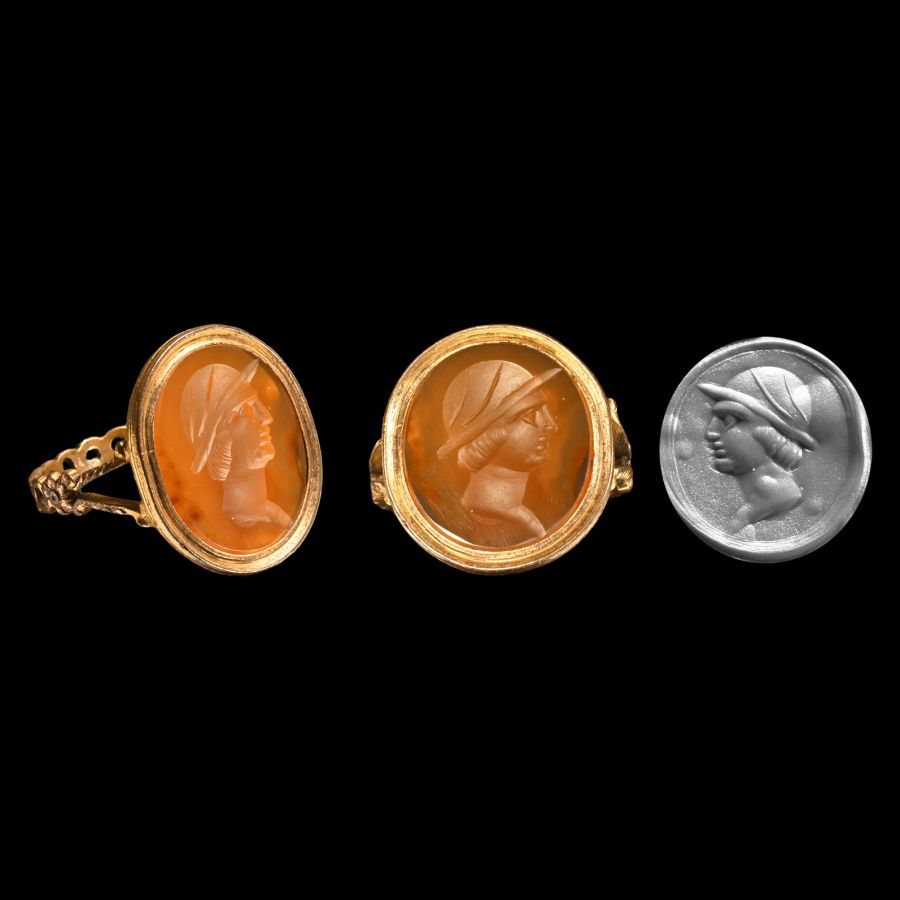
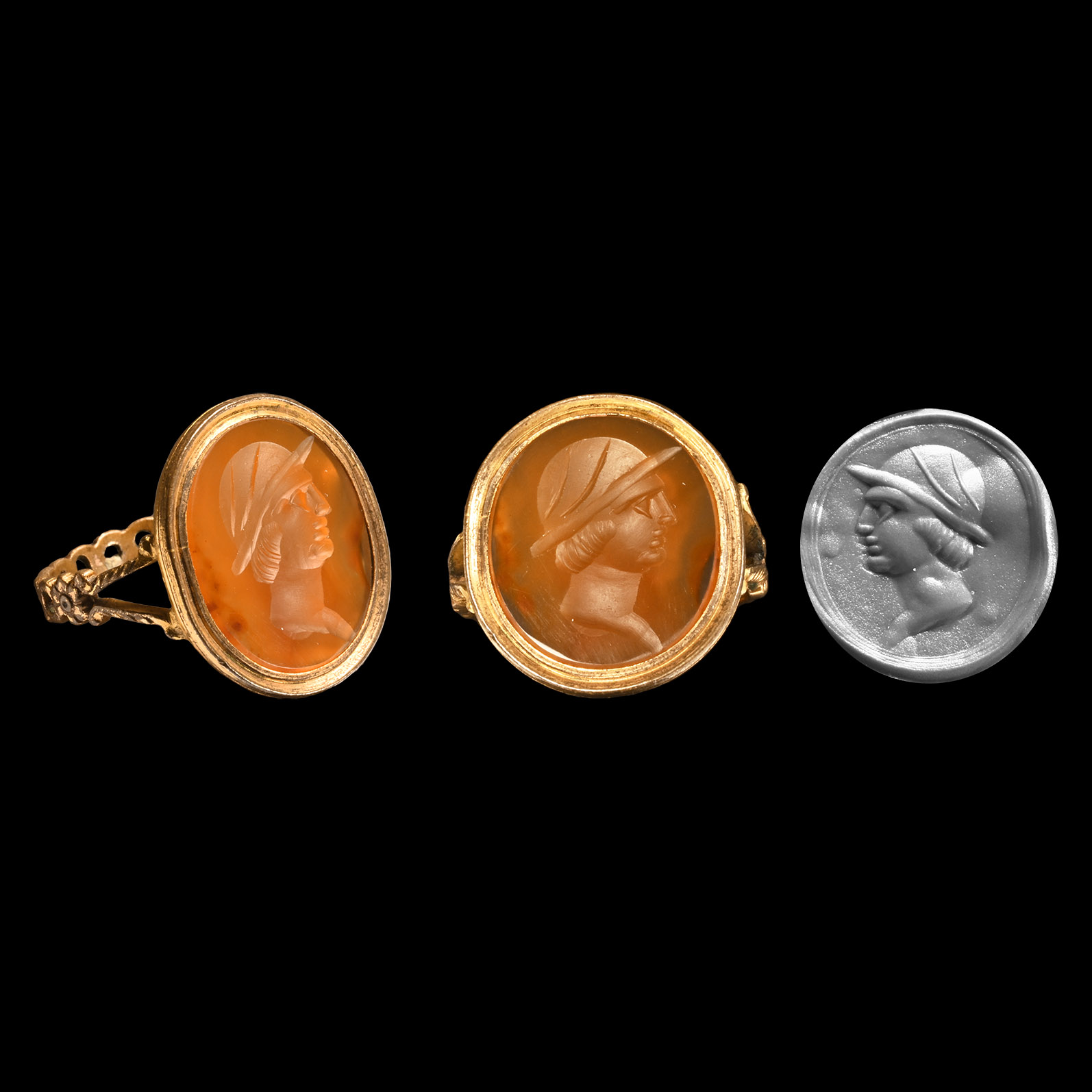
Post Medieval Gold Ring with Mercury Gemstone
17TH-18TH CENTURY A.D.
3/4 in. (3.36 grams, 21.24 mm overall, 18.50 mm internal diameter (approximate size British Q 1/2, USA 8 1/4, Europe 18.12, Japan 17)).
A gold finger ring with openwork hoop and split shoulders, ellipsoid bezel with carnelian intaglio of Mercury wearing a petasos.
ProvenanceEnglish private collection.
CONDITIONTimeLine Auctions follows a vetting process to ensure the authenticity and legality of all items, reinforcing our commitment to integrity and responsible trading. Each antiquity, antique, and coin lot undergoes thorough examination by a vetting committee of at least ten external specialists, professional trade association members, scientists, and archaeologists: Our Vetting Process
AUCTIONS:
TimeLine is a leading auction house specialising in antiquities, ancient art, collectables, natural history, coins, medals, and books. Our auctions offer museums, collectors, historians, and enthusiasts the opportunity to acquire unique and historically significant pieces.
-
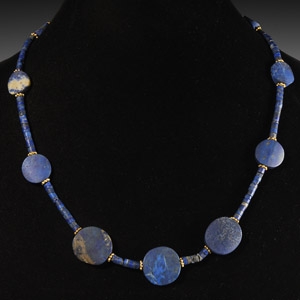
Bactrian Style Lapis Lazuli Bead Necklace String
19th-20th century A.D.Sold for (Inc. bp): £85
A necklace string composed of cylindrical lapis lazuli beads with gold-coloured spacer beads and graduated convex tabular beads. 43 grams, 55 cm long
Acquired 1980s-1990s. H.N. collection, Milton Keynes, UK. -
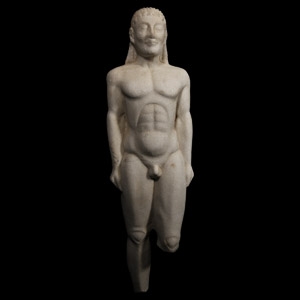
Marble Archaic Kouros Statue
20th century A.D.Sold for (Inc. bp): £1,690
A Greek style marble archaic kouros statue carved with braided hair held by a diadem, arms held straight at the sides, legs in advancing pose. 16.5 kg, 71 cm high
French collection, 1960s-early 2000s. From an important Paris gallery, France.
The kouros (free-standing nude male youth) first appeared in ancient Greece in the Archaic Greek period; kouros figures have been found across the Greek-speaking world, concentrated mainly in sanctuaries of Apollo. The term means ‘male youth, particularly one of noble rank’; when a pubescent boy came of age in ancient Greece, he was known as a kouros, at which point he could participate in the initiation feast of the brotherhood. The god Apollo was known as the greatest kouros. Typically life-sized, these figures were produced in marble, but have also been found in limestone, wood, bronze and terracotta. The female counterpart is the kore. -
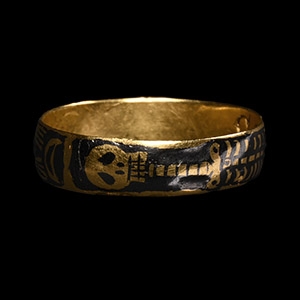
Early Georgian Gold Enamelled Memento Mori Skeleton Ring for 'S N'
Dated 1717 A.D.Sold for (Inc. bp): £4,420
A gold George I period memento mori ring decorated around the exterior with a stylised human skeleton against a black enamelled field, the body featuring an elongated neck, exaggerated numbers of ribs and disproportionately short legs, with a crescent at the base of the feet; interior engraved 'SN 17.17'. 3.15 grams, 20.76 mm overall, 18.77 mm internal diameter (approximate size British Q 1/2, USA 8 1/4, Europe 18.12, Japan 17)
Acquired in the late 1990s-2000. Property of an East London gentleman.
