
Loading, please wait...
LOT 0358
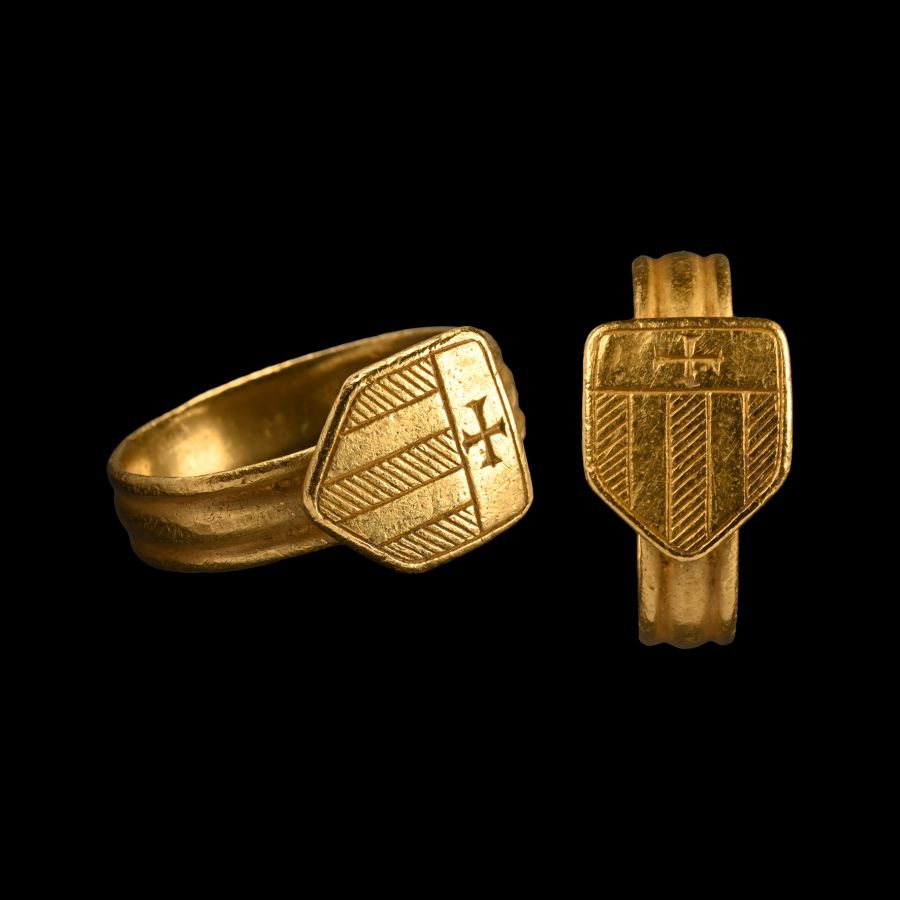
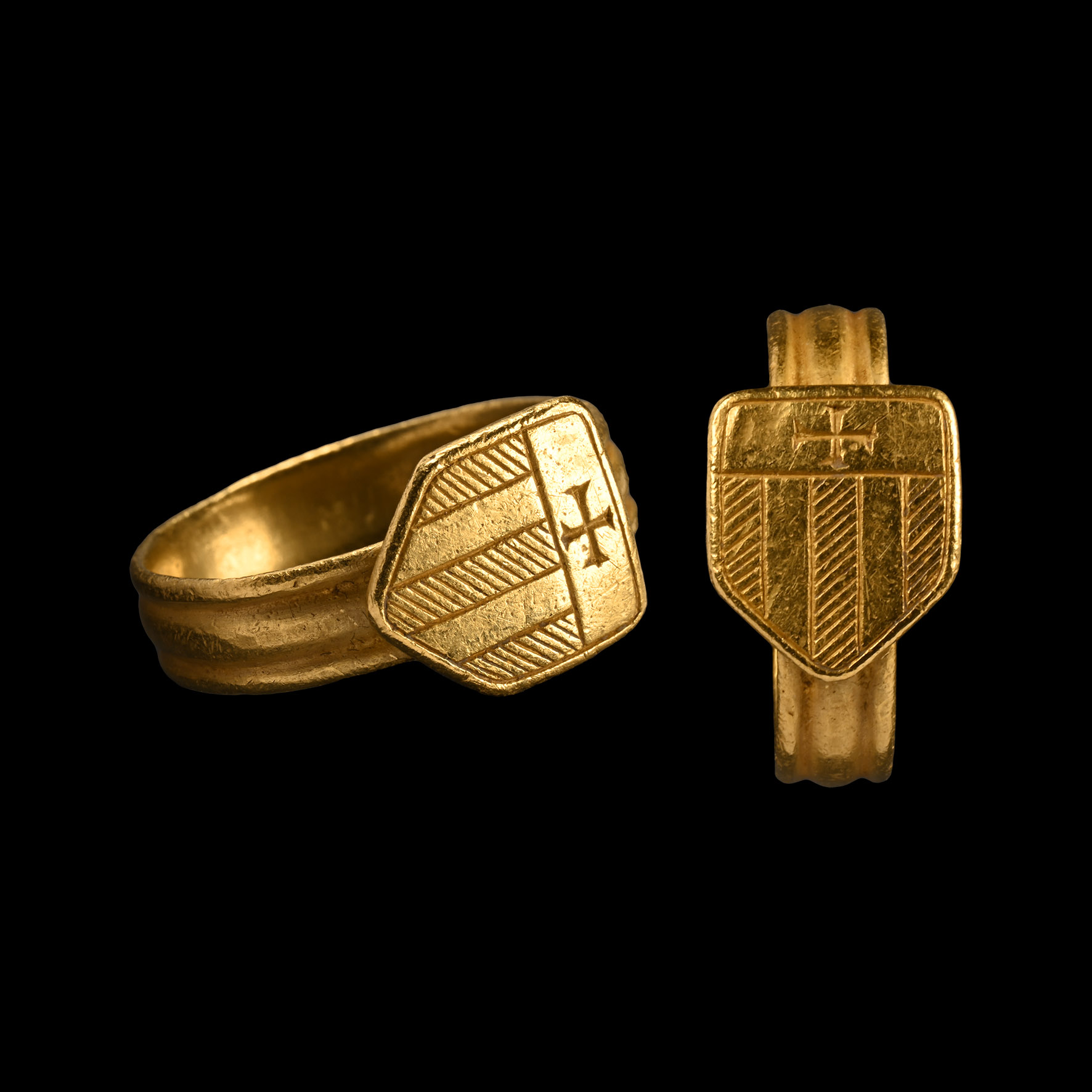
Post Medieval Gold Heraldic Signet Ring with the Arms of the Friars of the Order of the Blessed Virgin Mary of Mercy
15TH-16TH CENTURY A.D. OR LATER
7/8 in. (7.79 grams, 22.13 mm overall, 19.72 mm internal diameter (approximate size British S, USA 9, Europe 20, Japan 19)).
A broad flat hoop with three raised bands to outer face to which is affixed a shield-shaped bezel engraved with 'party per fess, a croix pattée and paly' being the arms of the Order; possibly of Spanish manufacture.
ProvenanceFrom a 1990s private collection.
Property of a European gentleman.
Accompanied by information on the history of the Order.
This lot has been checked against the Interpol Database of stolen works of art and is accompanied by search certificate no.11908-205634.
This Order, sometimes known as the Mercedarians, was founded by Saint Peter Nolasco in 1218 A.D. in Barcelona and still exists today as an international community of priests and brothers who generally follow the monastic Rule of St Augustine; the Order originally sought to save or ransom Christian prisoners of the Moors and other followers of Islam, extending firstly from Moorish Spain and on eastwards, across north Africa and to the Saracen Holy Land, even going so far as the members of the Order specifically taking a Fourth Vow to offer themselves or their lives up to save a Christian captive who is in danger of losing their faith.
This gold ring, showing the arms of the Order, would have been owned and worn by a senior member or office-holder.
TimeLine Auctions follows a vetting process to ensure the authenticity and legality of all items, reinforcing our commitment to integrity and responsible trading. Each antiquity, antique, and coin lot undergoes thorough examination by a vetting committee of at least ten external specialists, professional trade association members, scientists, and archaeologists: Our Vetting Process
AUCTIONS:
TimeLine is a leading auction house specialising in antiquities, ancient art, collectables, natural history, coins, medals, and books. Our auctions offer museums, collectors, historians, and enthusiasts the opportunity to acquire unique and historically significant pieces.
LOT 0358
Post Medieval Gold Heraldic Signet Ring with the Arms of the Friars of the Order of the Blessed Virgin Mary of Mercy
Estimate £3,000 - 4,000€3,480 - 4,640 (for guidance only)$4,050 - 5,400 (for guidance only)
-
Napoleon Brass Figure
Early 19th century A.D.Sold for (Inc. bp): £52
In characteristic pose with arms folded over the chest, wearing a tricorn hat with a cockade. 49.8 grams, 67 mm
Acquired 1960s-1990s. Late Alison Barker collection, a retired London barrister. -
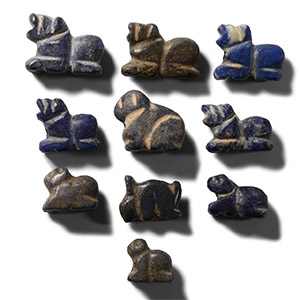
Lapis Lazuli Lion Amulet Group
20th century A.D.Sold for (Inc. bp): £72
Comprising group of mixed size small amuletic beads in form of a crouching lion; each pierced for stringing. 22 grams total, 11-19 mm
UK gallery, early 2000s. -
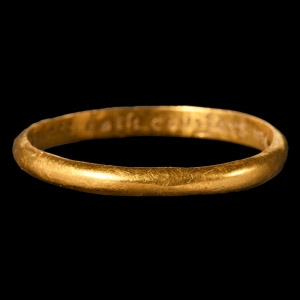
Post Medieval Gold 'x The sight of thee doth comfort me' Posy Ring
18th century A.D.Sold for (Inc. bp): £1,430
The slender band with a convex outer face, inscription to the hoop interior in cursive lettering: 'x The sight of thee doth comfort me'. 1.49 grams, 19.04 mm overall, 16.89 mm internal diameter (approximate size British M, USA 6, Europe 12.46, Japan 12)
Acquired in the early 1990s. Property of a Berkshire, UK, gentleman.
