
Loading, please wait...
LOT 0349
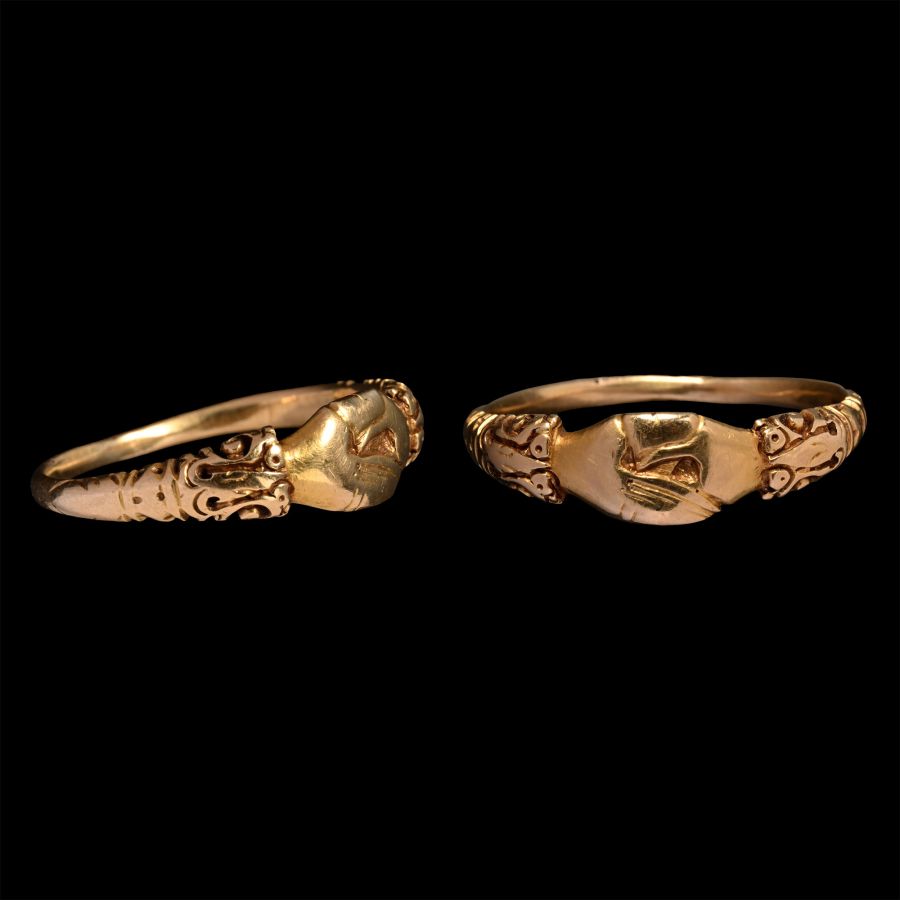
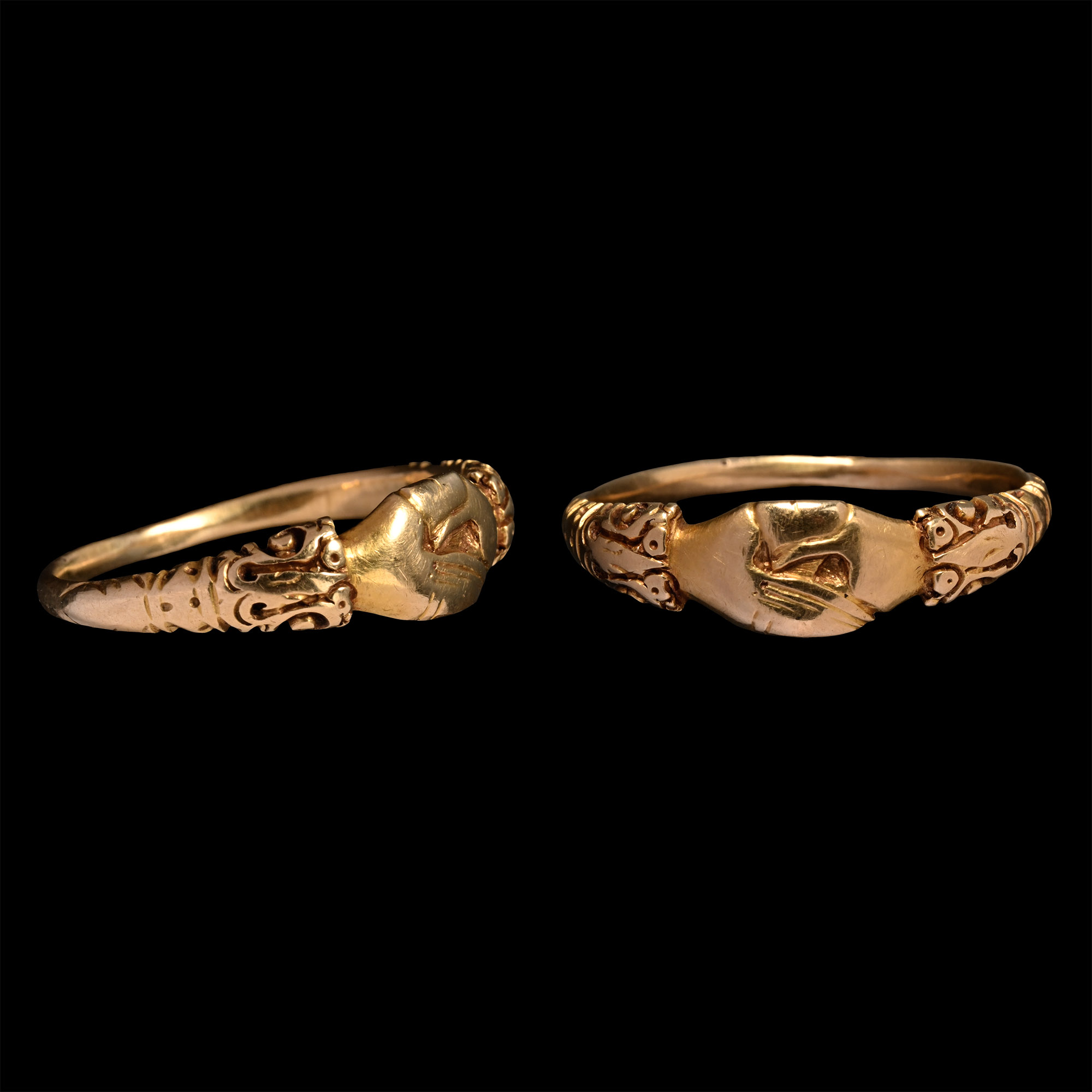
Post Medieval Gold Fede Ring
ENGLAND, 16TH-17TH CENTURY A.D.
1 in. (3.71 grams, 23.07 mm overall, 20.14 mm internal diameter (approximate size British T, USA 9 1/2, Europe 21.26, Japan 20)).
Slender shank and expanding shoulders formed as lace cuffs, the bezel a pair of clasped hands gripping a heart.
ProvenancePrivate collection, Europe.
Acquired on the English art market.
Cf. Chadour, A.B., Rings. The Alice and Louis Koch Collection, volume I, Leeds, 1994, item 759, for type.
FootnotesThe two clasping hands with elaborate cuffs clutch a heart. This ring features the ancient fede motif of two hands clasped together, however in their grasp is a heart. These symbols represented love and fidelity. The ring was likely a token of love symbolising everlasting devotion, or possibly a betrothal ring. The word Fede takes its name from the Italian word for faith or trust with the two clasped hands symbolising an attachment that usually led to marriage. The motif of the two clasped hands was already in use in ancient Rome, it was a symbol of pledging of vows, which derives from the Roman ‘dextarum iunctio’ (right hand joined). Fede rings remained popular throughout Europe until well into the 19th century with their peak of manufacture during the Middle Ages and the Renaissance.
CONDITIONTimeLine Auctions follows a vetting process to ensure the authenticity and legality of all items, reinforcing our commitment to integrity and responsible trading. Each antiquity, antique, and coin lot undergoes thorough examination by a vetting committee of at least ten external specialists, professional trade association members, scientists, and archaeologists: Our Vetting Process
AUCTIONS:
TimeLine is a leading auction house specialising in antiquities, ancient art, collectables, natural history, coins, medals, and books. Our auctions offer museums, collectors, historians, and enthusiasts the opportunity to acquire unique and historically significant pieces.
-
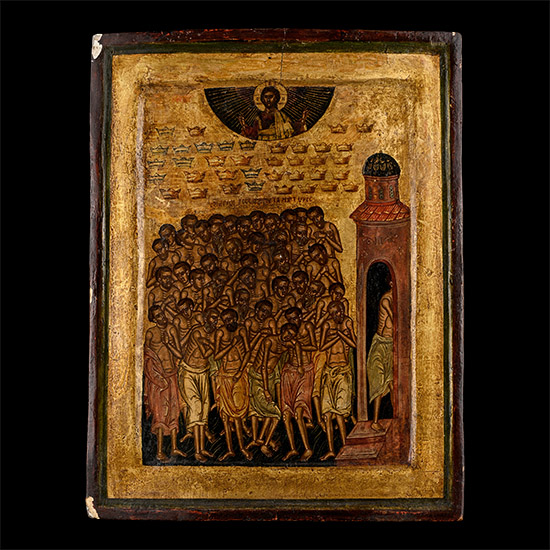
Veneto-Cretan Icon with Forty Martyrs of Sebaste
17th century A.D.Estimate: £6,000 - 8,000 (+bp*)
Opening Bid: £3,000
Depicting the martyrs freezing to death in a lake in Cappadocia, clad only in their undergarments (esophoria); Jesus above, dressed in gold and red, offering the crowns of martyrdom as a sign of reward; a tower to the side of the martyrs; Greek inscriptions: inside the gold nimbus 'O ѾN' (= The Only One who always exists), the inscription above the martyrs reading: 'Οι Άγιοι Τεσσαράκοντα Μάρτυρες = The Saint Holy 40 Martyrs'. 810 grams, 30 x 22.5 cm
Acquired on the European art market. Private collection, London, UK. Accompanied by an academic report by Dr Raffaele D’Amato. This lot has been checked against the Interpol Database of stolen works of art and is accompanied by search certificate number no.13063-249294.
The icon depicts the martyrdom of the 40 soldiers of the Legio XII Fulminata, who died in a frozen lake in Cappadocia in 320 AD. The drama experienced by these courageous men, nourished by their faith in Christ, is evocatively expressed. Their frozen bodies are painted in ochre and olive green, reflecting the stages of their agony. Christ is offering them crowns of glory from heaven as a sign of reward. The cult of the 40 Martyrs spread rapidly, first in Constantinople, where several churches were dedicated to them, then in the Balkans and Russia. -
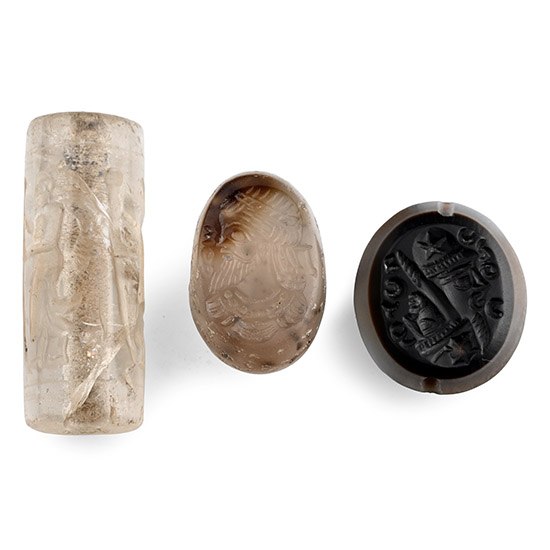
Stone Stamp and Cylinder Seal Group
20th century A.D.Sold for (Inc. bp): £20
Comprising cylinder-type with advancing figure holding a staff; nicolo-type with profile bust and legend; Sasanian-type with profile bust. 47 grams total, 27-44 mm
Private collection, UK. -
.jpg)
Large Post Medieval Merchant’s Seal Ring Engraved with 'BG' and Shield
Germany, 16th century A.D.Sold for (Inc. bp): £12,350
Engraved with the owner's initials ‘B G’ above a tilting shield with flanche; merchant's mark motif of capital 'A' and a cross. 20.03 grams, 28.33 mm overall, 23.00 x 18.47 mm internal diameter (approximate size British T 1/2, USA 9 3/4, Europe 21.89, Japan 21)
Private collection, Europe. Acquired on the English art market. This lot has been checked against the Interpol Database of stolen works of art and is accompanied by a search certificate number no.13051-248349.
Merchants' marks were chosen by their owners as a form of personal cypher, and so it is almost impossible to decipher the owner of many merchants' marks, as they were not governed by the strict regulation and recording that heraldry laws dictated. Merchants' rings were engraved with geometric symbols used to mark their goods or personal belongings and used instead of a coat of arms for those not entitled to them. Most merchants in the sixteenth and seventeenth centuries had marks, easily identifiable and formed with a few strokes. Many such rings also bear religious or talismanic inscriptions or imagery, combining a spiritual with a commercial function. The shape of the shield on this example draws direct parallels to the heraldic shields and jewels of this period in Germany.
