
Loading, please wait...
LOT 1439
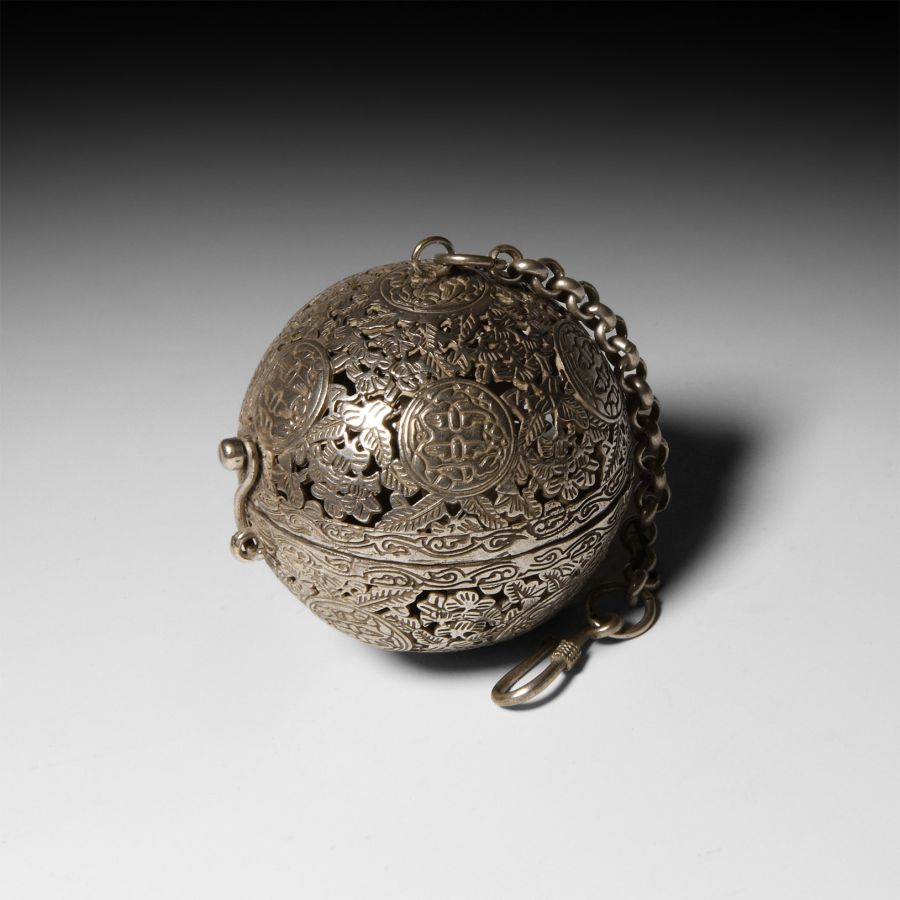
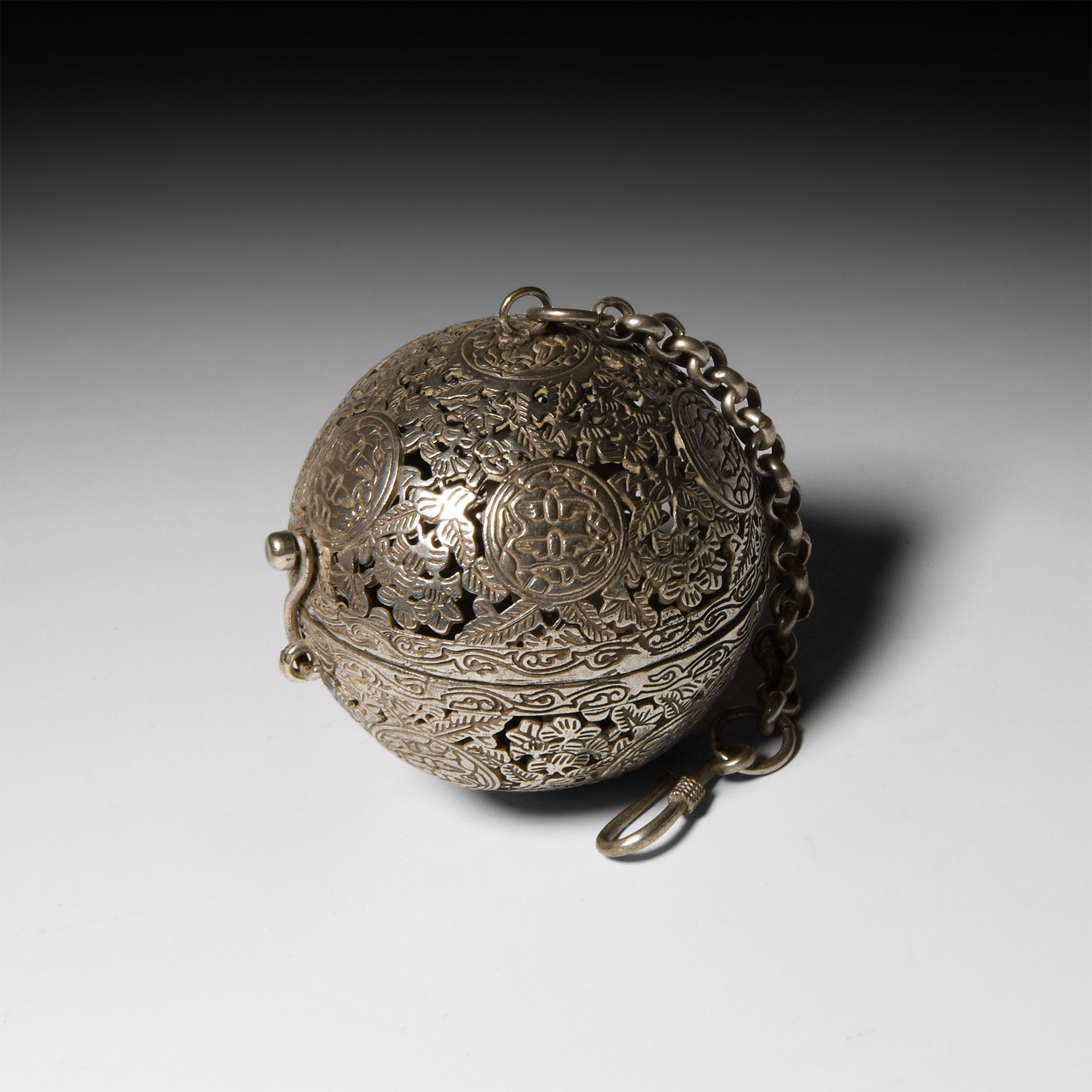
Post Medieval Gimballed Incense Burner
20TH CENTURY A.D.
6 1/4 in. (91 grams, 16 cm long).
A silver hinged spherical incense burner with swivel clasp and gimbal; pierced decoration of foliate form with roundels incised with flying insects; swivel clasp and suspension chain with decorated hook; Chinese characters (possibly a maker's name) inscribed to hook. [No Reserve]
Provenancewith a London, UK gallery 1971-early 2000s.
CONDITIONTimeLine Auctions follows a vetting process to ensure the authenticity and legality of all items, reinforcing our commitment to integrity and responsible trading. Each antiquity, antique, and coin lot undergoes thorough examination by a vetting committee of at least ten external specialists, professional trade association members, scientists, and archaeologists: Our Vetting Process
AUCTIONS:
TimeLine is a leading auction house specialising in antiquities, ancient art, collectables, natural history, coins, medals, and books. Our auctions offer museums, collectors, historians, and enthusiasts the opportunity to acquire unique and historically significant pieces.
-
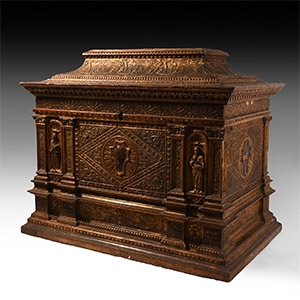
Northern Italian Gilt Wooden Casket
18th-19th century A.D.Estimate: £4,000 - 6,000 (+bp*)
Opening Bid: £2,000
An architectural gilt wooden casket with hinged lid; the exterior with billeting, egg-and-dart ornament and gadrooning, flowering vegetal schemes over the whole; the two principal faces each with a central heater shield painted with heraldic devices, flanked by robed standing figures holding a book each within a niche and with a palmette motif above; remains of polychrome to the shields and elsewhere. 69.5 x 44.5 cm
English private collection. This lot has been checked against the Interpol Database of stolen works of art and is accompanied by search certificate number no.11679-199810
The arms are quartered: or an eagle sable; sable a demi-lion rampant or issuant from a fess; sable a mullet of eight points or; or a lion's head erased sable; the repetition of the colours 'or' gold and 'sable' black may be due to the overall colour-scheme of the casket. The timber shows some old insect flight holes and we are advised that this piece has been recently treated with Permethrin, as a precaution. -
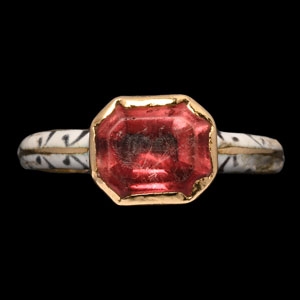
Stuart Period Gold, Rock Crystal and White Enamel Ring
17th century A.D.Sold for (Inc. bp): £4,420
A gold ring composed of a slender hoop embellished with tapering, white enamelled shoulders with black enamelled flourishes, fluted box collet setting, set with a pink foil back and table-cut rock crystal; accompanied by a vintage ring box. 1.89 grams, 21.50 mm overall, 16.63 mm internal diameter (approximate size British L 1/2, USA 6, Europe 11.87, Japan 11)
Valued by Bentley & Skinner, Piccadilly, London W1, 2016. Property of an East Sussex collector. Accompanied by a copy of the Bentley & Skinner insurance valuation. This lot has been checked against the Interpol Database of stolen works of art and is accompanied by search certificate no.11669-197584.
The V & A Museum explains that during the '...Renaissance, the ring developed from the simple forms of the medieval period into a miniature work of art, combining the skills of the chaser, engraver and enameller as well as the stone cutter. -
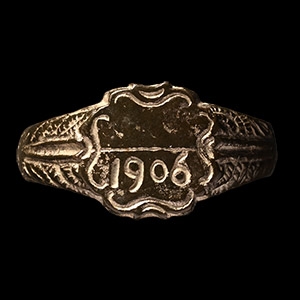
Edwardian Ring with Date
Dated 1906 A.D.Sold for (Inc. bp): £26
A bronze finger ring with foliate ornament to the shoulders, florid bezel with incised date '1906' below horizontal band. 4.81 grams, 25.08 mm overall, 21.95 mm internal diameter (approximate size British Z, USA 12 1/2, Europe 28.77, Japan 27)
Acquired in the late 1990s-2000. Property of an East London gentleman.
