
Loading, please wait...
LOT 0356
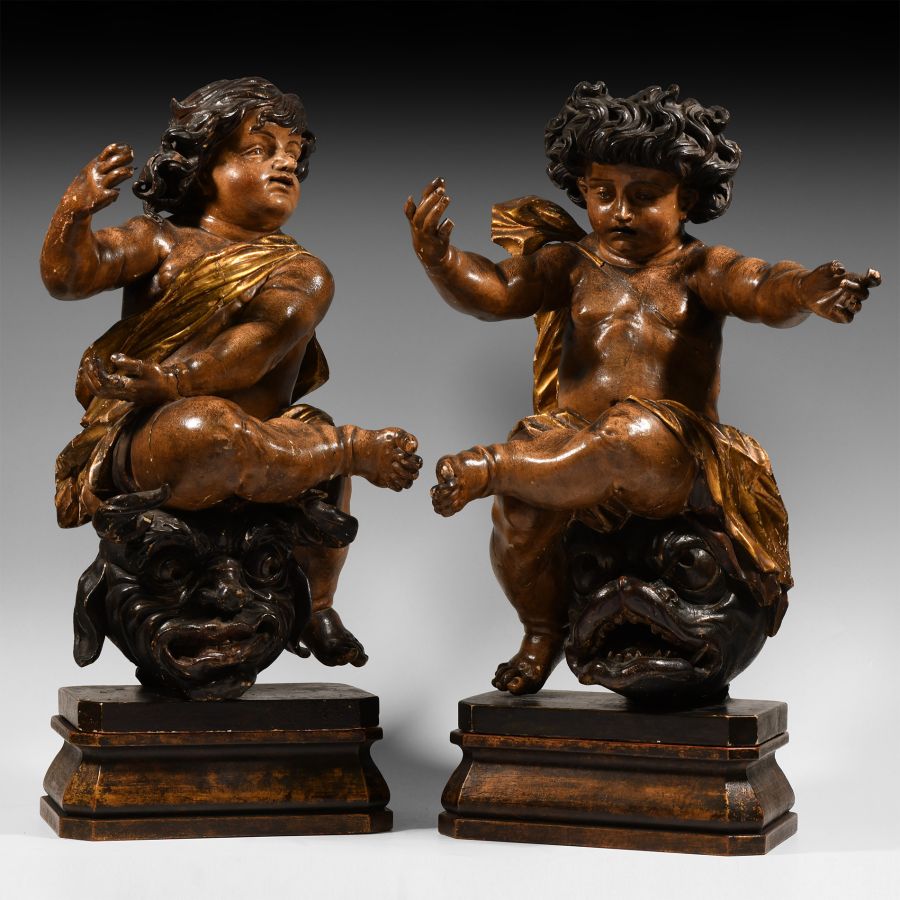
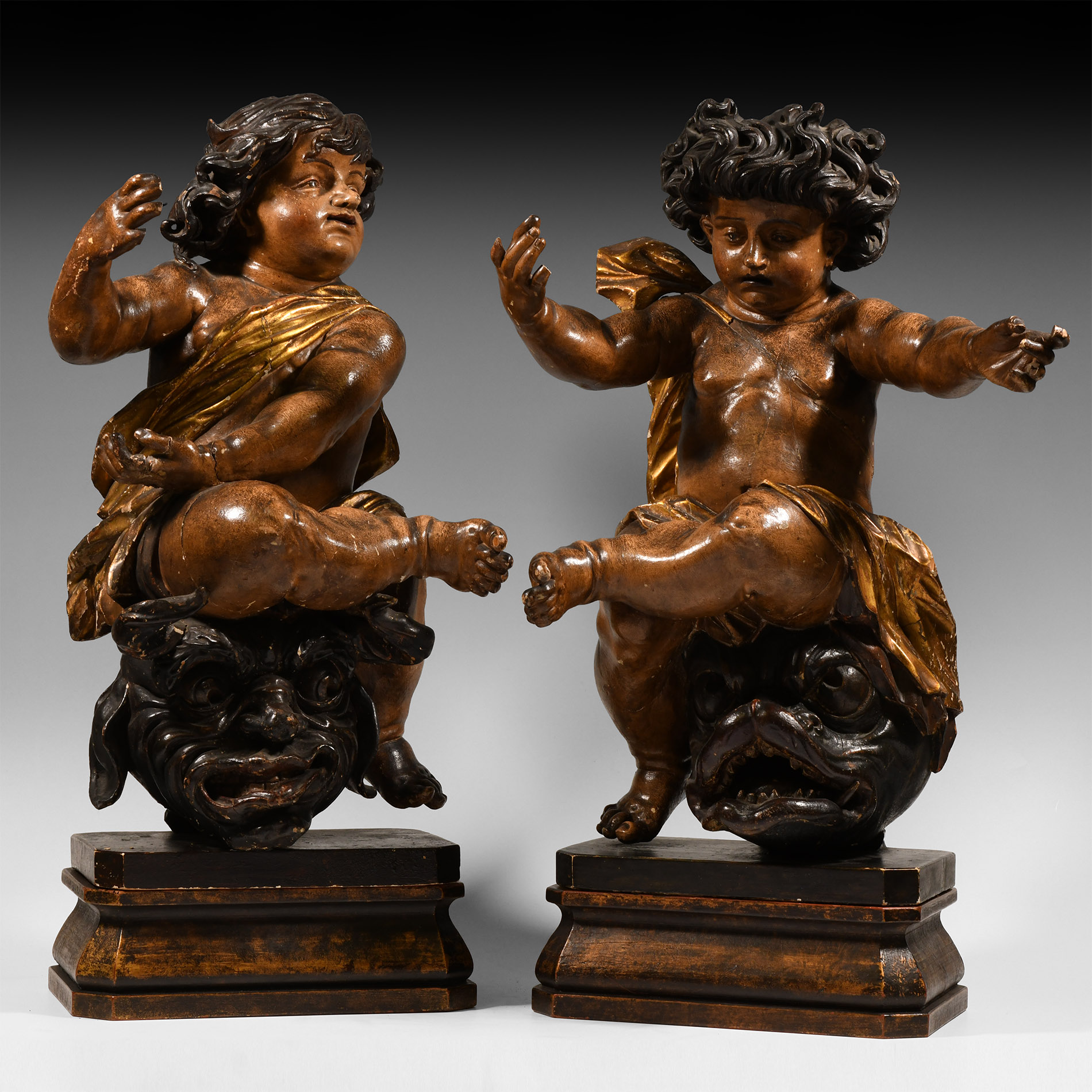
Post Medieval Gilt and Painted Wooden Cherub Pair
GERMANY, 17TH CENTURY A.D.
29 1/8 - 30 in. (74-76 cm high).
A pair of naturalistically modelled cherubs shown naked and chubby with infant bodies and mature heads, perched with one crossed leg atop grotesque heads- that of the Devil and a pug, each dynamically posed as though playing an instrument or holding a bowl; with polychrome paint and gilding; Baroque; on octagonal plinth bases. [2]
Provenancewith Hotel Des Ventes De Monte, Monaco, 14 December 2021, lot 60.
English private collection.
This lot has been checked against the Interpol Database of stolen works of art and is accompanied by search certificate number no.11676-199839.
TimeLine Auctions follows a vetting process to ensure the authenticity and legality of all items, reinforcing our commitment to integrity and responsible trading. Each antiquity, antique, and coin lot undergoes thorough examination by a vetting committee of at least ten external specialists, professional trade association members, scientists, and archaeologists: Our Vetting Process
AUCTIONS:
TimeLine is a leading auction house specialising in antiquities, ancient art, collectables, natural history, coins, medals, and books. Our auctions offer museums, collectors, historians, and enthusiasts the opportunity to acquire unique and historically significant pieces.
LOT 0356
Post Medieval Gilt and Painted Wooden Cherub Pair
Estimate £8,000 - 10,000€9,280 - 11,600 (for guidance only)$10,800 - 13,500 (for guidance only)
-
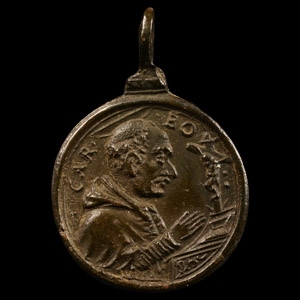
Post Medieval Ecclesiastical Pendant
Circa 17th century A.D.Sold for (Inc. bp): £13
A bronze bifacial disc pendant comprising: obverse: tonsured and nimbate head and upper body with hands raised in prayer towards a Corpus Christi, legend 'CAR. BOV'; reverse: nimbate head and upper body of a robed and bearded cleric with cross moline, legend '·S·IO·GVALB ·INS·OR·VA·VNBRO·'; pierced suspension lug. 2.31 grams, 26 mm high
Found Rodings, Essex, UK. Acquired on the UK antiques market between 1974-1985. Albert Ward collection, Essex, UK. -
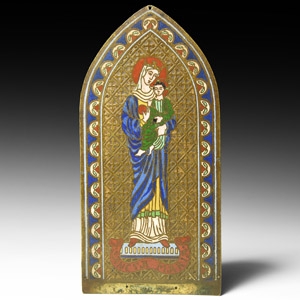
Post Medieval Enamelled Plaque in Limoges Style
19th century A.D.Sold for (Inc. bp): £114
An enamelled plaque in Limoges style, Saint Mary carrying the infant Jesus standing at the centre, banner reading 'SANCTA MARIA' below on a field of lozenges containing crosses; three piercings for attachment. 278 grams, 20.2 cm
Fine condition.
Old North American collection. Massachusetts, USA, 2005. Property of a Suffolk gentleman. -
.jpg)
Post Medieval Large Tile with Virgin and Child Scene
19th-20th century A.D.Sold for (Inc. bp): £1,170
A large rectangular ceramic tile displaying a scene with the Virgin and Child flanked by musicians over a winged putti head, winged putti flanking a wreath containing an armorial shield below; egg-and-dart border. 14.9 kg, 66 cm high
English private collection.
