
Loading, please wait...


LOT 0387
Post Medieval Engraved Silver-Gilt Rock Crystal Set Box
GERMANY, 18TH CENTURY A.D.
2 3/8 in. (65 grams, 59 mm).
Lid set with a large rock crystal cabochon; gilded interior; sides engraved with a continual Renaissance interlace and similar to the base; small French duty mark to the front of the base of the box and to the rim of the lid.
ProvenancePrivate collection, Europe.
Acquired on the English art market.
TimeLine Auctions follows a vetting process to ensure the authenticity and legality of all items, reinforcing our commitment to integrity and responsible trading. Each antiquity, antique, and coin lot undergoes thorough examination by a vetting committee of at least ten external specialists, professional trade association members, scientists, and archaeologists: Our Vetting Process
AUCTIONS:
TimeLine is a leading auction house specialising in antiquities, ancient art, collectables, natural history, coins, medals, and books. Our auctions offer museums, collectors, historians, and enthusiasts the opportunity to acquire unique and historically significant pieces.
LOT 0387
Post Medieval Engraved Silver-Gilt Rock Crystal Set Box
Estimate £700 - 900€810 - 1,040 (for guidance only)$950 - 1,220 (for guidance only)
-
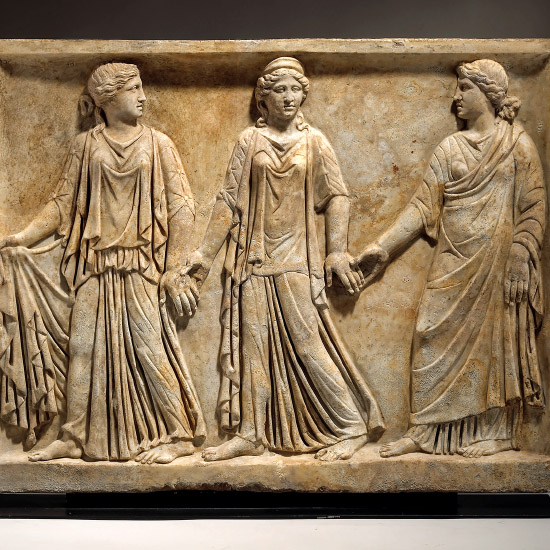
Large Marble Relief with Three Figures
18th-19th century A.D.Sold for (Inc. bp): £5,720
Rectangular slab with raised border and high-relief scene; three standing females wearing floor-length draped and tiered robes, holding hands; the left figure with right hand extended slightly, holding out the folds of her robe, head turned back towards the middle figure whose hand she holds; middle figure facing with diadem in her neatly dressed hair, holding the extended hand of the third figure holding the hem of her robe and angled stiffly away from the others. 145 kg total including stand, 106.5 cm wide
Private collection, UK. This lot has been checked against the Interpol Database of stolen works of art and is accompanied by search certificate number no.13391-259010.
A group of three young females is often interpreted as the Three Graces. However, in classical art, these three figures usually stand close together and are nude or sparsely clothed - unlike the females in this carving. Groups of three goddesses - such as Persephone, Demeter and Hekate - may denote the phases of the moon or, more broadly, the three phases of a female life as maiden / mother/ elder. The scene bears some resemblance to the 1st century AD relief of 'Three dancing nymphs' in Santa Barbara Museum of Art, California; however, that has a more exuberant and lively air contrasted with the rigid formality of the piece. -

Tudor Period Ring with DE and Cross
Circa 16th century A.D.Sold for (Inc. bp): £52
Substantial ring with fluted shoulders, a rectangular bezel with a central cross flanked by letters D and E. 11.03 grams, 26.65 mm overall, 20.86 x 22.20 mm internal diameter (approximate size British W, USA 11, Europe 25, Japan 24)
Ex German art market, 2000s. Acquired from an EU collector living in London. From the collection of a Surrey, UK, gentleman. -
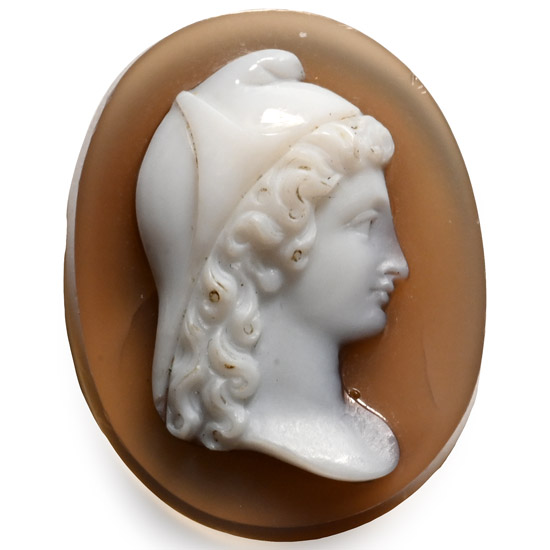
Post Classical Agate Cameo with a Helmeted Bust
20th century A.D.Sold for (Inc. bp): £169
Oval cameo with profile bust of a young warrior with curly, long hair wearing a helmet with a long neck guard. 1.53 grams, 19 mm
Acquired on the European art market.
