Loading, please wait...
LOT 1465
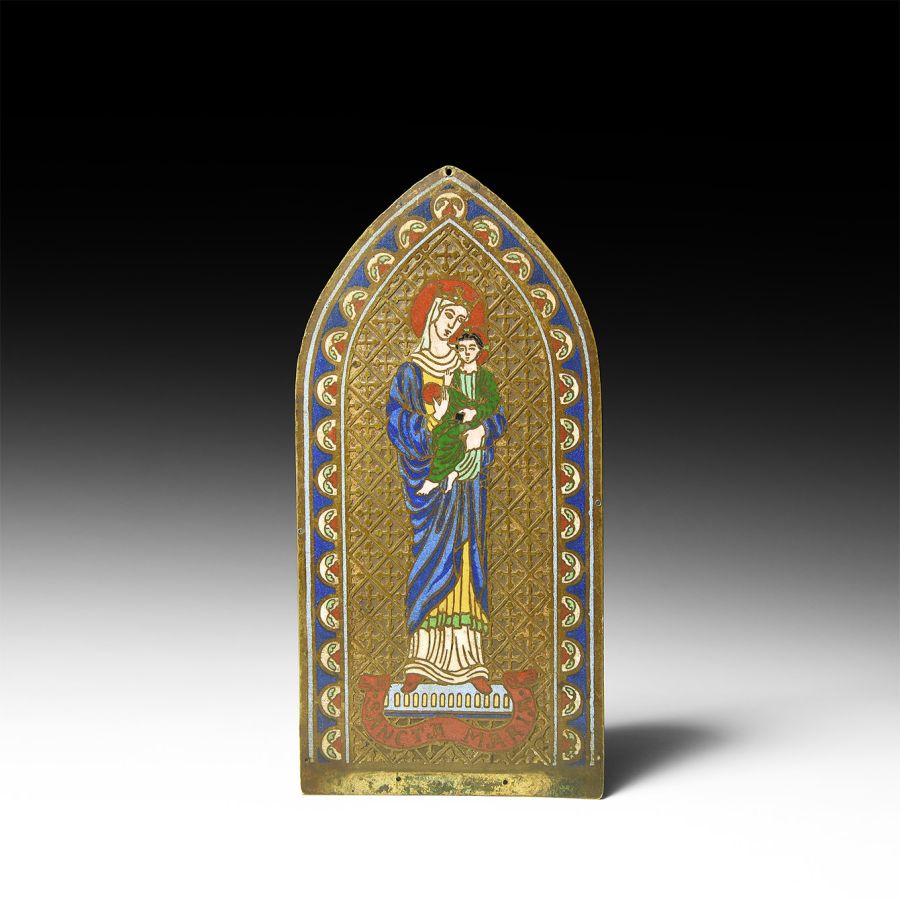
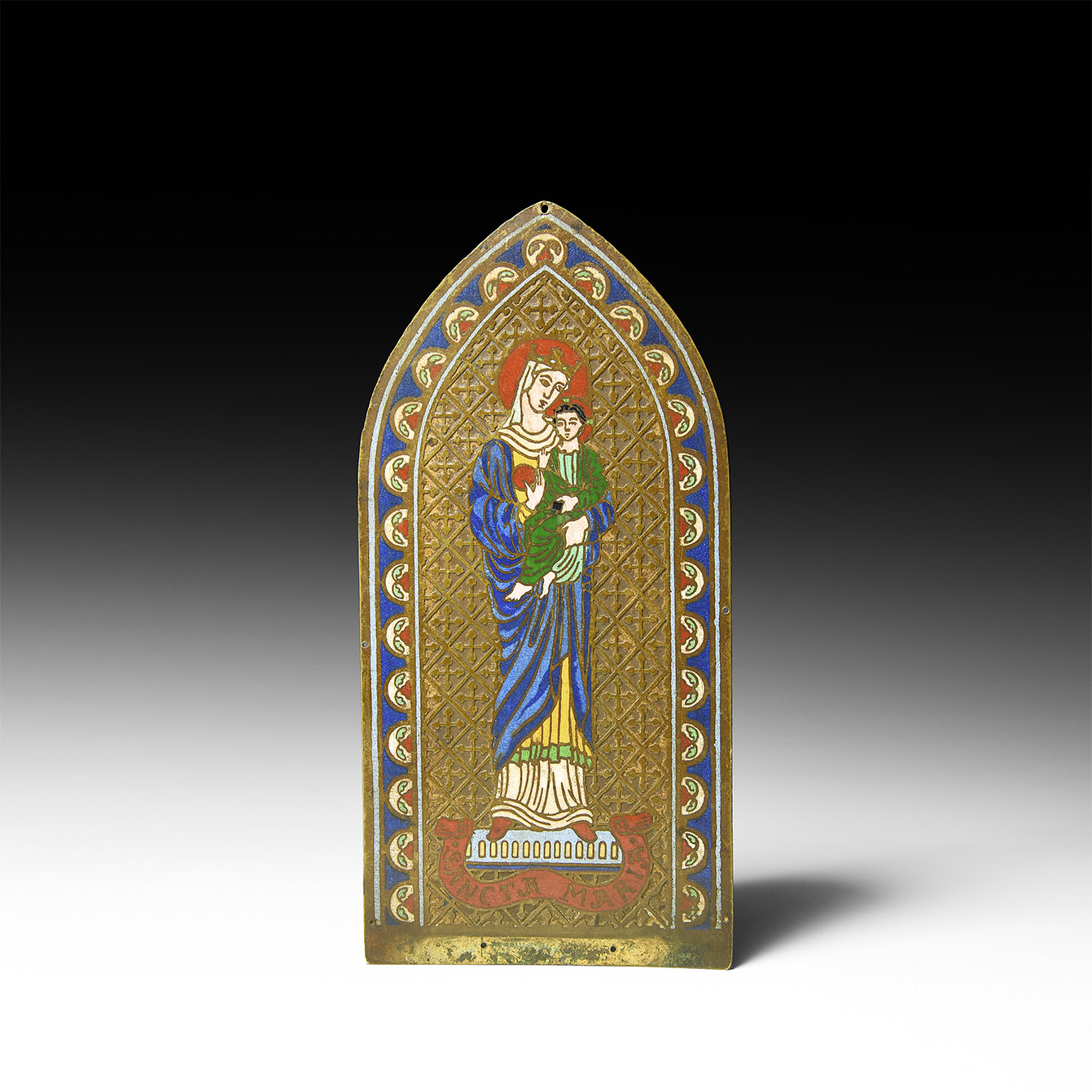
Post Medieval Enamelled Plaque in Limoges Style
19TH CENTURY A.D.
8 in. (278 grams, 20.2 cm).
An enamelled plaque in Limoges style, Saint Mary carrying the infant Jesus standing at the centre, banner reading 'SANCTA MARIA' below on a field of lozenges containing crosses; three piercings for attachment.
ProvenanceOld North American collection.
Massachusetts, USA, 2005.
Property of a Suffolk gentleman.
TimeLine Auctions follows a vetting process to ensure the authenticity and legality of all items, reinforcing our commitment to integrity and responsible trading. Each antiquity, antique, and coin lot undergoes thorough examination by a vetting committee of at least ten external specialists, professional trade association members, scientists, and archaeologists: Our Vetting Process
AUCTIONS:
TimeLine is a leading auction house specialising in antiquities, ancient art, collectables, natural history, coins, medals, and books. Our auctions offer museums, collectors, historians, and enthusiasts the opportunity to acquire unique and historically significant pieces.
-
Massive Painted Oak Framed Slate Altar Screen
19th century A.D.Sold for (Inc. bp): £169
A magnificent and superb quality Victorian Gothic revival painted altar or reredos panel, as exemplified by the works and designs of Augustus Pugin, on Welsh slate depicting a large golden cross with latticed arms and squared quatrefoil terminals showing the emblems and names of the four Evangelists, Matthew, Mark, Luke and John; the cross set over a circle enclosing a quatrefoil background with the main discus showing a white cross trefoil on a red expanding cross against a green background with the Christogram letters 'IHS' entwined for Jesus Christ; the design set against a dark blue field ornamented with 48 golden radiant six-pointed stars; complete with the original carved oak frame together with the carved oak projecting base plinth shelf with quatrefoil perforations and another Christogram 'IHS' within a blue oval to the central projection. 73 kg total, 134.5 cm base and 159 cm high
Fine condition.
Collection formed in the 2000s. Property of an East Anglia gentleman.
From the 4th century A.D., the vision of Ezekiel and John's Apocalypse, assigned the lion, the angel, the eagle and the ox a stable place in the iconography of the tetramorph to represent the evangelist Mark (lion) next to the calf (Luke), the angel (Matthew) and the eagle (John). They are, in Christian iconography and theology, the four winged cherubs singing the triumphal hymn, exclaiming, proclaiming, and saying: 'Holy, holy, holy, Lord Sabaoth'. The oldest representations date back to the 5th century A.D., and are found in the mosaics of the baptistry of Naples and in the apse of S. Prudenziana in Rome. The tetramorph was a favourite subject in 12th century ecclesiastic art and its use has continued to the present day. -
Tudor Silver Saint James Double Scallop Shell Dress Mount
16th century A.D.Sold for (Inc. bp): £59
A complete silver dress fitting or strap mount in the form of two conjoined scallop shells along one edge of a sub rectangular bar with sloping sides, the fitting with central perforation and two slender mounting lugs to reverse. 1.24 grams, 12 mm
Found whilst searching with a metal detector by Kevin Ford on 1st March 2019 in Chinnor, South Oxfordshire, UK. Accompanied by a copy of the British Museum's Portable Antiquities Scheme Report (PAS) number OXON-86C7C3. Accompanied by a letter to HM Coroner for Oxfordshire from the Oxfordshire Finds Liaison Officer (FLO) with treasure reference number 2019 T648.
The scallop shell was associated with St. James and the pilgrimage site of Santiago de Compostela in Spain, one of the most important pilgrimage centres in medieval Europe. The scallop shell became the symbol for pilgrimage more generally in this period. It is an overtly Catholic symbol which could have been worn with freedom before c. 1540, or in the period of the Marian revival of Catholicism from 1553-1558. Pilgrimage to the shrine at Compostela from England would have been interrupted by the English Reformation. The PAS report notes that similar examples have been declared as treasure, including: KENT-FEE744 (2014 T641) and NLM-538148 (2010 T539), both dating to the 16th century A.D. -
Elizabethan Boat-Shaped Pendant with Putti
16th-early 17th century A.D.Estimate: £1,000 - 1,400 (+bp*)
Opening Bid: £475
A gold pendant formed as a crescent frame with vertical bar and two outer bands; bar with trefoil finial, pierced for suspension; crescent with pierced lugs to the lower edge and wire dangles; outer bands with putto mask to the centre, frond detailing and green enamelling. 2.77 grams, 27 mm
Acquired 1960s-1990s. Late Alison Barker collection, a retired London barrister.