
Loading, please wait...
_900x900.jpg "Post Medieval Embroidered Mitre and Tooled Leather Case")
_200x200.jpg "Post Medieval Embroidered Mitre and Tooled Leather Case")
_900x900.jpg "Post Medieval Embroidered Mitre and Tooled Leather Case")
_200x200.jpg "Post Medieval Embroidered Mitre and Tooled Leather Case")
_900x900.jpg "Post Medieval Embroidered Mitre and Tooled Leather Case")
_200x200.jpg "Post Medieval Embroidered Mitre and Tooled Leather Case")
.jpg "Post Medieval Embroidered Mitre and Tooled Leather Case")
.jpg "Post Medieval Embroidered Mitre and Tooled Leather Case")
.jpg "Post Medieval Embroidered Mitre and Tooled Leather Case")
LOT 0372
Post Medieval Embroidered Mitre and Tooled Leather Case
FRANCE, CIRCA 1700-1720 A.D.
17 in. (1.38 kg, 43 cm).
Two boards from an episcopal mitre with linen facing and dense silver-thread foliage ornament to each; housed in a custom-made wooden case with linen lining, leather-covered with tooled and gilt detailing to both faces and sides, episcopal arms to upper face with Catholic episcopal headgear over a heater shield with three fleurs-de-lys in chief and a bend sinister lozengy; to the reverse, five radiating arms pierced to allow straps to pass beneath to secure the lid. [No Reserve]
ProvenanceFrancesca Galloway Ltd, 2001.
This lot is accompanied by an illustrated lot declaration signed by the Head of the Antiquities Department, Dr Raffaele D’Amato.
TimeLine Auctions follows a vetting process to ensure the authenticity and legality of all items, reinforcing our commitment to integrity and responsible trading. Each antiquity, antique, and coin lot undergoes thorough examination by a vetting committee of at least ten external specialists, professional trade association members, scientists, and archaeologists: Our Vetting Process
AUCTIONS:
TimeLine is a leading auction house specialising in antiquities, ancient art, collectables, natural history, coins, medals, and books. Our auctions offer museums, collectors, historians, and enthusiasts the opportunity to acquire unique and historically significant pieces.
LOT 0372
Post Medieval Embroidered Mitre and Tooled Leather Case
Sold for (Inc. bp): £1,950
-
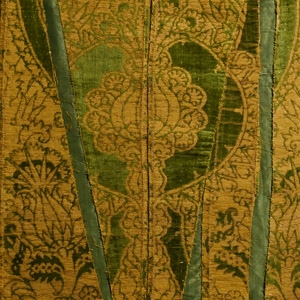
Tudor Period Textile Fragments
16th century A.D.Sold for (Inc. bp): £1,300
Group of rectangular and other green velvet panels and strip with gold-coloured rosettes, foliage and other ornament. 530 grams, 80 x 65 cm
Private collection, Chateau de Frechou, France. Daguerre Societe de Ventes Volontaires, 21 March 2016, no.4. This lot is accompanied by an illustrated lot declaration signed by the Head of the Antiquities Department, Dr Raffaele D’Amato. -
.jpg)
Roman Style Silver Dog Brooch
20th century A.D.Sold for (Inc. bp): £52
Hollow-formed dog with its head resting on it forepaws, with textured fur, catch beneath the head and pin-lugs beneath the hindlegs, hinged pin. 16.6 grams, 34 mm
Acquired on the UK art market from various auction houses and collections mostly before 2000. From an important Cambridgeshire estate; thence by descent. This lot is accompanied by an illustrated lot declaration signed by the Head of the Antiquities Department, Dr Raffaele D’Amato. -
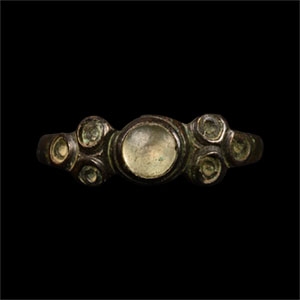
Bronze Ring with Cabochon
Circa 18th century A.D.Sold for (Inc. bp): £46
Featuring a slender hoop, raised trio of ring-and-dot motifs to each shoulder, round bezel set with glass cabochon. 1.18 grams, 21.07 mm overall, 16.92 mm internal diameter (approximate size British M, USA 6, Europe 12.46, Japan 12)
From an English collection formed before 2000. This lot is accompanied by an illustrated lot declaration signed by the Head of the Antiquities Department, Dr Raffaele D’Amato.
