Loading, please wait...

Use mousewheel to zoom in and out, click to enlarge

Details

LOT 2398

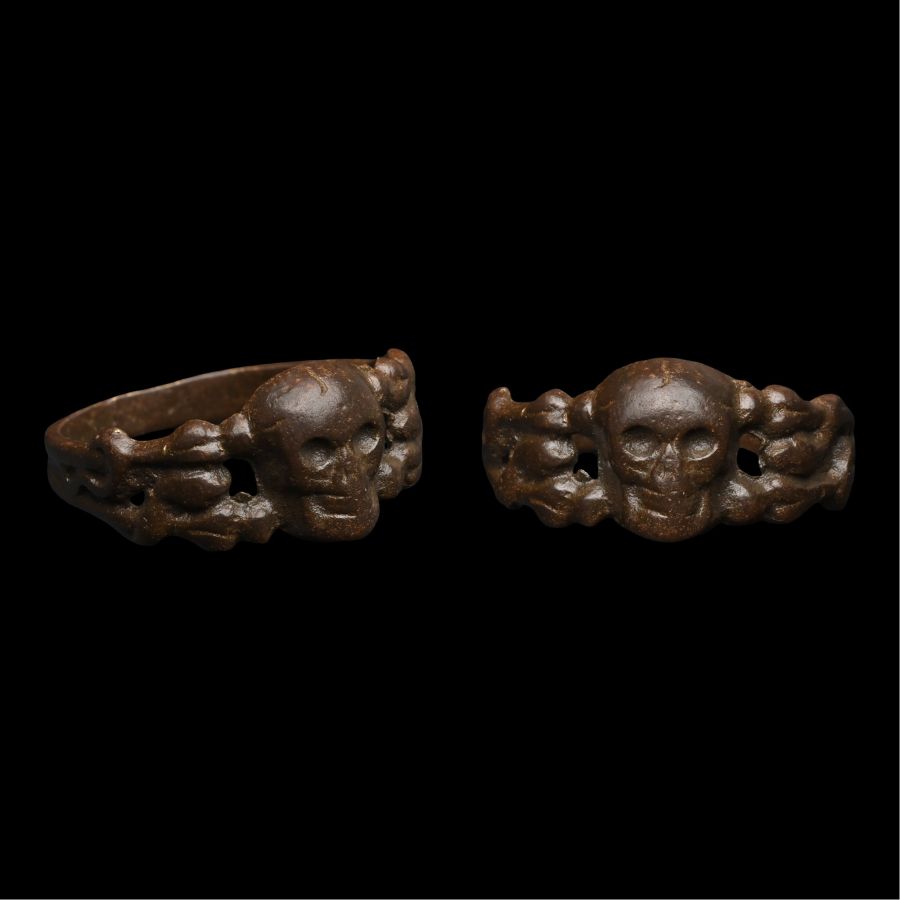
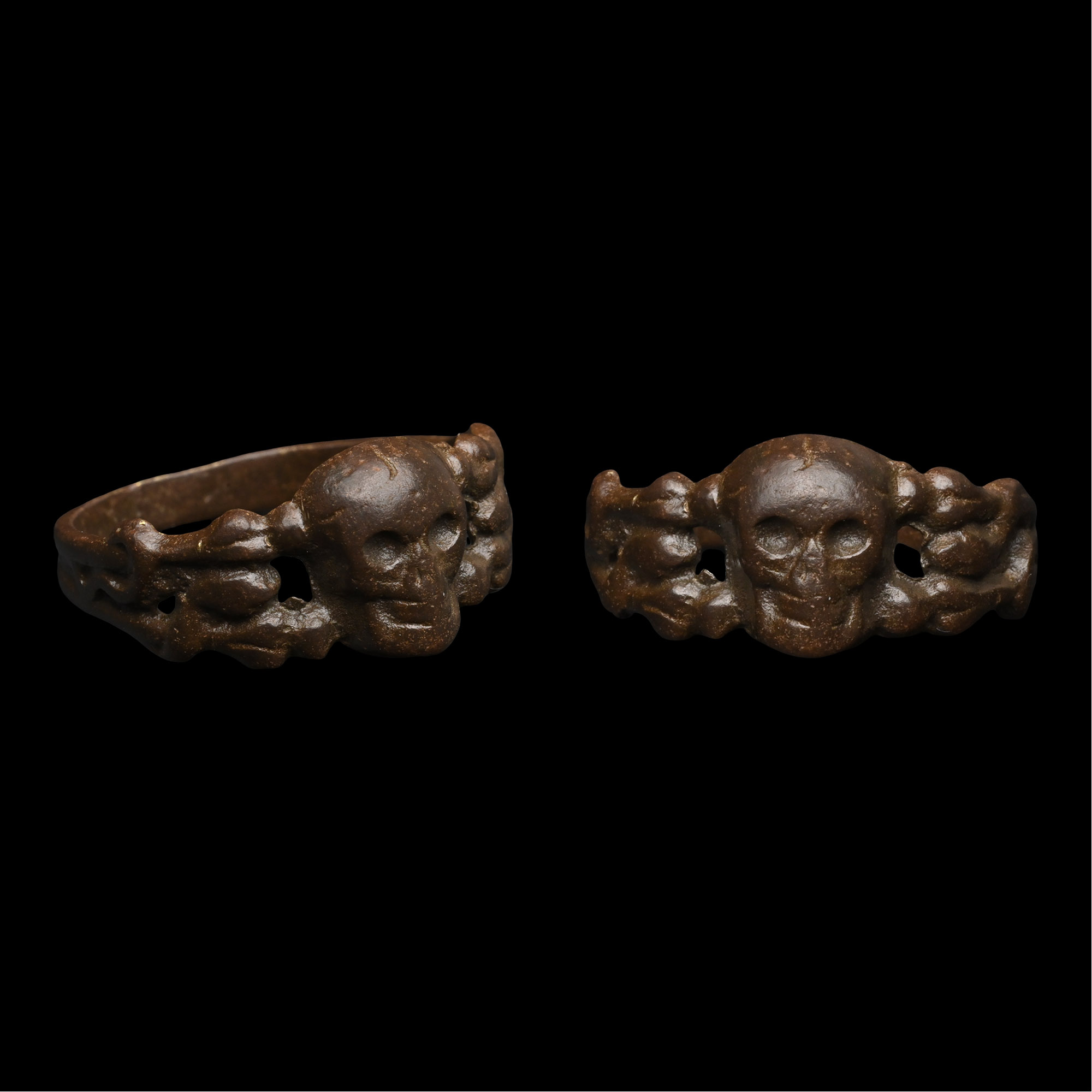
Post Medieval Bronze Skull Ring

CIRCA 19TH CENTURY A.D.

7/8 in. (3.44 grams, 22.68 mm overall, 18.29 mm internal diameter (approximate size British O 1/2, USA 7 1/4, Europe 15.61, Japan 15)).

Slender hoop formed as a pair of long bones with a snake curled around the shafts at the shoulders, the bezel a skull with recessed eye sockets. [No Reserve]

Provenance

Ex German art market, 2000s.
Acquired from an EU collector living in London.
From the collection of a Surrey, UK, gentleman.

CONDITION

VETTING:

TimeLine Auctions follows a vetting process to ensure the authenticity and legality of all items, reinforcing our commitment to integrity and responsible trading. Each antiquity, antique, and coin lot undergoes thorough examination by a vetting committee of at least ten external specialists, professional trade association members, scientists, and archaeologists: Our Vetting Process


AUCTIONS:

TimeLine is a leading auction house specialising in antiquities, ancient art, collectables, natural history, coins, medals, and books. Our auctions offer museums, collectors, historians, and enthusiasts the opportunity to acquire unique and historically significant pieces.

LOT 2398

Post Medieval Bronze Skull Ring

Sold for (Inc. bp): £59

Print page

RELATED LOTS

  • Post-Byzantine Gold Archbishops Pectoral Pendant
    Post-Byzantine Gold Archbishop's Pectoral Pendant
    16th-17th century A.D.

    Sold for (Inc. bp): £7,020

    Round enkolpion with finely worked icons both on the front and back, and eight small side eyelets for lost pearl ropes on the edge; at the top, a double eyelet for the chain; bordered by a delicate beaded edge with a slight knock in one place due to age; embossed depictions on both sides, finely rendered in repoussé; on the obverse a frontal bust portrait of the deceased Saviour, both arms of Christ limply hanging at his sides, the lifeless head resting on his right shoulder, behind him a nimbus and the cross, to the left of the soma (body of Christ) the abbreviation 'IC' (= Jesus), on the right 'XC' (= Christus), above the head a plaque with a Greek two-line inscription: 'O Basilevs tis doxis Christos' (Christ, the King of Glory); the Virgin Mary (Theotokos) depicted on the back, her hands raised in a gesture of prayer (orans) with exquisitely modelled facial features, flanked by an inscription referring to the Mother of God: the abbreviation 'MP' on the left, 'THY' on the right, furthermore, she is invoked as 'He Gorgoepikoo' (She who is quick to hear). 21.3 grams, 44 mm


    Acquired by the previous owner on the European art market in the late 1990s. Property of a German university professor. Hermann Historica, Auction 87, 2020 no.19. This lot has been checked against the Interpol Database of stolen works of art and is accompanied by search certificate number no.13291-254371.

    Adorned with an icon of Christ and the Virgin Mary, this outstanding enkolpion symbolises purity of heart and the seal of confession and faith. Since the Byzantine era, golden enkolpia were pontifical insignia and usually worn by bishops. In this case, the size, the artistic craftsmanship, and the topics of the icons, depictions of Christ and the Theotokos, lead to the conclusion that it must have been the enkolpion of a high-ranking primate or archbishop. Extremely rare in this size and quality. Remarkable is also the artist's choice to depict the Mother of God slightly turned to the right and not show her frontally, as is common.

    Lot Details

  • Russian Wooden Icon with St John the Baptist
    Russian Wooden Icon with St John the Baptist
    19th century A.D.

    Sold for (Inc. bp): £1,430

    Comprising a painted board with mounting panel and slots to the reverse, gessoed surface with painting of St John the Baptist standing nimbate with wings spread behind him, left hand supporting a bowl containing his severed head and holding an unfurled scroll with Cyrillic text 'Repent ye, for the Kingdom of Heaven is at hand,' (Matthew 3:2); right hand raised in blessing; landscape with sand-dunes and trees; gilded title above; the upper border with gilt Slavonic inscription reading 'Holy John the Forerunner'; from the Palekh Icon School, probably made in Mstera circa 1890. 1.02 kg, 31 cm high

    Fine condition.

    Ex property of a London lady, part of her family's collection. This lot has been checked against the Interpol Database of stolen works of art and is accompanied by a search certificate no.11546-196366.

    The Palekh icon school emerged in the 17th century, inspired by the Moscow and Suzdal traditions of icon painting. Although preserving many features of traditional Russian iconography, the school created its own style that remained active into the 18th century. The hallmarks of the school include the frequent use of gold on the clothes of the saints and a rich palette. Bodies are shown as tall and slender and abrupt transitions between light and shadow are distinctive features of Palekh icons. The wings of Saint John derive from the double meaning of the Greek word used to describe him in Mark 1:2 - Angelos, meaning both messenger and angel. John is often called a 'Heavenly Man' and 'Earthly Angel' in Orthodoxy. At his feet is shown a small tree with an axe cutting into it, illustrating Luke 3:9, 'And now also the axe is laid unto the root of the tree...'

    Lot Details

  • Marble Head of a Roman Nobleman
    Marble Head of a Roman Nobleman
    19th century A.D.

    Sold for (Inc. bp): £33

    Carved in the round, a Grand Tour male head with laurel-leaf diadem to the brow; exaggerated eyes and small mouth. 360 grams, 85 mm


    Acquired on the UK art market in the early 2000s.

    Lot Details

Stay up-to-date with the latest from TimeLine Auctions by joining our mailing list