
Loading, please wait...


LOT 0348
Post Medieval Banded Agate Cameo of a Woman in Gold Ring
18TH CENTURY A.D.
3/4 in. (3.17 grams, 21.26 mm overall, 17.72 mm internal diameter (approximate size British L, USA 5 3/4, Europe 11.24, Japan 10)).
Hollow-formed with pie-dish bezel and inset cameo.
ProvenancePrivate collection, Europe.
Acquired on the English art market.
Cf. Chadour, A.B., Rings. The Alice and Louis Koch Collection, volume I, Leeds, 1994, item 790, for type.
FootnotesThe cameo is Italian and carved in the classical style of the 2nd century AD, although it dates to the 18th century. Her hair is tied back, and she is wearing a double-banded diadem. The agate displays a deep umber hue, with the bust depicted in light bluish white with highlights of light caramel. In the late 18th century, interest in the classical world became exponentially high, and demand became great for objects from or relating to the ancient world. The high-carat gold ring dates to the late 18th century; there is a small dent to the shoulder of the band.
CONDITIONTimeLine Auctions follows a vetting process to ensure the authenticity and legality of all items, reinforcing our commitment to integrity and responsible trading. Each antiquity, antique, and coin lot undergoes thorough examination by a vetting committee of at least ten external specialists, professional trade association members, scientists, and archaeologists: Our Vetting Process
AUCTIONS:
TimeLine is a leading auction house specialising in antiquities, ancient art, collectables, natural history, coins, medals, and books. Our auctions offer museums, collectors, historians, and enthusiasts the opportunity to acquire unique and historically significant pieces.
LOT 0348
Post Medieval Banded Agate Cameo of a Woman in Gold Ring
Estimate £600 - 800€700 - 930 (for guidance only)$810 - 1,080 (for guidance only)
-
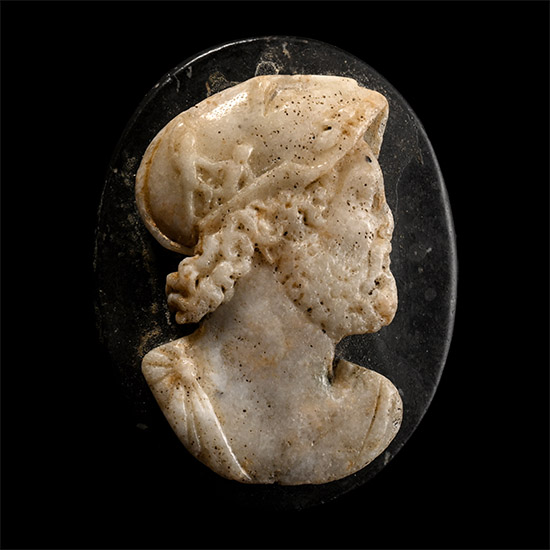
Grand Tour Stone Cameo with Bust of Ajax
18th century A.D.Sold for (Inc. bp): £338
Large oval cameo with profile bust of the Greek hero Ajax, shown bearded and with his helmet pushed up exposing his face. 27.3 grams, 48 mm
UK private collection, acquired on the French art market in the 2000s.
Ajax is recorded in The Iliad as ‘the best man among the Thracians, being both brave and of great stature’. He was one of the strongest warriors for the Achaeans, second only to his cousin Achilles. His epic duel with Hector is detailed in the seventh book of the famed poem by Homer. -

Boxed Oak Section From Lord Nelson's HMS Victory
Circa 1805 A.D.Sold for (Inc. bp): £442
Cut section of original oak from Lord Nelson's flagship HMS Victory; supplied in an original display box. 40 grams total, 79 x 54 mm including case
From the private coin collection of a West London, UK, gentleman. -
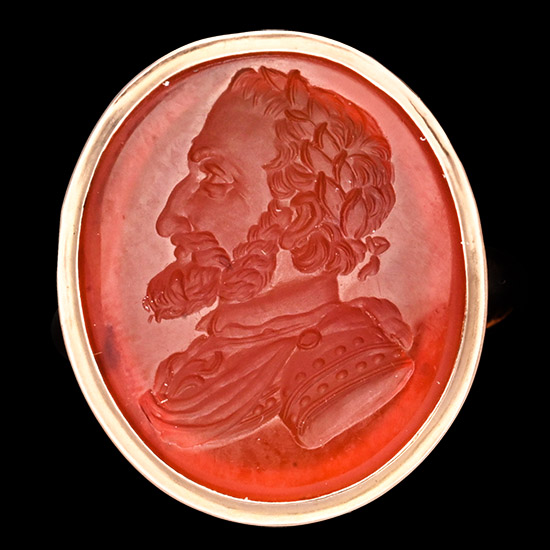
French Carnelian Gemstone with King Henry IV in Gold Ring
19th century A.D.Estimate: £1,200 - 1,700 (+bp*)
Opening Bid: £600
Finely engraved intaglio portraying a left-facing bust of Henry IV (1553–1610), King of France, in armour, with a decorated gorget and distinctive curled beard, set in a high-carat gold bezel and later fitted with a modern plain shank; supplied with a museum-quality impression. 5.24 grams, 21.83 mm overall, 19.35 mm internal diameter (approximate size British P, USA 7 1/2, Europe 16.23, Japan 15)
Acquired on the European art market.
The engraving is directly after a medallic portrait by Guillaume Dupré, Henry IV’s official medallist, which was widely circulated during the king’s reign and thereafter. The king’s profile is clearly drawn from a familiar medallic type, often used in the 17th and 18th centuries as a symbol of royal authority and dynastic legitimacy.
