Loading, please wait...

Use mousewheel to zoom in and out, click to enlarge

Details

LOT 0390

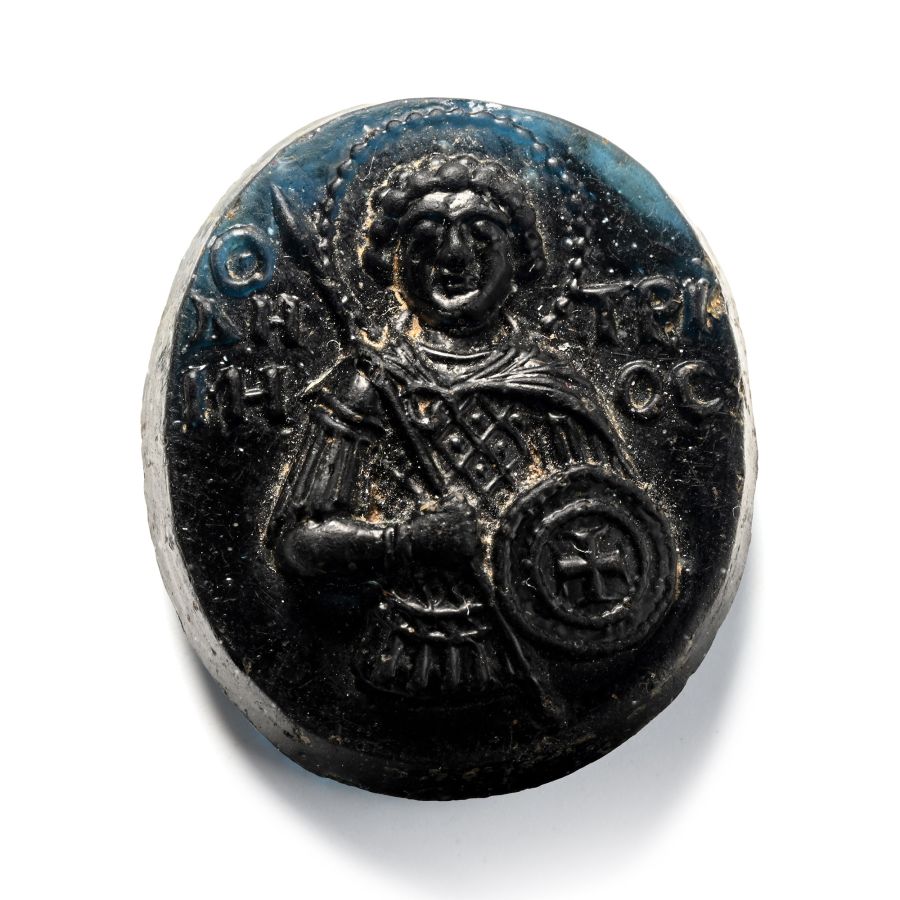
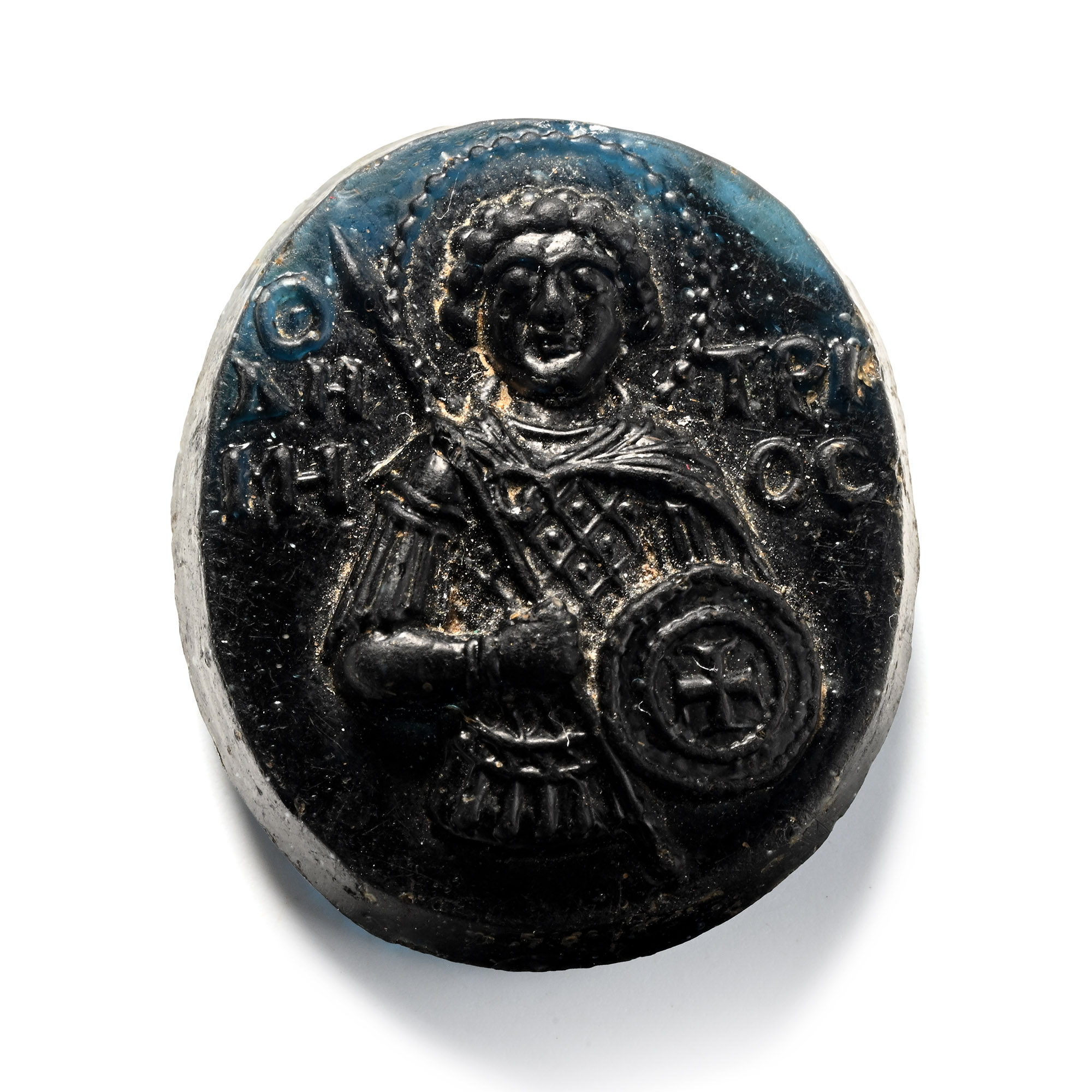
Post-Classical Glass Paste Cameo of Saint Demetrius

17TH-18TH CENTURY A.D. OR EARLIER

1 1/4 in. (9.43 grams, 31 mm).

Discoid inlay with facing figure modelled in the half-round, clad in reticulated armour with pauldron and pteruges, cloak to the shoulders, small targe-type shield with cross in circle motif, grasping a spear held across the body; bare-headed with curly hair and beaded nimbus surrounding; legend in the field 'ΟΔΗΜΗΤΡΙΟC' (Dimitrios).

Provenance

Private English collection, formed between the late 1970s and early 1990s.
Private collection, London, UK.

This lot has been checked against the Interpol Database of stolen works of art and is accompanied by search certificate number no.13150-248707.

CONDITION

VETTING:

TimeLine Auctions follows a vetting process to ensure the authenticity and legality of all items, reinforcing our commitment to integrity and responsible trading. Each antiquity, antique, and coin lot undergoes thorough examination by a vetting committee of at least ten external specialists, professional trade association members, scientists, and archaeologists: Our Vetting Process


AUCTIONS:

TimeLine is a leading auction house specialising in antiquities, ancient art, collectables, natural history, coins, medals, and books. Our auctions offer museums, collectors, historians, and enthusiasts the opportunity to acquire unique and historically significant pieces.

LOT 0390

Post-Classical Glass Paste Cameo of Saint Demetrius

Sold for (Inc. bp): £3,380

Print page

RELATED LOTS

  • Roman Bronze Hand-Standing Acrobat
    Roman Bronze Hand-Standing Acrobat
    1st-2nd century A.D.

    Sold for (Inc. bp): £7,800

    A statuette of an acrobat on a round, drum-shaped base, standing on his hands, body arching slightly and legs together; wearing a loin cloth and cap decorated with floral pattern; eyes inlaid with silver. 162 grams, 12 cm high


    Ex property of a Surrey collector; acquired in the early 1970s. This lot has been checked against the Interpol Database of stolen works of art and is accompanied by search certificate number no.13125-249637.

    Acrobats in ancient Rome could perform at a number of venues; either in theatres, as 'gap fillers' between gladiatorial contests at the amphitheatre, at private parties or at impromptu street performances and fairs. A convivium was a dinner party with family, friends or associates. It was somewhat like a Greek symposium except that it was generally regarded as a chance to talk business or politics rather than philosophy and weighty matters. A commissatio was a wild drinking party. Prostitutes, jugglers, musicians, acrobats, actors and fire-eaters entertained guests at the banquets of wealthy Romans. From the descriptions given by Roman authors these banquets were lavish affairs with rose petals scattered on the floor, mechanical devices lowering acrobats and entertainers from the ceiling and slaves blew exotic scents into the room. The emperors also had special entertainment barges constructed on some of the ornamental lakes in the parks of Rome where acrobats entertained the guests.

    Lot Details

  • Greek Gold and Carnelian Necklace with Garnet-Set Pendant
    Greek Gold and Carnelian Necklace with Garnet-Set Pendant
    5th-4th century B.C.

    Estimate: £3,000 - 4,000 (+bp*)

    Opening Bid: £1,500

    A restrung necklace comprising carinated carnelian beads interspersed with sheet-gold beads of plain and granulated types, two tapering round-section beads with collars and domed finials, a central gold polygonal pendant with eight concave sides, polished oval garnet cabochon at the centre, granulated collar around base, raised tear-shaped cell to each corner also with granulated border, alternately set with enamel and garnet cabochons, a single applied bead between each; modern hook-and-eye clasp. 39.16 grams, 53 cm


    Acquired in the mid-1980s to early 1990s. Private collection, London, UK. This lot has been checked against the Interpol Database of stolen works of art and is accompanied by search certificate number no.13124-246808.

    Lot Details

  • Large Roman Bronze Robed Torso
    Large Roman Bronze Robed Torso
    1st century B.C.-1st century A.D.

    Estimate: £30,000 - 40,000 (+bp*)

    Opening Bid: £16,667

    Likely representing Harpocrates, depicted frontally and wearing a draped full-length himation, the right arm raised and left arm bent at the elbow; mounted on a custom-made display stand. 7.55 kg total, 53.5 cm high including stand


    Private collection, Hong Kong, acquired in the 1970s. Spanish art market. Acquired by the present owner from the above. Accompanied by an academic report by Dr Raffaele D'Amato. This lot has been checked against the Interpol Database of stolen works of art and is accompanied by a search certificate number no.13040-248071.

    The body of this statue was hollow-cast by the lost wax method; traces of solder within the arm sockets and around the neck indicate that the arms and head were cast separately. The position of the body and comparative images suggest the statue represents Harpocrates. Harpocrates, the son of Isis and Horus, was one of the most represented children, especially after the diffusion of his cult into the Roman Empire. He is usually depicted naked, but draped figures of the god were produced in the Hellenised east and spread throughout the Empire. Statues of Harpocrates were at the entrance of almost all temples, to indicate that in those places the gods should have been honoured with silence, or, according to Plutarch, men who had an imperfect knowledge of the divinity should only speak of it with respect.

    Lot Details

Stay up-to-date with the latest from TimeLine Auctions by joining our mailing list