
Loading, please wait...
_900x900.jpg "Post Byzantine Triptych Centre Icon of the Intercession")
_200x200.jpg "Post Byzantine Triptych Centre Icon of the Intercession")
.jpg "Post Byzantine Triptych Centre Icon of the Intercession")
LOT 1400
Post Byzantine Triptych Centre Icon of the Intercession
17TH-19TH CENTURY A.D.
5 1/8 in. (142 grams, 13 cm high).
A central plaque from a brass triptych with standing nimbate Mother of God, dressed in a chlamys and tunica talaris, with her arms extended outward and the head turned to the right, surrounded by two groups of worshippers, arranged in three rows: the angels at the top, the right ones at the centre and prophets with angels at the bottom; two flags flying horizontally on each side of her head, surrounded by plant decorations, while the sun and moon are depicted at the two corners of the plaque, separated by an inscription in Russian; in the upper part, in the shape of an eastern dome, is represented the Holy Trinity, Father and Son, seated on a throne of clouds, a cross in the middle surmounted by a dove. [No Reserve]
ProvenanceAcquired on the UK art market, 2000s.
Property of an Essex gentleman.
See Ahlborn, R.E. & Beaver-Bricken Espinola, Russian Copper Icons and Crosses from the Kunz Collection: Castings of Faith, Washington, 1991, nos.51, p.49, 55, p.80.
FootnotesThe icon represents the Intercession of Mary, 'Joy of all who sorrow'. It formed the central part of a triptych with the Mother of God at the centre, surmounted by iconography of veneration. The (here missing) other parts of the triptych were embossed with scenes of the lives of Christ or Mary.
CONDITIONTimeLine Auctions follows a vetting process to ensure the authenticity and legality of all items, reinforcing our commitment to integrity and responsible trading. Each antiquity, antique, and coin lot undergoes thorough examination by a vetting committee of at least ten external specialists, professional trade association members, scientists, and archaeologists: Our Vetting Process
AUCTIONS:
TimeLine is a leading auction house specialising in antiquities, ancient art, collectables, natural history, coins, medals, and books. Our auctions offer museums, collectors, historians, and enthusiasts the opportunity to acquire unique and historically significant pieces.
-
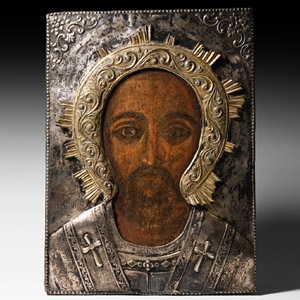
Greek Icon with Bust of Saint Eleutherios
18th century A.D.Sold for (Inc. bp): £702
A wooden painted icon of Saint Eleutherios with a repoussé silver oklad that covers all but the face, embossed in rich priestly robes, representing the priest's omophorion decorated with crosses, over an embroidered robe or sticharion, the nimbus gilded and embossed with foliage and rays over a silver background, Greek inscription 'O AΓΙΟΣ ΕΛΕΥΘΕΡΙΟΣ' (Saint Eleutherios) to the sides. 1.9 kg, 37.5 x 28.7 cm
Property of a London lady, part of her family's collection.
As bishop in Illyricum, Eleutherios promoted the cause of at a time when the persecutions not only made it difficult to win and hold converts, but also at a time when the gravest danger was in being a high-ranking prelate of the Church. Oblivious to this threat, he was acclaimed in the inner circle of Christianity as the brightest luminary of Christian Rome since the apostles. His immense popularity grew and thereby became more dangerous to the state. He was finally brought to the attention of Emperor Hadrian, who ordered his arrest, and then cast into prison, tortured, and put to death on December 15th. -
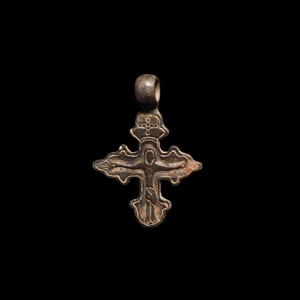
Post Medieval Silver Cross Pendant
17th-19th century A.D.Sold for (Inc. bp): £57
A silver cruciform pendant bearing the figure of Christ on the cross with elaborate arms in low-relief, a cross composed of pellets above, simple detailing to the hands, feet and loin cloth worn by Christ, suspension loop above. 6.9 grams, 38 mm
Fine condition.
Acquired on the UK art market in the late 1990s. Property of a UK gentleman. -
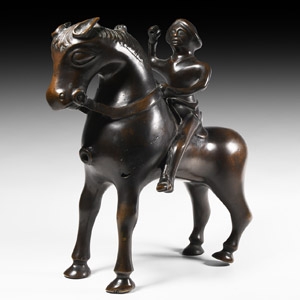
Bronze Aquamanile with Horse and Rider
Early 19th century A.D.Estimate: £6,000 - 8,000 (+bp*)
Opening Bid: £2,200
A bronze aquamanile portraying a mounted rider, both horse and rider modelled in the round with semi-naturalistic anatomical and facial features; the horse standing facing forwards, ears pinned back and with short tail; the male figure positioned with one hand on the reins, the other raised to eye level, wearing period costume and boots; rectangular vessel mouth behind horse's forelock with remains of hinge for a lid (absent), conical pouring spout to its lower chest; some splits; modelled on c.15th century German examples. 5.6 kg, 30.5 cm high
Acquired from St Marys Convent, Peekshill, New York. From Emily Gagnon, Dallas, USA. UK private collection, 2002. This lot has been checked against the Interpol Database of stolen works of art and is accompanied by search certificate number no.11686-197726
The practical function of the aquamanile was to pour clean water over the hands before dining, and in religious contexts to symbolically purify the body before undertaking communion. The origins of the form are often traced to the area of Iran, and it reached Western Europe through contacts with the Byzantine Empire.
