Loading, please wait...

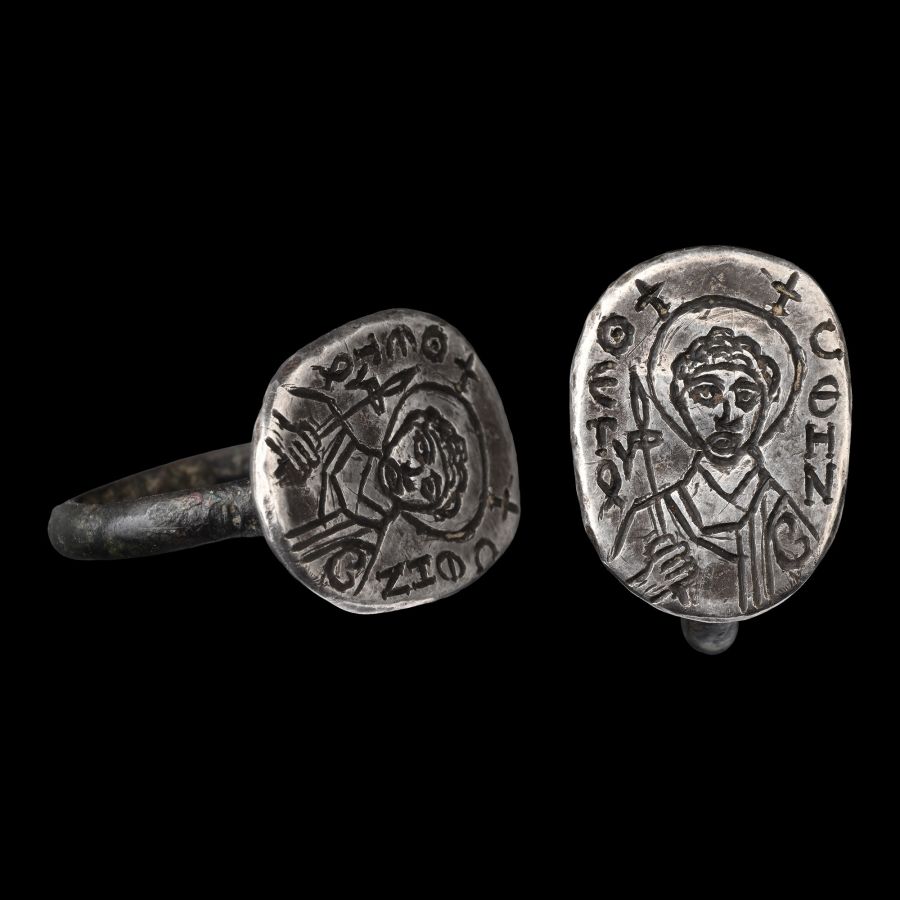
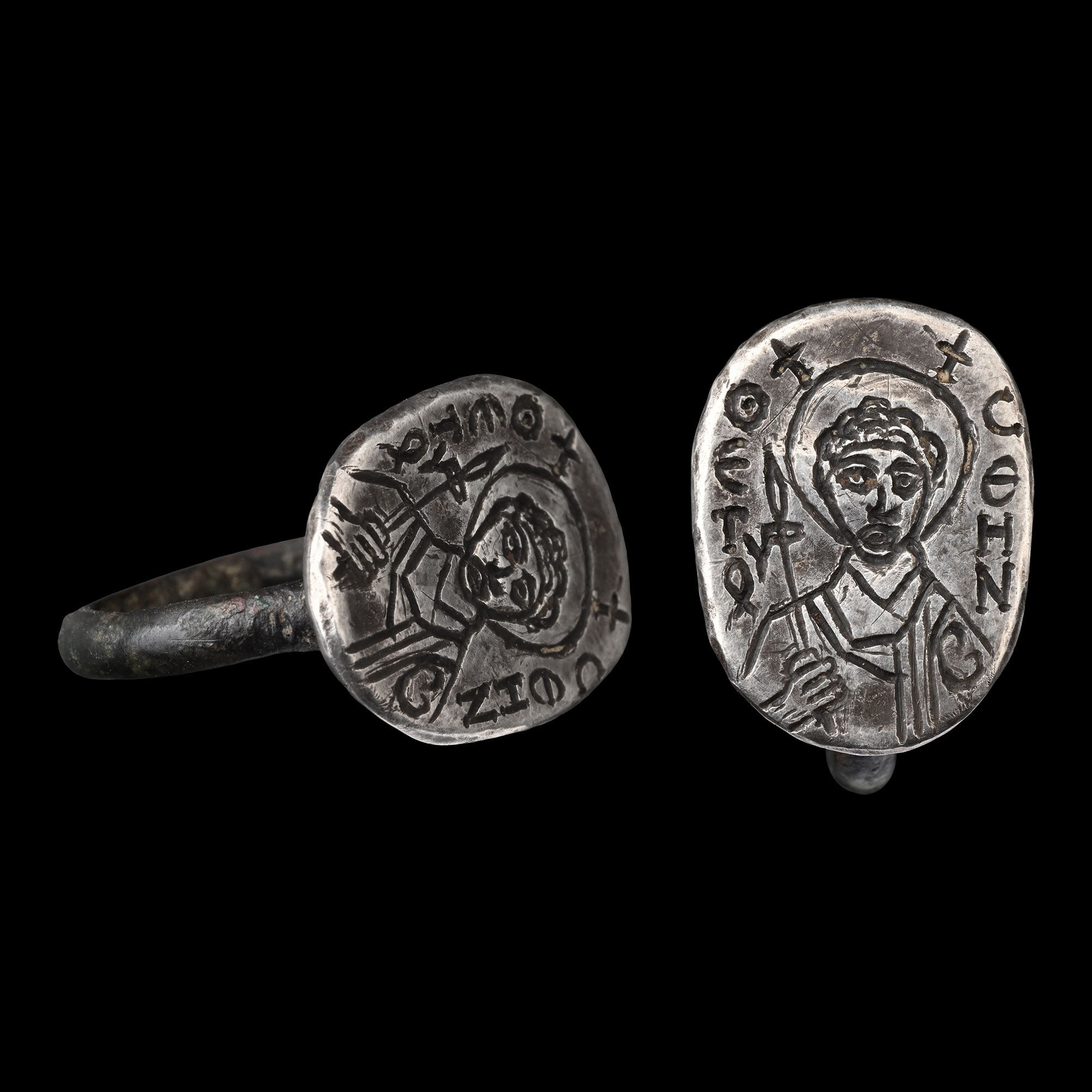
Post Byzantine Silver Ring with Saint Demetrios Post Byzantine Silver Ring with Saint Demetrios Post Byzantine Silver Ring with Saint Demetrios
Use mousewheel to zoom in and out, click to enlarge
Details

LOT 1134

Post Byzantine Silver Ring with Saint Demetrios

18TH-19TH CENTURY A.D.

7/8 in. (6.99 grams, 22.95 mm overall, 18.99 x 17.57 mm internal diameter (approximate size British Q, USA 8, Europe 17.49, Japan 16)).

With a D-section hoop and a large oval bezel with a nimbate bust holding a staff, Greek inscription 'ΘET?' and 'CΘHN' flanking the bust.

Provenance

Ex German art market, 2000s.
Acquired from an EU collector living in London.
From the collection of a Surrey, UK, gentleman.

CONDITION
VETTING:

TimeLine Auctions follows a vetting process to ensure the authenticity and legality of all items, reinforcing our commitment to integrity and responsible trading. Each antiquity, antique, and coin lot undergoes thorough examination by a vetting committee of at least ten external specialists, professional trade association members, scientists, and archaeologists: Our Vetting Process


AUCTIONS:

TimeLine is a leading auction house specialising in antiquities, ancient art, collectables, natural history, coins, medals, and books. Our auctions offer museums, collectors, historians, and enthusiasts the opportunity to acquire unique and historically significant pieces.

LOT 1134

Post Byzantine Silver Ring with Saint Demetrios

Estimate £150 - 200€170 - 230 (for guidance only)$200 - 270 (for guidance only)

Opening Bid
£80 (EUR 93; USD 108) +BP*

Sign in to Bid

Please enter a e-mail
Please enter a password
Or Create Account here.
Please confirm to accept TC and Privacy policy

Bids: 0
RELATED LOTS
  • Large Byzantine Bronze Cross Pendant with Christ and Saints
    Large Byzantine Bronze Cross Pendant with Christ and Saints
    Circa 10th-12th century A.D.

    Estimate: £250 - 350 (+bp*)

    Bids: 2   |   Current Bid: £15

    Obverse: central facing nimbate figure of Mary with 'MHP ΘV' legend, facing nimbate bust in each of the roundels; reverse with cruciform void and pellets; hinged loop with ropework detailing. 43.1 grams, 88 mm


    From the private coin collection of a West London, UK, gentleman, formed since the mid 1980s.

    Lot Details

  • Byzantine Carved Agate Cameo of The Holy Banquet
    Byzantine Carved Agate Cameo of The Holy Banquet
    6th-8th century A.D.

    Estimate: £4,000 - 6,000 (+bp*)

    Bids: 1   |   Current Bid: £3,200

    Plano-convex in section with low-relief carving: scene with a meal at a so-called sigma table surrounded by Christ, Peter, John and the other disciples; Christ and Peter attending and beardless Saint John the Evangelist preparing the fish. 9.95 grams, 32 mm


    From a North American gentleman's collection, 1990s. This lot has been checked against the Interpol Database of stolen works of art and is accompanied by search certificate number no.13368-259040.

    In early Byzantine art, Saint Peter is often depicted as the only figure apart from Christ to be shown with a nimbus, to emphasise his pre-eminent position as a church father and the 'rock' of the church.

    Lot Details

  • Byzantine Greek Fire Ceramic Fire Bomb or Hand Grenade
    Byzantine 'Greek Fire' Ceramic Fire Bomb or Hand Grenade
    9th-11th century A.D.

    Estimate: £80 - 100 (+bp*)

    Opening Bid: £5

    Piriform body with a rounded base and domed mouth, circumferential bands on the body; intended to be filled with explosive liquid and a wick, and used as a hand grenade. 747 grams, 14 cm


    From an important specialist collection, London, UK, 1990s. Accompanied by an academic paper by military specialist Dr Raffaele D'Amato, dated 15 July 2019 and titled 'Eastern Roman Empire - Greek Fire Bomb or Hand Grenade (μεσαίον kακάβιον) 9th-11th century AD'.

    Apart from the use of siphons or manual flame-throwers called cheirosiphona, special corps of Roman soldiers employed terracotta grenades, in the form of small jars, abundantly evidenced in archaeological excavations. They were called μεσαία kακαβιά or κυτροκακάβια, where the former had a bulbous shape and the latter a more cylindrical form.

    Lot Details