
Loading, please wait...
LOT 1484
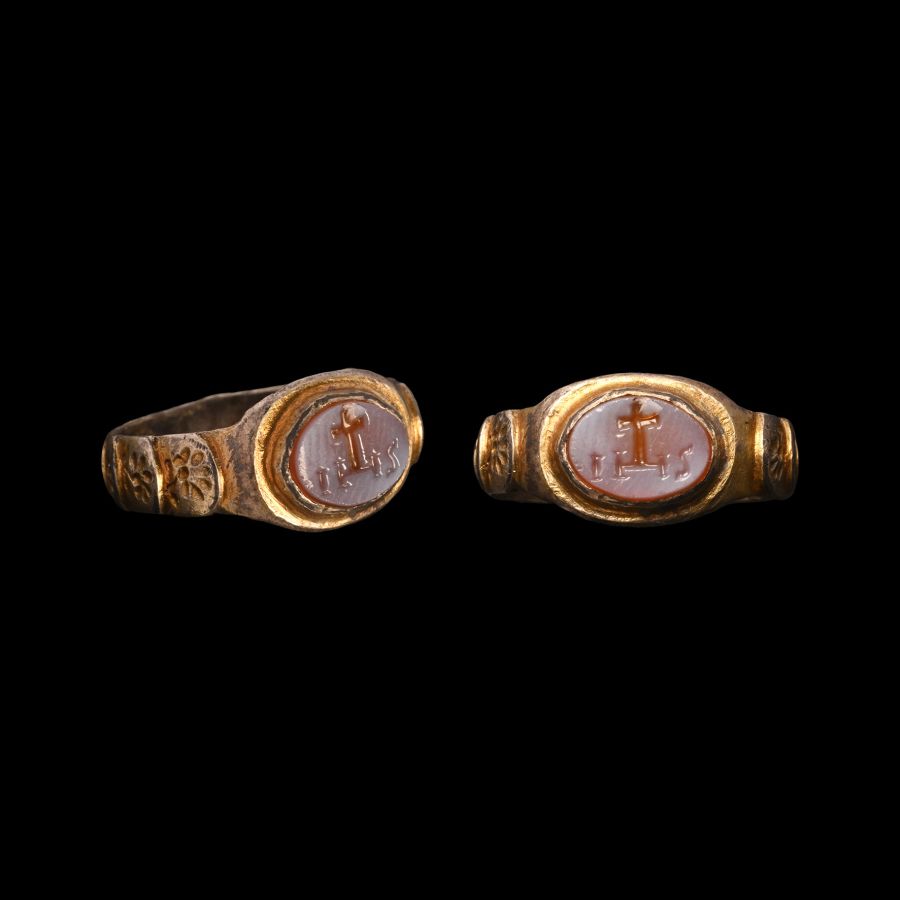
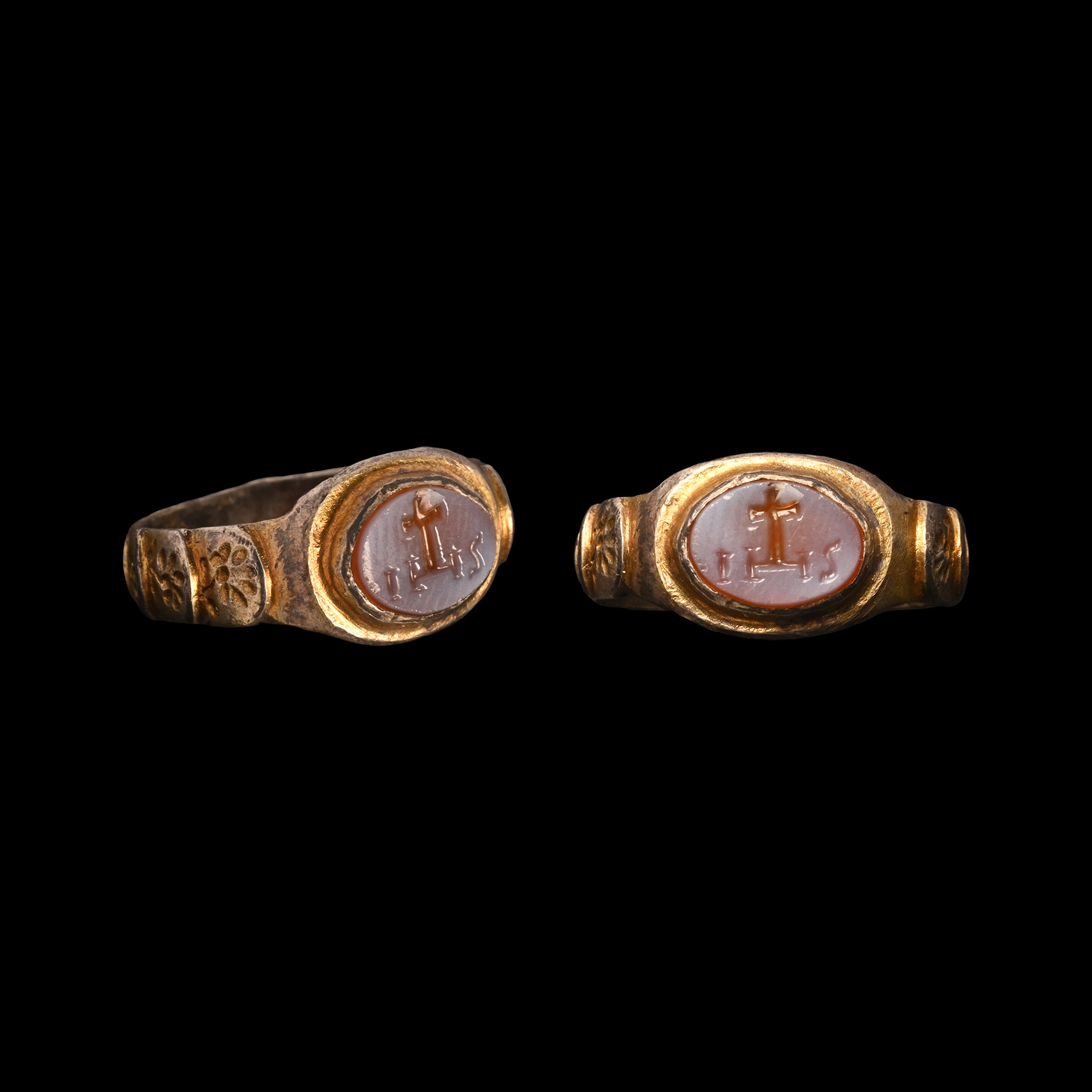
Post Byzantine Gilt Silver Ring with Cross Gemstone
17TH CENTURY A.D. OR EARLIER
3/4 in. (4.26 grams, 21.70 mm overall, 18.96 mm internal diameter (approximate size British O, USA 7, Europe 14.98, Japan 14)).
A silver-gilt finger ring with tiered scales to the hoop, ellipsoid bezel with inset ellipsoid carnelian intaglio of a cross over 'IHS' Christogram.
ProvenanceFrom a collection formed between 1990-2000.
Ex East London collection.
English private collection.
TimeLine Auctions follows a vetting process to ensure the authenticity and legality of all items, reinforcing our commitment to integrity and responsible trading. Each antiquity, antique, and coin lot undergoes thorough examination by a vetting committee of at least ten external specialists, professional trade association members, scientists, and archaeologists: Our Vetting Process
AUCTIONS:
TimeLine is a leading auction house specialising in antiquities, ancient art, collectables, natural history, coins, medals, and books. Our auctions offer museums, collectors, historians, and enthusiasts the opportunity to acquire unique and historically significant pieces.
LOT 1484
Post Byzantine Gilt Silver Ring with Cross Gemstone
Estimate £400 - 600€460 - 700 (for guidance only)$540 - 810 (for guidance only)
-
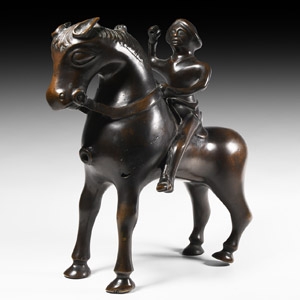
Bronze Aquamanile with Horse and Rider
Early 19th century A.D.Estimate: £6,000 - 8,000 (+bp*)
Opening Bid: £2,200
A bronze aquamanile portraying a mounted rider, both horse and rider modelled in the round with semi-naturalistic anatomical and facial features; the horse standing facing forwards, ears pinned back and with short tail; the male figure positioned with one hand on the reins, the other raised to eye level, wearing period costume and boots; rectangular vessel mouth behind horse's forelock with remains of hinge for a lid (absent), conical pouring spout to its lower chest; some splits; modelled on c.15th century German examples. 5.6 kg, 30.5 cm high
Acquired from St Marys Convent, Peekshill, New York. From Emily Gagnon, Dallas, USA. UK private collection, 2002. This lot has been checked against the Interpol Database of stolen works of art and is accompanied by search certificate number no.11686-197726
The practical function of the aquamanile was to pour clean water over the hands before dining, and in religious contexts to symbolically purify the body before undertaking communion. The origins of the form are often traced to the area of Iran, and it reached Western Europe through contacts with the Byzantine Empire. -
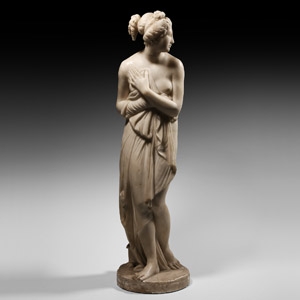
Marble Bathing Venus
Neoclassical, 19th century A.D.Sold for (Inc. bp): £1,235
A marble interpretation of the famous 'Bathing Venus' (Pudica Venus) statue, modelled naturalistically in the round, nude, hair piled behind her head, holding her garment to her breast, standing on a composite discoid base imitating a stone pavement, with a casket at her feet; after Giambologna's Renaissance original; restored. 21.2 kg, 78 cm high
Old repair to neck.
French collection, 1960s-early 2000s. From an important Paris gallery, France.
The original 'Bathing Venus' statue in bronze has been attributed to Giambologna (Giovanni da Bologna) (1529-1608), and was probably created for King Henry IV of France as a diplomatic gift from Ferdinando I de’ Medici, Grand Duke of Tuscany. This is a neoclassical interpretation of that Renaissance statue. -
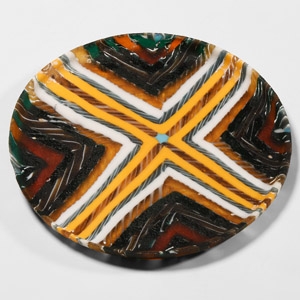
Post Medieval Mosaic Glass Dish
21st century A.D.Sold for (Inc. bp): £13
A shallow translucent glass dish displaying a polychrome cross with chevrons to each quarter. 104 grams, 12 cm wide
From a UK private collection.
