
Loading, please wait...
_900x900.jpg "Post Byzantine Bronze Ring with Inscription")
_200x200.jpg "Post Byzantine Bronze Ring with Inscription")
.jpg "Post Byzantine Bronze Ring with Inscription")
LOT 0763
Post Byzantine Bronze Ring with Inscription
CIRCA 18TH CENTURY A.D.
7/8 in. (5.55 grams, 22.52 mm overall, 17.80 mm internal diameter (approximate size British O, USA 7, Europe 14.98, Japan 14)).
With ellipsoid plaque, incuse border and text 'KERO / HOHAN / A'.
ProvenanceFrom the collection of a High Wycombe, Buckinghamshire, UK, gentleman, circa 2000.
LiteratureCf. Chadour, A.B., Rings. The Alice and Louis Koch Collection, volume I, Leeds, 1994, item 67, for type.
CONDITIONTimeLine Auctions follows a vetting process to ensure the authenticity and legality of all items, reinforcing our commitment to integrity and responsible trading. Each antiquity, antique, and coin lot undergoes thorough examination by a vetting committee of at least ten external specialists, professional trade association members, scientists, and archaeologists: Our Vetting Process
AUCTIONS:
TimeLine is a leading auction house specialising in antiquities, ancient art, collectables, natural history, coins, medals, and books. Our auctions offer museums, collectors, historians, and enthusiasts the opportunity to acquire unique and historically significant pieces.
LOT 0763
Post Byzantine Bronze Ring with Inscription
Estimate £100 - 140€120 - 160 (for guidance only)$140 - 190 (for guidance only)
-
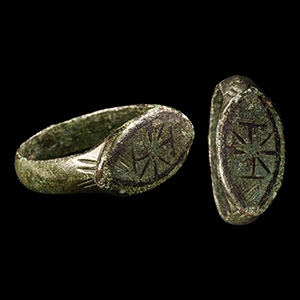
Byzantine Bronze Signet Ring with Niello Cross
Circa 14th century A.D.Sold for (Inc. bp): £78
With a D-section hoop, keeled shoulders supporting a lentoid bezel; the bezel with a niello border and a radiating cross motif. 5.04 grams, 22.85 mm overall, 17.65 mm internal diameter (approximate size British P, USA 7 1/2, Europe 16.23, Japan 15)
Private collection formed since the 1940s. UK art market. Property of an Essex gentleman. -
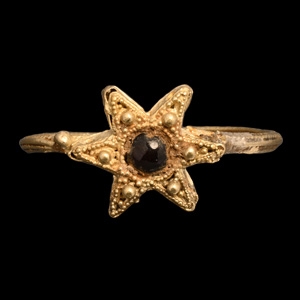
Byzantine Gold Star Ring
Circa 13th-14th century A.D.Estimate: £800 - 1,000 (+bp*)
Opening Bid: £400
Composed of a slender carinated hoop adorned with filigree supporting a hollow-formed star-shaped bezel set with central polished cabochon garnet and granules, each of six arms pierced, remaining granule to one shoulder. 1.76 grams, 23.61 mm overall, 20.80 mm internal diameter (approximate size British S 1/2, USA 9 1/4, Europe 20.63, Japan 19)
Acquired 1990s-early 2000s. East Anglian private collection. -
.jpg)
Byzantine Bronze Ring with 'Globus Cruciger' Gemstone
Circa 6th-8th century A.D.Sold for (Inc. bp): £221
With narrow, flat-bottomed hoop and tapering shoulders, inset garnet cabochon with 'globus cruciger' motif. 4.75 grams, 24.93 mm overall, 17.59 mm internal diameter (approximate size British M 1/2, USA 6 1/4, Europe 13.09, Japan 12)
Acquired on the German art market before 2000. Property of a Surrey, UK, collector.
The globus cruciger comprises a sphere surmounted by a cross potent, symbolising the domination of the world by Christianity.
