
Loading, please wait...
Details
LOT 255410
Polished Spartan Basalt Green Porphyry Gaming Piece Group
ROMAN, 4TH-6TH CENTURY A.D. OR LATER
3/4 - 7/8 in. (125 grams total, 18-23 mm).
A group of twelve hand-cut and hand-polished globular gaming pieces. [10, No Reserve]
Provenance
Acquired in the 1990s from the Bath Antiques Centre, Somerset, UK.
From the private collection of a Somerset gentleman.
Footnotes
Also known as Lapis Lacedaemonius and Porfido Verde Antico, a type of green porphyry quarried in Greece. Spartan basalt is a form of andesite or volcanic rock known today only from a single source in the village of Krokees on the Peloponnese in Greece. In addition, ancient sources mention a quarry of Lapis Lacedaemonius in Taygetus.
CONDITIONVETTING:
TimeLine Auctions follows a vetting process to ensure the authenticity and legality of all items, reinforcing our commitment to integrity and responsible trading. Each antiquity, antique, and coin lot undergoes thorough examination by a vetting committee of at least ten external specialists, professional trade association members, scientists, and archaeologists: Our Vetting Process
AUCTIONS:
TimeLine is a leading auction house specialising in antiquities, ancient art, collectables, natural history, coins, medals, and books. Our auctions offer museums, collectors, historians, and enthusiasts the opportunity to acquire unique and historically significant pieces.
LOT 255410
Polished Spartan Basalt Green Porphyry Gaming Piece Group
Estimate £200 - 300€230 - 350 (for guidance only)$270 - 410 (for guidance only)
Opening Bid
£5 (EUR 6; USD 7) +BP*
RELATED LOTS
-
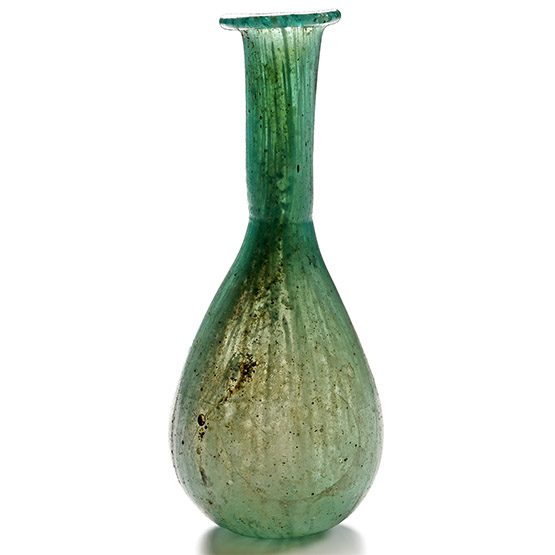
Roman Marbled Turquoise Glass Bottle
1st - 3rd century A.D.Estimate: £400 - 600 (‡+bp*)
Opening Bid: £200
Comprising an iridescent piriform body, tapering tubular neck with pinched and everted rolled rim. 9.44 grams, 84 mm
Acquired on the European art market in 2001.
Indented toilet bottles with long necks are rather common. In Western provinces of the Roman Empire they occur most frequently in and around the Rhineland. In the Eastern Part of the Empire, find places include Crete, Cyprus, Anatolia, Syria and Egypt. -
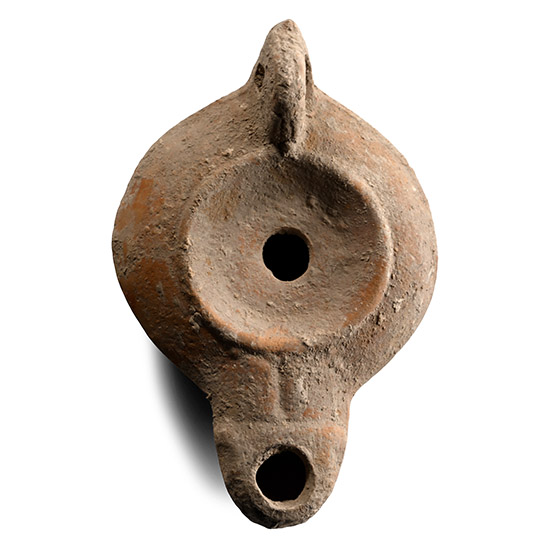
Roman Terracotta Oil Lamp
2nd century A.D.Estimate: £50 - 70 (+bp*)
Opening Bid: £5
Squat in profile with broad shoulder and recessed discus with central filler hole; elongated nozzle, carinated sidewall. lug handle with tapering hole. 49 grams, 96 mm
From the private collection of a Canadian gentleman living in Essex, UK, formed since the 1920s-circa 1990. Property of an Essex lady until the the late 1990s; thence by descent. From the private collection of an Essex gentleman since the late 1990s. -
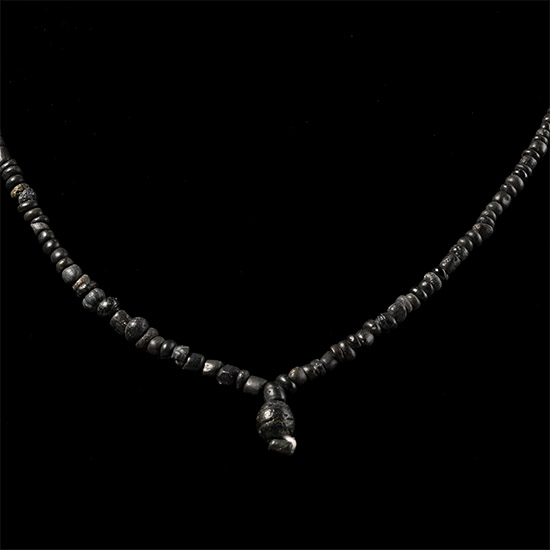
Roman Black Glass Bead Necklace String
1st-4th century A.D. and laterEstimate: £50 - 70 (+bp*)
Opening Bid: £5
Composed mainly of oblate beads with a larger bead as a central feature, restrung. 8.1 grams, 44.7 cm
Acquired in the 1990s. Ex London, UK, collection.
