
Loading, please wait...
LOT 0459
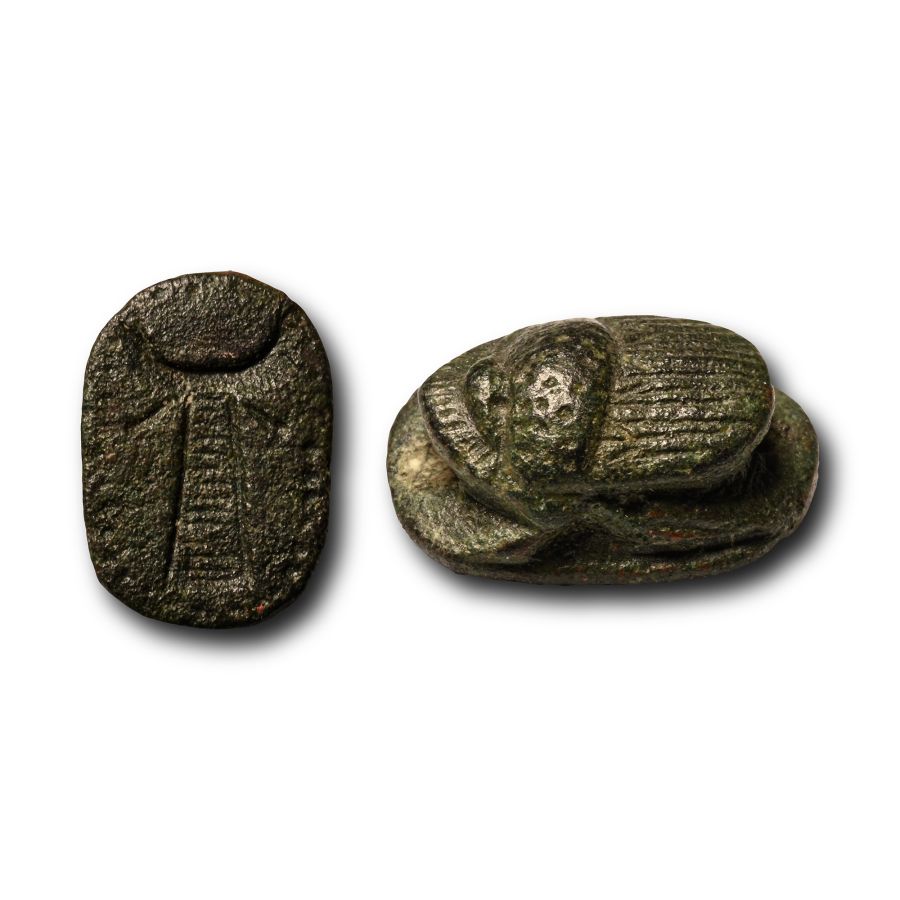
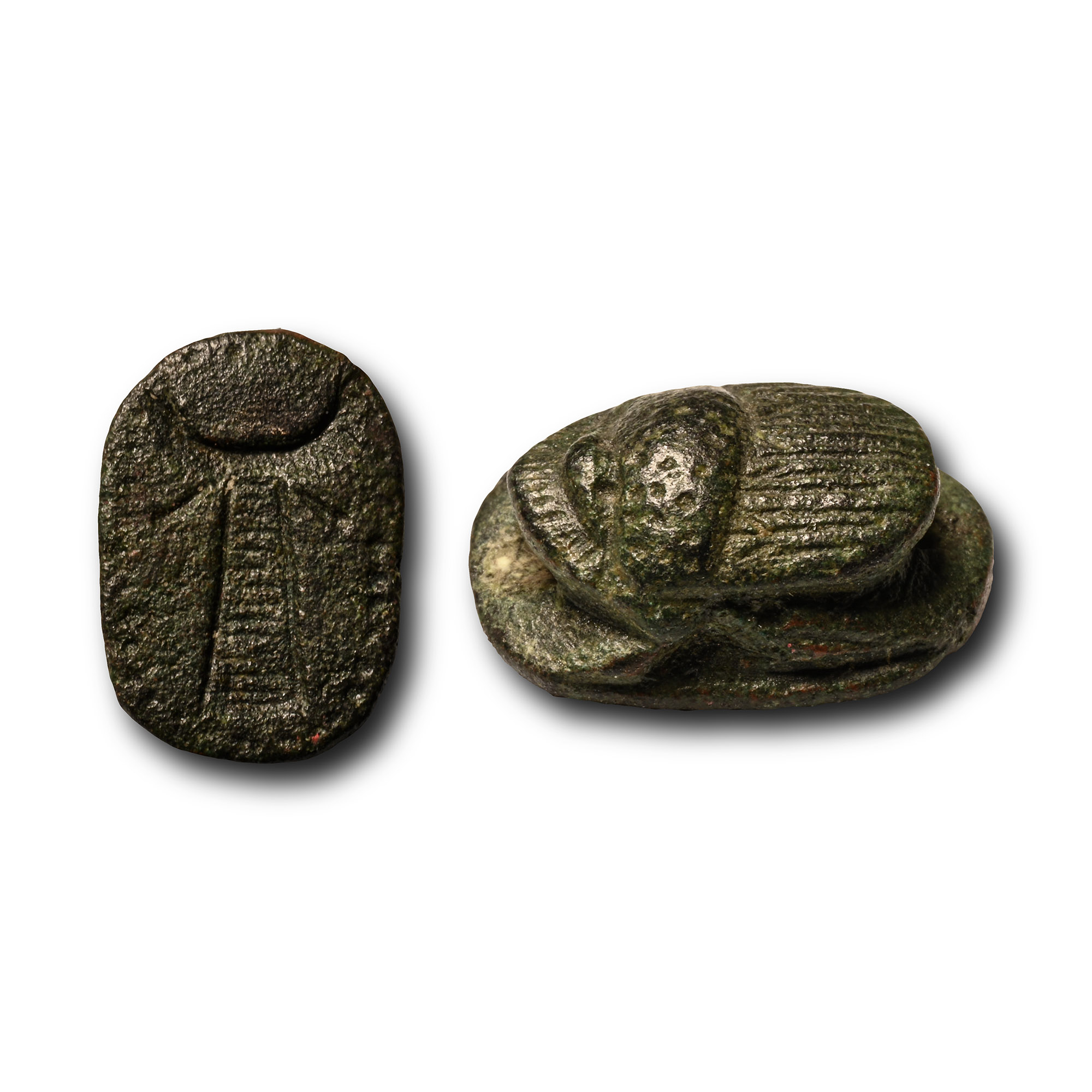
Phoenicio-Egyptian Dark Green Stone Scarab
CIRCA 6TH-4TH CENTURY B.C.
5/8 in. (3.94 grams, 15 mm).
With textured carapace, bull-horned column to the reverse.
ProvenanceFrom the property of the late Mr SM, London, UK, 1969-1999.
LiteratureCf. Moscati, S., I Fenici (The Phoenicians), Milano, 1988, p.395, for examples of Phoenician scarabs.
FootnotesThe widespread adoption of the scarab, both as a symbol linked to the concept of rebirth, and in its function as a seal, exemplifies the extent of Egyptian influence on Phoenician culture, from its origins in the Levant to its spread across the Mediterranean.
CONDITIONTimeLine Auctions follows a vetting process to ensure the authenticity and legality of all items, reinforcing our commitment to integrity and responsible trading. Each antiquity, antique, and coin lot undergoes thorough examination by a vetting committee of at least ten external specialists, professional trade association members, scientists, and archaeologists: Our Vetting Process
AUCTIONS:
TimeLine is a leading auction house specialising in antiquities, ancient art, collectables, natural history, coins, medals, and books. Our auctions offer museums, collectors, historians, and enthusiasts the opportunity to acquire unique and historically significant pieces.
LOT 0459
Phoenicio-Egyptian Dark Green Stone Scarab
Estimate £250 - 350€290 - 410 (for guidance only)$340 - 470 (for guidance only)
-
.jpg)
Egyptian Bronze Sistrum with Bes and Hathor
Roman Period, 30 B.C.-323 A.D.Sold for (Inc. bp): £14,950
The large liturgical rattle with a columnar handle composed of a bifacial figure of Bes standing on a lotus capital, flanked by seated sphinxes, his feathered crown supporting the bust of goddess Hathor wearing a broad collar and a curling wig, two rearing uraei emerging from the sides to support the base of the rattle, both wearing the pschent crown, above the cobras a standing figure of the goddess Hathor in cow form, wearing a tripartite wig and a sun disc between the horns; the rattle with a looped body with flared outer rims and set with three metal rods to accept metal discs, a pair of reclining lions to the base and the top with three felines surrounding a cockerel, and resting one of their front paws on the bird. 1.52 kg, 39.5 cm
German art market. European private collection, 1970s-early 2000s. Acquired from the above; thence by descent. Private collection, London, UK. Accompanied by an academic report by Dr Raffaele D’Amato. This lot has been checked against the Interpol Database of stolen works of art and is accompanied by search certificate number no.12348-225588.
The sistrum (seshesh in ancient Egyptian) was a rattle-like musical instrument, played exclusively by women in religious ceremonies. It was often decorated with the bust of the goddess Hathor to whom the sistrum was sacred. Their use continued into the Roman period in ceremonies associated with the cult of Isis. -
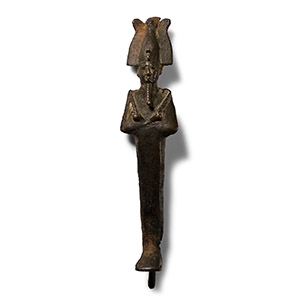
Egyptian Bronze Statuette of Osiris
Late Period, 664-332 B.C.Sold for (Inc. bp): £650
A slender standing figure of Osiris in iconic mummiform appearance, wearing the tall conical Atef crown with its flanking Ostrich plumes, and central uraeus, a long, internally-detailed divine beard, and holding the crook (heka) and flail (nekhakha) regalia; with tang under feet for attachment. 63 grams, 15 cm
Acquired on the German art market, 1989-1995. with The Museum Gallery, 19 Bury Place, London, WC1, UK, 1998-2003. Property of a London based academic, 2003-present.
Osiris is a deity who represents death and fertility and is commonly regarded as the quintessential god of rebirth. Though he was once a mortal ruler, as a deceased entity, his domain was the Underworld. Abydos was the primary centre of Osiris’ cult, where a renowned yearly celebration of the god was held. -
.jpg)
Egyptian Limestone False Door Relief Panel
Middle Kingdom, circa 1900-1750 B.C.Sold for (Inc. bp): £1,105
Rectangular panel from a false door stela carved in sunk relief with raised vertical borders framing a scene with a male figure wearing a knee-length kilt, collar and short wig, seated on a stool with lion-claw feet, holding a bolt of cloth in his left hand; before him, a pedestal table with splayed feet, the top laden with vertical loaves; traces of pigment to the collar, kilt and table; rear face dressed but plain. 4.12 kg, 28.7 cm
Acquired in the mid 1980s-1990s. Private collection, Switzerland, thence by descent. Private collection, since the late 1990s.
The ancient Egyptians believed the soul of the departed could move in and out of the tomb using a ‘false door.’ This door was identified by a recessed surface with a symbolic entrance at its centre. In the Middle Kingdom, the false door design was combined with other elements or represented by a raised border and cornice above on rectangular stelae.
