
Loading, please wait...
LOT 0832
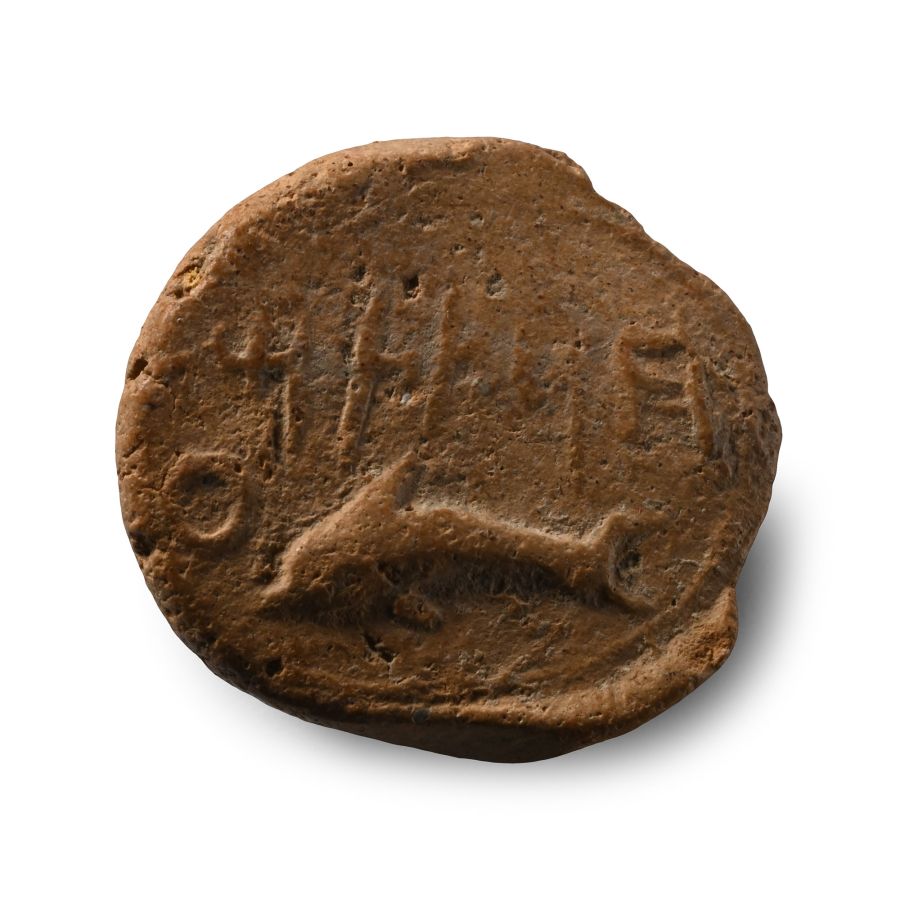
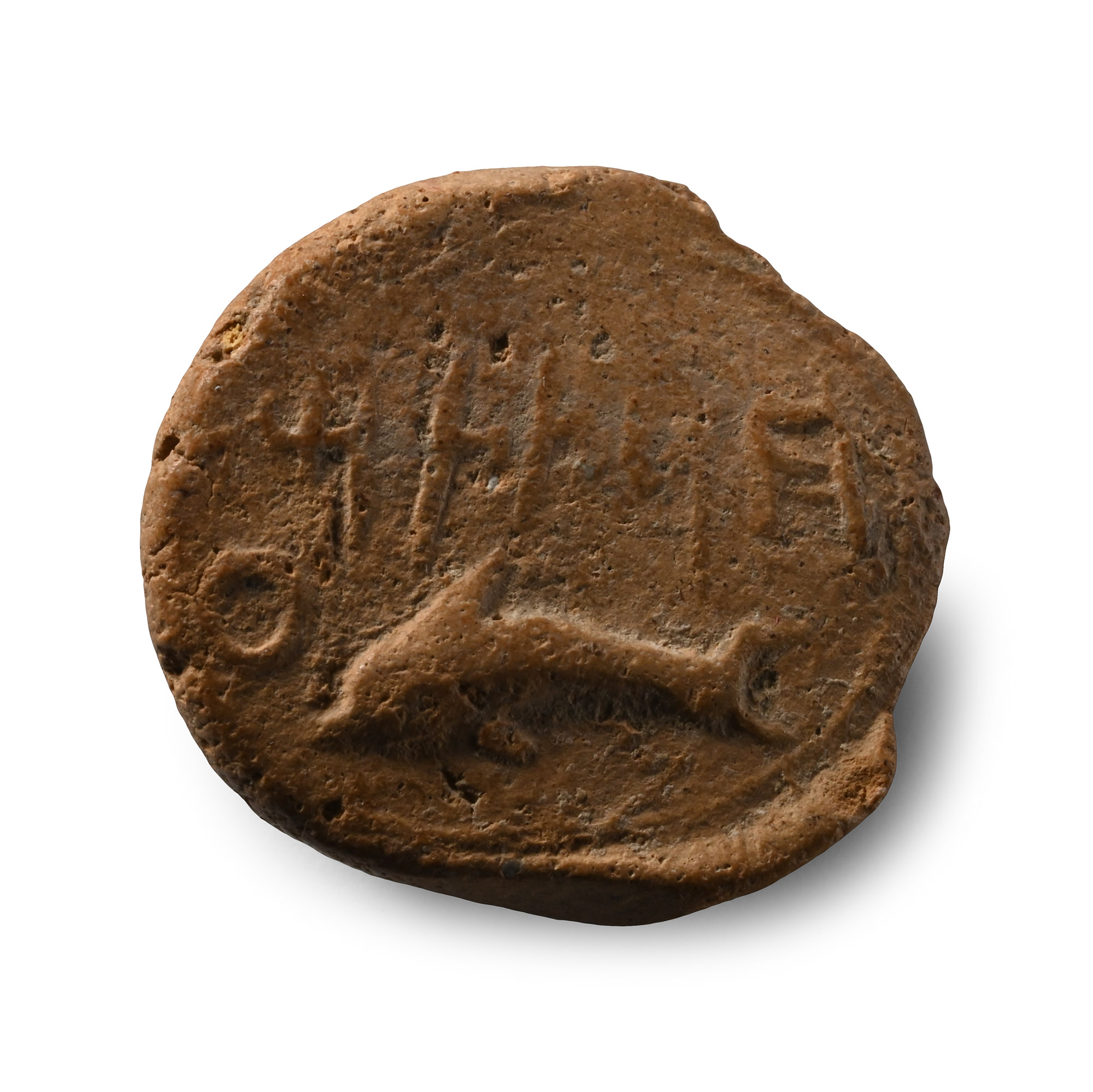
Phoenician Terracotta Bulla with a Dolphin
5TH CENTURY B.C.
5/8 in. (1.05 grams, 17.71 mm).
Plano-convex in profile with impressed dolphin and legend.
ProvenanceAcquired in 1994.
Private collection, Switzerland, thence by descent.
Private collection, since the late 1990s.
This Phoenician terracotta bulla, decorated with a dolphin, reflects the strong maritime identity of the Phoenician world. Bullae were typically used to seal documents or goods, serving both a practical and symbolic function in trade and administration. The dolphin, a creature closely associated with the sea, would have held particular meaning for the Phoenicians, whose culture and prosperity were deeply tied to seafaring and commerce across the Mediterranean. Often seen as a symbol of protection, guidance, and safe passage, the dolphin adds an additional layer of meaning to the object, suggesting not only its use in everyday transactions but also a connection to the wider beliefs and environment of the ancient coastal world.
CONDITIONTimeLine Auctions follows a vetting process to ensure the authenticity and legality of all items, reinforcing our commitment to integrity and responsible trading. Each antiquity, antique, and coin lot undergoes thorough examination by a vetting committee of at least ten external specialists, professional trade association members, scientists, and archaeologists: Our Vetting Process
AUCTIONS:
TimeLine is a leading auction house specialising in antiquities, ancient art, collectables, natural history, coins, medals, and books. Our auctions offer museums, collectors, historians, and enthusiasts the opportunity to acquire unique and historically significant pieces.
LOT 0832
Phoenician Terracotta Bulla with a Dolphin
Estimate £100 - 140€120 - 160 (for guidance only)$140 - 190 (for guidance only)
Opening Bid
£50 (EUR 58; USD 68) ‡+BP*
-
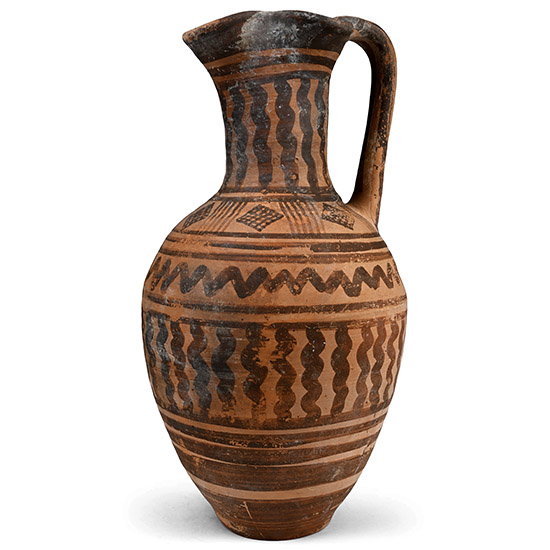
Boeotian Late Geometric Oinochoe
Late 8th century B.C.Estimate: £2,000 - 3,000 (‡+bp*)
Opening Bid: £1,000
Ovoid body with tall neck and trefoil mouth, ribbed strap handle; body decorated with broad parallel bands and vertical zig-zags, with hatched lozenges along the shoulder. 1.23 kg, 34 cm
Ex Prof. Kurt Alder, Riehen, November 1978, from his uncle Dr Werner Alder, Lugano; thence by descent. This lot has been checked against the Interpol Database of stolen works of art and is accompanied by search certificate no.13531-263113.
Vessels of the Geometric period (900-700 BCE) are easily recognisable by their abstract decorative designs, which originate from woven textiles and baskets. While early period pottery typically had sparse geometric motifs on a black background, the amount of decoration increased progressively to the point that the objects from the late Geometric period are often entirely covered - in this example, even the strap handle is decorated. -
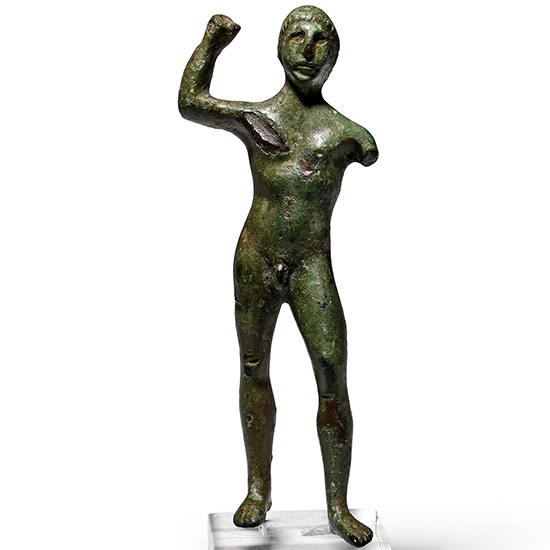
Sabellian Bronze Statuette of Attacking Herakles
8th-4th century B.C.Estimate: £400 - 600 (‡+bp*)
Opening Bid: £205
The nude hero depicted with a slender yet muscular body, the right arm angled and raised, the pierced hand probably once held a club, the left leg thrust forward energetically, lowering the hip line and emphasising the dynamic movement of the composition, the navel indicated by an engraved circular line, the knees marked by vertical incisions; the oval face characterised by eyes represented by triangular depressions, a narrow nose, a wide mouth whose slightly irregularly shaped lips separated by an incision, and a pointed chin; the short, cap-like hair detailed with fine incisions. 146 grams total, 12.6 cm high including stand
Ex Erika (1934-2025) and Jakob (1927-2025) Binkert, Binningen, Switzerland; inherited from Jakob's father, August Binkert-Textor (1896-1979), between 1940-1970, Basel. with Jean-David Cahn AG, Basel, Auction 2, 26 June 2000, no.239B; thence by descent.
Votive bronze from a Sabellian workshop in the typical local style. The Sabelli lived in the Samnium region (southern Apennines), where the cult of Heracles, as in Etruria, was widespread. -
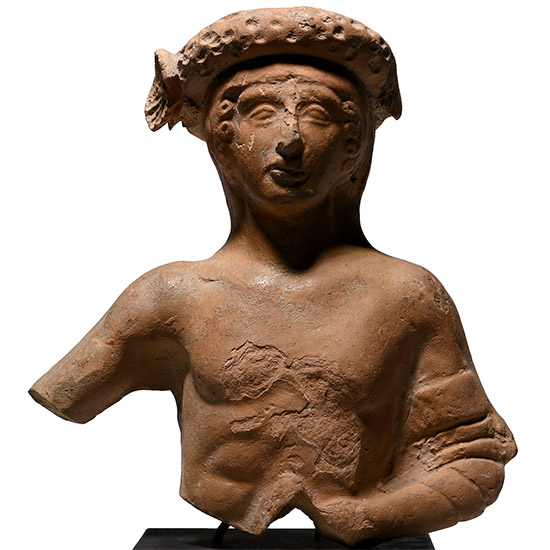
Greek Terracotta Figure of Young Dionysos
5th century B.C.Estimate: £1,200 - 1,700 (‡+bp*)
Opening Bid: £675
Modelled as a hollow torso nude of a youthful male, with a beardless face, full lips, tall nose and almond-shaped eyes; short curly hair with a thick wreath including a rosette, folded fabric draped over the right hand; mounted on a custom-made stand. 327 grams total, 15 cm including stand
Ex Prof. Hans Dahn (1919-2019), Lausanne; acquired 12 March 1954 from Donati in Basel (Dahn's list no.105).
It remains a matter of debate who these clay symposiasts- characterised by their specific, sometimes very imaginative headdresses- represent. They have been variously interpreted as Dionysos, heroised deceased persons or representative images of the urban elite. The type was particularly popular in Taranto. The recumbent man probably held a kantharos in his left hand and wore a coat that was tightly wrapped around his left arm.
