
Loading, please wait...
_900x900.jpg "Phoenician Terracotta Bulla with a Dolphin")
_200x200.jpg "Phoenician Terracotta Bulla with a Dolphin")
.jpg "Phoenician Terracotta Bulla with a Dolphin")
LOT 0576
Phoenician Terracotta Bulla with a Dolphin
5TH CENTURY B.C.
5/8 in. (1.05 grams, 17.71 mm).
Plano-convex in profile with impressed dolphin and legend.
ProvenanceAcquired in 1994.
Private collection, Switzerland, thence by descent.
Private collection, since the late 1990s.
TimeLine Auctions follows a vetting process to ensure the authenticity and legality of all items, reinforcing our commitment to integrity and responsible trading. Each antiquity, antique, and coin lot undergoes thorough examination by a vetting committee of at least ten external specialists, professional trade association members, scientists, and archaeologists: Our Vetting Process
AUCTIONS:
TimeLine is a leading auction house specialising in antiquities, ancient art, collectables, natural history, coins, medals, and books. Our auctions offer museums, collectors, historians, and enthusiasts the opportunity to acquire unique and historically significant pieces.
LOT 0576
Phoenician Terracotta Bulla with a Dolphin
Estimate £150 - 200€170 - 230 (for guidance only)$200 - 270 (for guidance only)
-
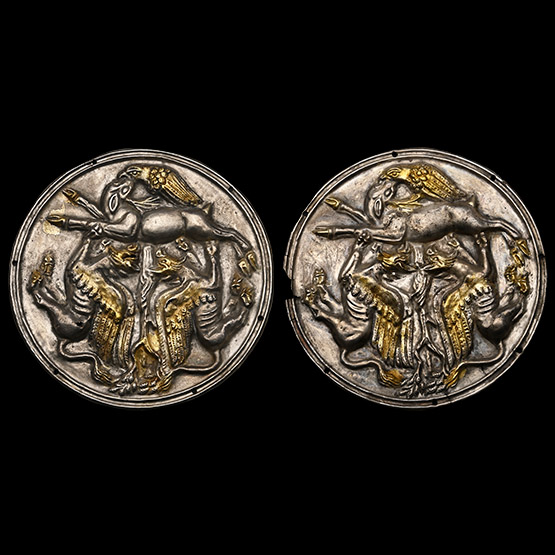
Greek Silver-Gilt Phalerae Depicting a Fight Between Gryphons, an Eagle and a Deer
Hellenistic, 1st century B.C.-1st century A.D.Sold for (Inc. bp): £31,200
A pair of circular horse trappings hammered from sheet-silver, each with a decoration of two gryphons and an eagle slaughtering a deer, the gryphons attacking the deer from below, and the eagle attacking its muzzle, a tree in the background; accompanied by a custom-made display case. 62 grams total, 13.2 cm
Private German collection, 1980s. Accompanied by an expertise from Striptwist Ltd, a London-based company run by historical precious metal specialist Dr Jack Ogden. Accompanied by an academic report by Dr Raffaele D’Amato. This lot has been checked against the Interpol Database of stolen works of art and is accompanied by a search certificate number no.13038-248044.
This phalera comes from the Hellenised East, and was likely used as decoration of the higher part of a horse harness, like the phalerae visible on the armoured and unarmoured horses of the famous graffiti of Dura Europos representing Parthian, Palmyrene or Roman clibanarii (D’Amato-Negin, 2018, pp.11,16-17,26). -
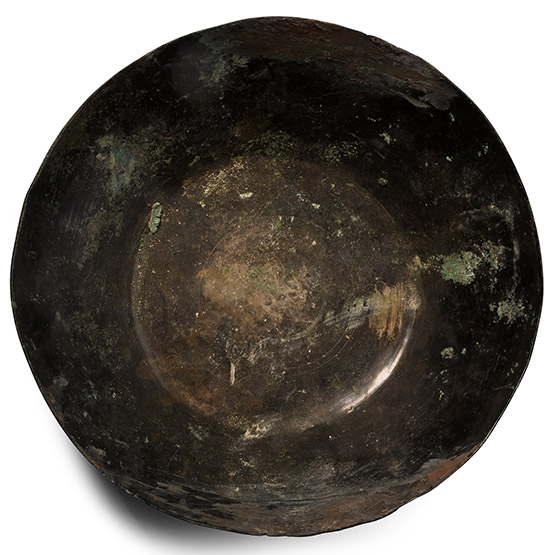
Parthian Bronze Bowl
2nd century B.C.-1st century A.D.Sold for (Inc. bp): £78
Broad and squat with flared sidewall. 153 grams, 17.5 cm
Ex 1990s collection and with a central London gallery. -
.jpg)
Greek Miniature Bronze Hydria
Geometric Period, 8th-6th century B.C.Estimate: £500 - 700 (‡+bp*)
Opening Bid: £250
With a bulbous body, flared foot, lateral loop handles to the shoulder and a strap handle to the rear. 23.5 grams, 37 mm
Acquired by a Swiss family in the mid-1980s to late 1990s, thence by descent. Private collection, Switzerland, since the late 1990s.
