
Loading, please wait...
LOT 0064
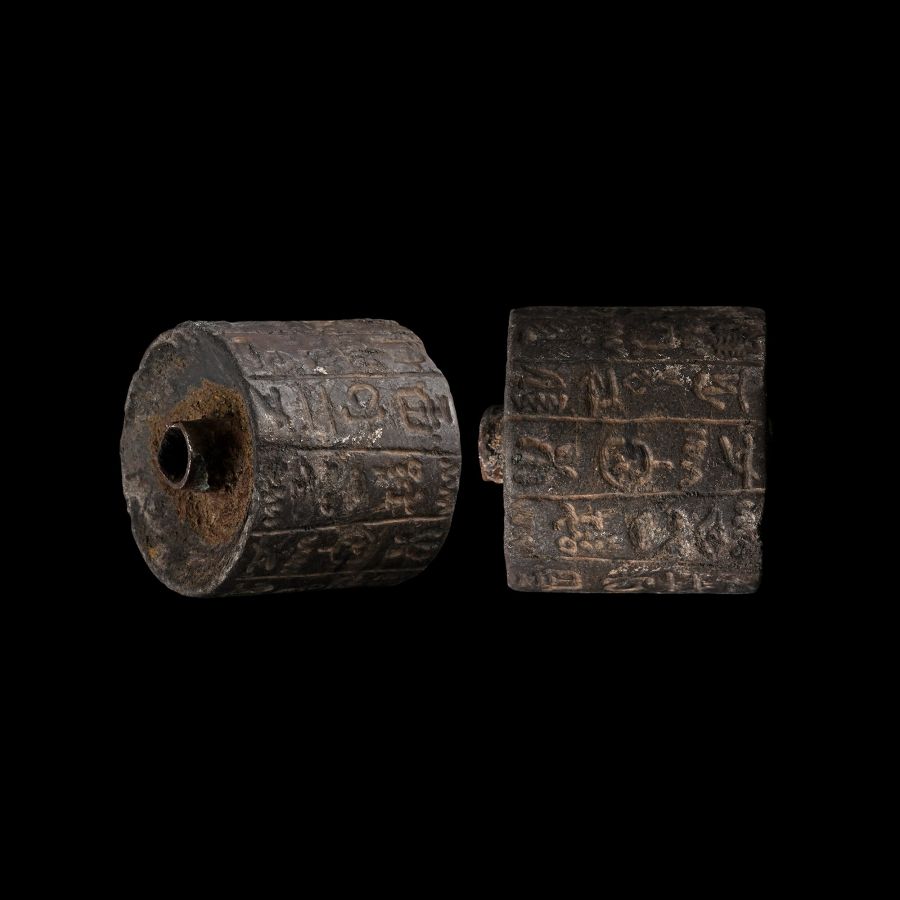
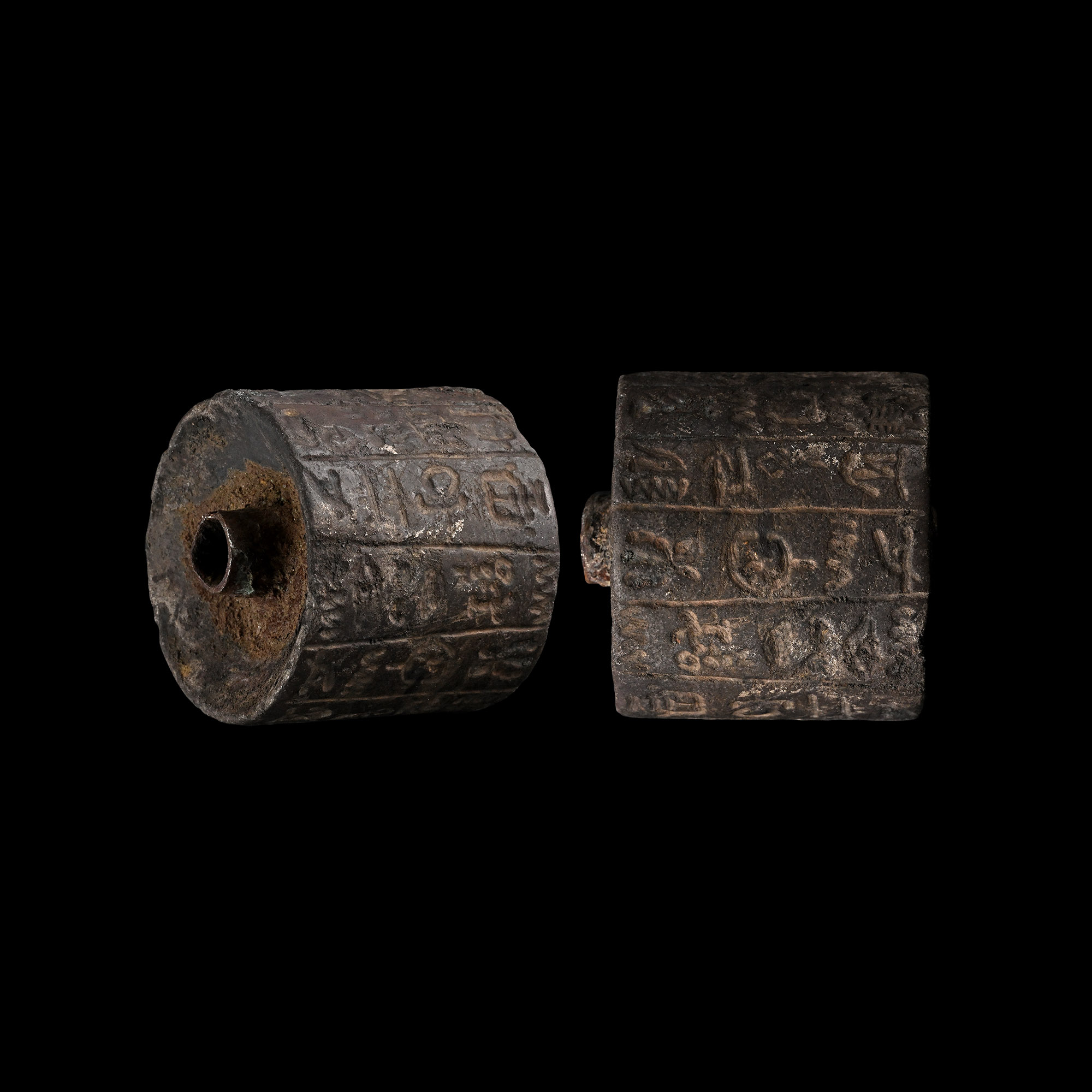
Phoenician Silver Cylinder Seal with Pseudo-Egyptian Hieroglyphs
LEVANT, 1ST MILLENNIUM B.C.
1 5/8 in. (97.8 grams, 40 mm).
Tubular with concave disc ends pierced by a sleeve to accept the axle; outer face divided by longitudinal straight lines, the resultant panels with shapes and symbols reminiscent of hieroglyphs but not interpretable using the Egyptian system.
ProvenanceLondon, UK, art market, 1980s.
Private collection, London, UK.
TimeLine Auctions follows a vetting process to ensure the authenticity and legality of all items, reinforcing our commitment to integrity and responsible trading. Each antiquity, antique, and coin lot undergoes thorough examination by a vetting committee of at least ten external specialists, professional trade association members, scientists, and archaeologists: Our Vetting Process
AUCTIONS:
TimeLine is a leading auction house specialising in antiquities, ancient art, collectables, natural history, coins, medals, and books. Our auctions offer museums, collectors, historians, and enthusiasts the opportunity to acquire unique and historically significant pieces.
LOT 0064
Phoenician Silver Cylinder Seal with Pseudo-Egyptian Hieroglyphs
Sold for (Inc. bp): £520
-
.jpg)
Egyptian Bronze Figure of Khnum, the Creator God
Late Period, 664-332 B.C.Sold for (Inc. bp): £11,700
A substantial figure of the ram-headed god Khnum advancing, wearing a tripartite wig with low central modius drilled for a separately cast headdress and finely pleated kilt, with ram's horns and eyes recessed for inlay, raised left hand, the right arm along the side; mounted on a custom-made stand. 466 grams, 22 cm high (803 grams total, 23.8 cm high including stand)
Bronze H: 19.6 cm, W: 5.4 cm, D: 6.9 cm Condition Surface has been extensively cleaned, in fair condition.
With Stendahl Art Gallery, Los Angeles, by at least circa 1950s, accompanied by an inventory card #39, with a matching number on the original base, and a photograph. Private collection, Hollywood, California, acquired from the above, circa 1950s. Accompanied by a copy of an Art Loss Register certificate, no.S00256888. This lot has been checked against the Interpol Database of stolen works of art and is accompanied by search certificate no. 13240-251804.
The god Khnum (or Khnemu), the 'Moulder', was one of the earliest gods of Egypt, worshipped especially at Philae and Elephantine, both in Nubia. He was thought to have made mankind out of clay on a potter's wheel. It was Khnum who helped Isis to gather the severed fragments of the body of the god Osiris and reassemble them. He was considered the father of the gods, along with Amun-Ra and Ptah. -
.jpg)
Egyptian Bronze Kneeling Figure of a King
Late Period-Ptolemaic Period, circa 664-30 B.C.Estimate: £30,000 - 40,000 (‡+bp*)
Opening Bid: £15,000
A solid cast statuette modelled in the round as a kneeling pharaoh wearing a thigh-length shendyt kilt, a broad collar and a nemes headdress adorned with a uraeus to the brow; with open hands positioned as though they once held an object, palms facing inward; mounted on a custom-made stand. 1.62 kg total, 16.7 cm high including stand
Private collection, E.M. (1880-1954), since the 1930s. Accompanied by an academic report by Egyptologist Paul Whelan. This lot has been checked against the Interpol Database of stolen works of art and is accompanied by search certificate number no.13196-249244.
The figure's overall appearance, particularly the muscular upper body, resembles two kneeling bronze figures – Brooklyn Museum 71.11 and Pennsylvania Museum E.13004 – both bearing the cartouche of 26th Dynasty pharaoh Necho II (610-595 BC). Unlike the varied poses of kneeling stone statues, those in bronze consistently rest on their knees and toes, with heels positioned under their buttocks. Figures with this hand gesture are often thought to have originally held an offering vessel or ritual object. However, none of the existing examples shows signs of having held an object. Instead, the gesture may symbolise both giving and receiving, representing veneration, offering, and a plea for protection to a particular deity. -
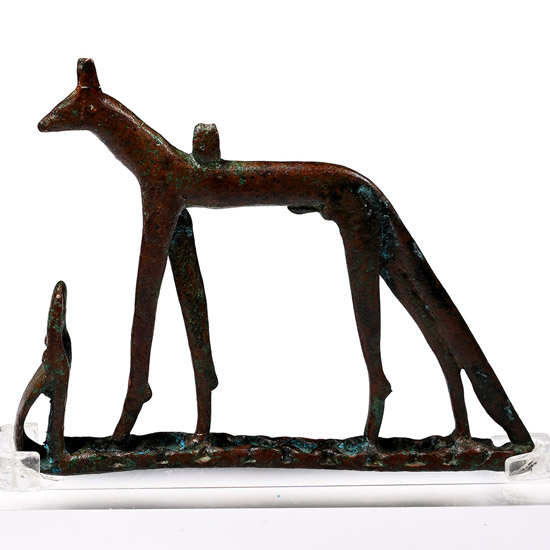
Large Egyptian Bronze Wepwawet Amulet
Third Intermediate-Late Period, 1069-332 B.C.Sold for (Inc. bp): £5,200
Showing the jackal deity Wepwawet standing with ears pricked on a sledge, the slender body modelled with long legs and a tail, suspension loop on the back; two rearing cobras before the jackal; mounted on a custom-made display stand. 54 grams, 91 mm (162 grams total, 11.7 cm including stand )
Ex Dr R. and Mrs L.B., Zumikon, Switzerland. with Galerie Rhéa, Zurich, Switzerland. This lot has been checked against the Interpol Database of stolen works of art and is accompanied by a search certificate number no.12627-236406.
This object may have been the decorative element of a ceremonial standard, examples of which have survived (cf. Petrie, W.M.F., Tanis: Part II / Nebesheh (Am) and Defenneh (Tahpanhes), London, 1886, pl. VII, no. 3). Wepwawet, meaning "Opener of the Ways," was an ancient Egyptian god associated primarily with warfare, protection, and funerary practices. Depicted as a jackal or a man with a jackal's head—often mistaken for Anubis—Wepwawet was believed to guide souls through the afterlife and open paths both in battle and in the spiritual realm. He originated in Asyut (ancient Lycopolis) in Upper Egypt and was one of the oldest deities in the Egyptian pantheon, with worship dating back to at least the First Dynasty (c. 3100–2900 BCE). Over time, Wepwawet became closely linked to Anubis, and the two were sometimes conflated, though Wepwawet retained his distinct identity as a god who preceded and cleared the way. In military contexts, Wepwawet was invoked to "open the way" for pharaohs and armies, ensuring victory and safe passage. In funerary texts, he was described as clearing the path to the afterlife, acting as a scout or guide for the deceased.
