
Loading, please wait...
_900x900.jpg "Phoenician Painted Terracotta Wine Jug")
_200x200.jpg "Phoenician Painted Terracotta Wine Jug")
.jpg "Phoenician Painted Terracotta Wine Jug")
LOT 0492
Phoenician Painted Terracotta Wine Jug
CIRCA 900-800 B.C.
8 1/8 in. (720 grams, 20.6 cm).
With globular body and carinated tubular neck, flared rim to the mouth; loop handle to the shoulder and low basal ring; painted radiating strokes to the shoulder, segmented band to the equator with hatching and other decoration. [No Reserve]
ProvenanceProperty of a British collector, acquired in the 1980s.
From a family collection of a North American gentleman living in the UK.
TimeLine Auctions follows a vetting process to ensure the authenticity and legality of all items, reinforcing our commitment to integrity and responsible trading. Each antiquity, antique, and coin lot undergoes thorough examination by a vetting committee of at least ten external specialists, professional trade association members, scientists, and archaeologists: Our Vetting Process
AUCTIONS:
TimeLine is a leading auction house specialising in antiquities, ancient art, collectables, natural history, coins, medals, and books. Our auctions offer museums, collectors, historians, and enthusiasts the opportunity to acquire unique and historically significant pieces.
-
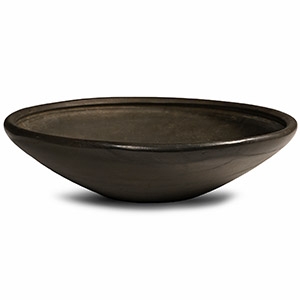
Egyptian Black Stone Lipped Bowl
2nd-3rd Dynasty, 2860-2640 B.C.Sold for (Inc. bp): £2,860
Shallow and broad in profile with carinated rim. 627 grams, 20 cm
From the private collection of Mr K.A., acquired in the 1990s-early 2000s. This lot has been checked against the Interpol Database of stolen works of art and is accompanied by a search certificate number no.12367-225768.
Stone vessels, made from various styles and types of stone, were commonly found in Early Dynastic and Old Kingdom tombs as funerary equipment. One of the most significant discoveries was the recovery of over 30,000 stone vessels in King Djoser's Step Pyramid complex. -
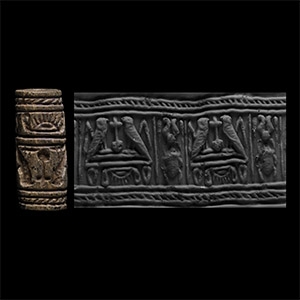
Egyptian Cylinder Seal with Hieroglyphs
Late Period, 664-332 B.C.Sold for (Inc. bp): £390
Steatite cylinder producing a decorative top and bottom border enclosing a scene depicting a nefer sign flanked by two falcons surmounting the hieroglyph for gold, nub, and another scene to the side depicting a scarab beetle with a double plumed sun disc above; with a suspension hole running through the cylinder's centre. 4.65 grams, 25 mm
From the collection of a gentleman, acquired on the London art market in the 1990s. -
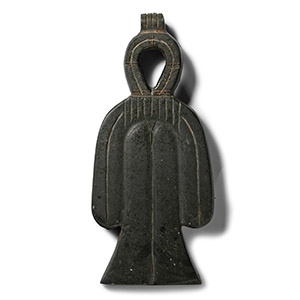
Egyptian Stone Tyet Amulet
Third Intermediate Period-Late Period, circa 743-332 B.C.Estimate: £1,500 - 2,000 (‡+bp*)
Opening Bid: £750
Finely carved tyet amulet with incised internal detailing and ribbed suspension loop at the top. 38.9 grams, 81 mm
Acquired in the mid 1980s-1990s. Private collection, Switzerland, thence by descent. Private collection, since the late 1990s.
The tyet amulet was associated with the goddess Isis and was often referred to as the 'knot' or 'girdle' of Isis. Some believe that it represents a bandage used to absorb menstrual blood. It was commonly placed within the mummy wrappings on the upper torso of the deceased, with the belief that it would invoke Isis' protection and safeguard the body, thus ensuring their rebirth in the afterlife.
