
Loading, please wait...


LOT 0432
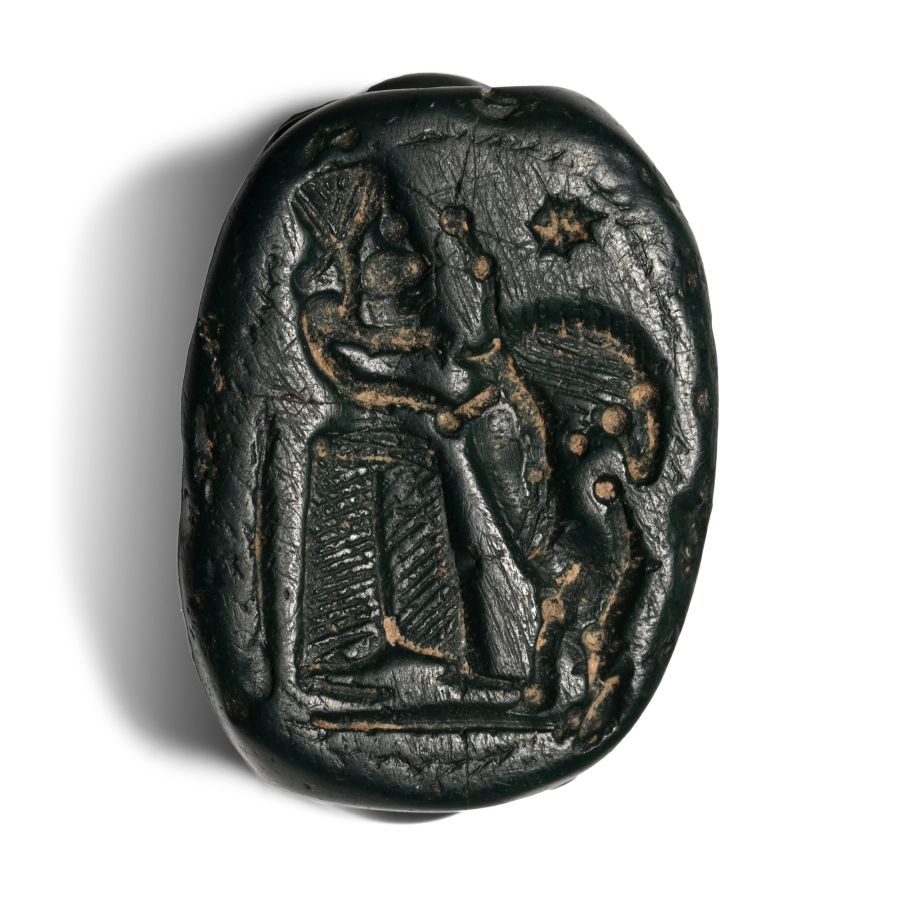
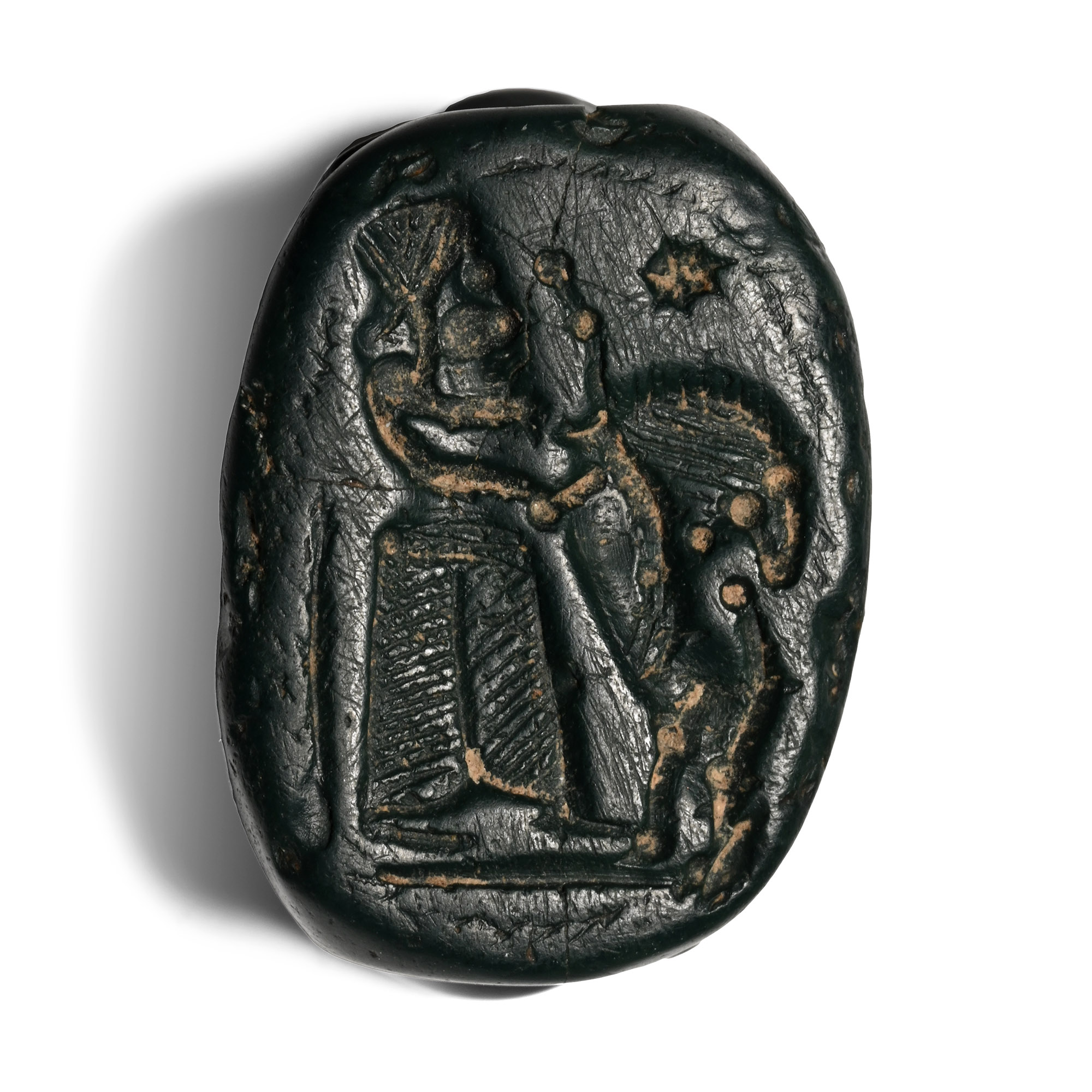
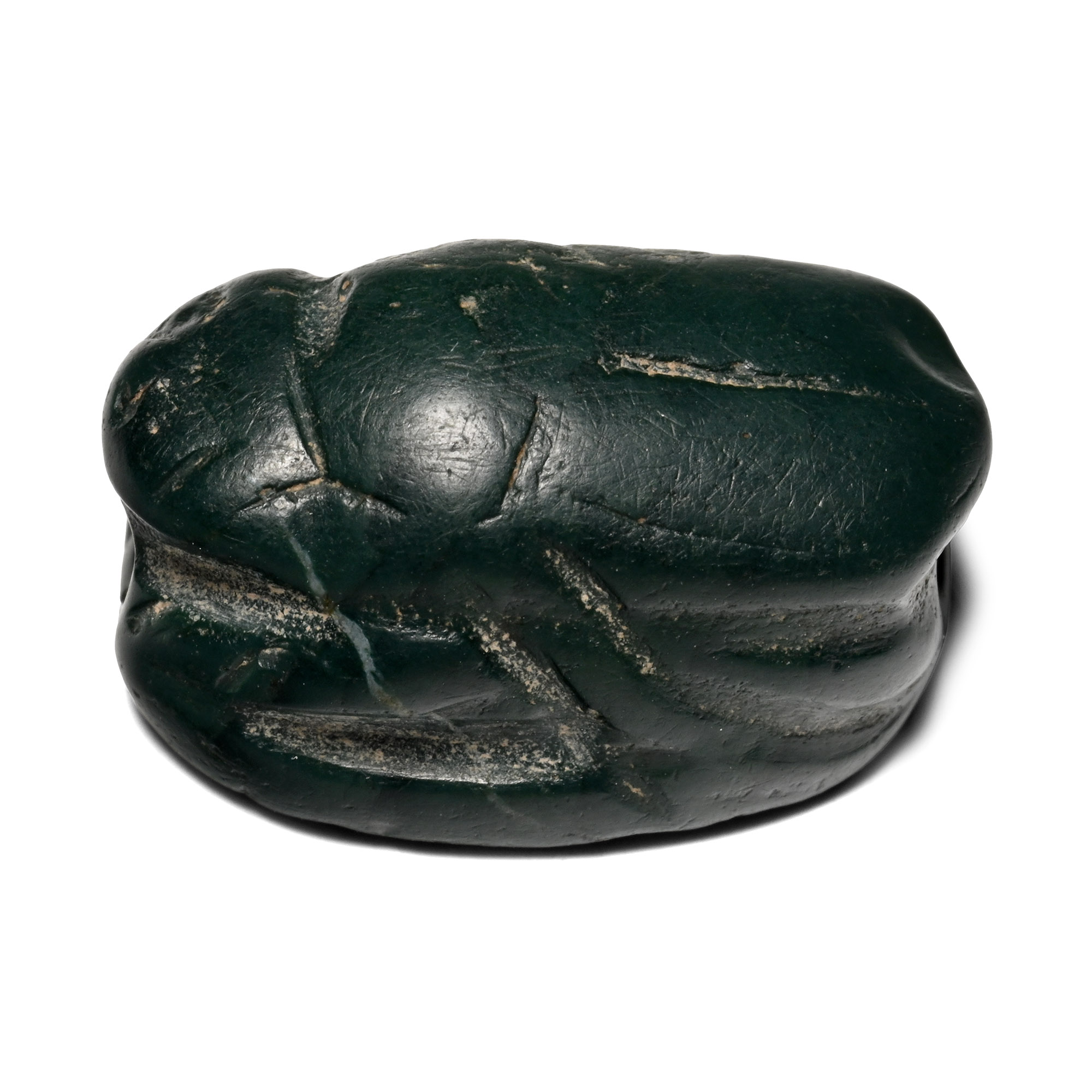
Phoenician Green Stone Scarab with Man Fighting Lion
5TH-4TH CENTURY B.C.
3/4 in. (2.63 grams, 18 mm).
Modelled with incised detailing, pierced longitudinally, the underside with a bearded king in Assyrian attire, wearing a long, striated garment and tall headdress, grasping the forelegs of a rearing lion, its head turned back, a star above.
ProvenancePrivate collection, 1990s-early 2000s.
LiteratureCf. Hölbl, G., Ägyptisches Kulturgut im phönizischen und punischen Sardinien I, Leiden, 1986, p. 302 and pl. 156, for a naturalistically carved green jasper Egyptianising scarab with an Assyrian king grasping an enemy depicted on the underside, discovered in Tharros, Sardinia.
FootnotesThe motif of the Egyptian king overcoming an enemy, whether human or animal, is well attested in the New Kingdom and was later adopted by non-Egyptian artisans for scarabs and seals.
CONDITIONTimeLine Auctions follows a vetting process to ensure the authenticity and legality of all items, reinforcing our commitment to integrity and responsible trading. Each antiquity, antique, and coin lot undergoes thorough examination by a vetting committee of at least ten external specialists, professional trade association members, scientists, and archaeologists: Our Vetting Process
AUCTIONS:
TimeLine is a leading auction house specialising in antiquities, ancient art, collectables, natural history, coins, medals, and books. Our auctions offer museums, collectors, historians, and enthusiasts the opportunity to acquire unique and historically significant pieces.
-
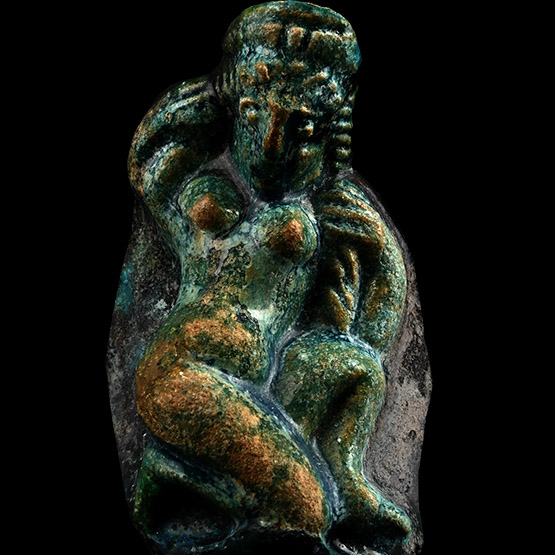
Egyptian Applique with Aphrodite
Ptolemaic Period, 332-30 B.C.Estimate: £350 - 450 (‡+bp*)
Opening Bid: £190
Fragment from a representation of the nude Aphrodite in high-relief, crouching with her left knee raised and her right knee touching the ground, holding her long hair with her hands and wearing a diadem on her head; an appliqué from a vessel with minor filling at the right thigh. 85 grams, 86 mm
Private collection, Somerset, England. with M.B., Los Angeles County, acquired 2014-2015 at a sale in the UK. with Ancient Resource, USA, Auction 70, 06 October 2018, no.7. This lot has been checked against the Interpol Database of stolen works of art and is accompanied by a search certificate number no.12827-240895. -
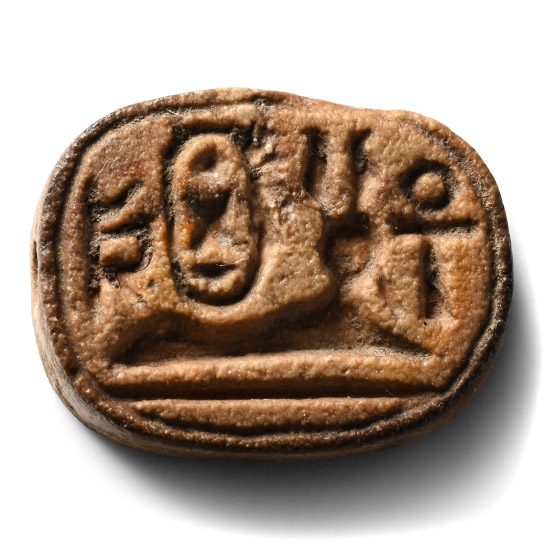
Egyptian Steatite Bifacial Scaraboid Seal
Late Period, 664-332 B.C.Sold for (Inc. bp): £217
An oval plaque pierced longitudinally, one side with a reclining lion, the other with hieroglyphs. 1.92 grams, 18 mm
From the private collection of a European gentleman (1942-2024), formed since the 1970s. -
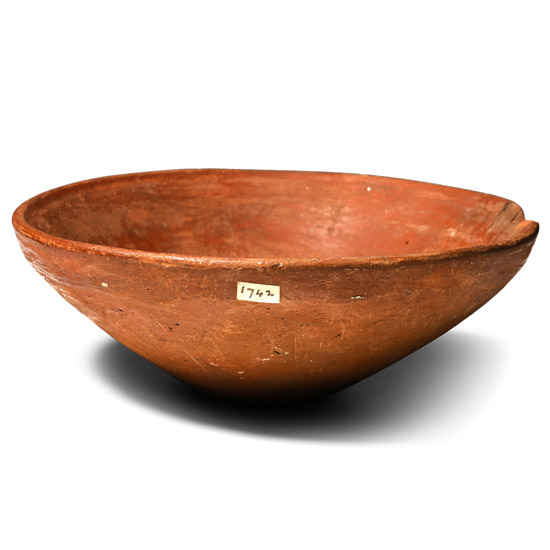
Egyptian Terracotta Bowl
Predynastic Period, 4th millennium B.C.Sold for (Inc. bp): £442
Conical in profile with narrow foot; old collector's notation to underside: 'Found by Petrie location Ballas and Naqada in 1895'. 375 grams, 15.5 cm wide
From the collection of David Donlan (1947-2025), a dedicated and lifelong collector with a passion for the ancient world and the natural sciences, forming his collection from 1960s onwards, using many reputable dealers across the United Kingdom, including the well-regarded Coincraft and The Parthenon Gallery.
Naqada (ancient Nubt) is situated on the west bank of the Nile, and is the type-site for the Predynastic period (Naqada I–III). It was a major centre of trade, craft production, and the process of unifying Egypt. Ballas is situated on the east bank opposite Naqada, and contains important Predynastic and Early Dynastic cemeteries excavated extensively by Flinders Petrie and James Quibell in conjunction with their work at Naqada. Their report was published in 1895.
