
Loading, please wait...
LOT 0551
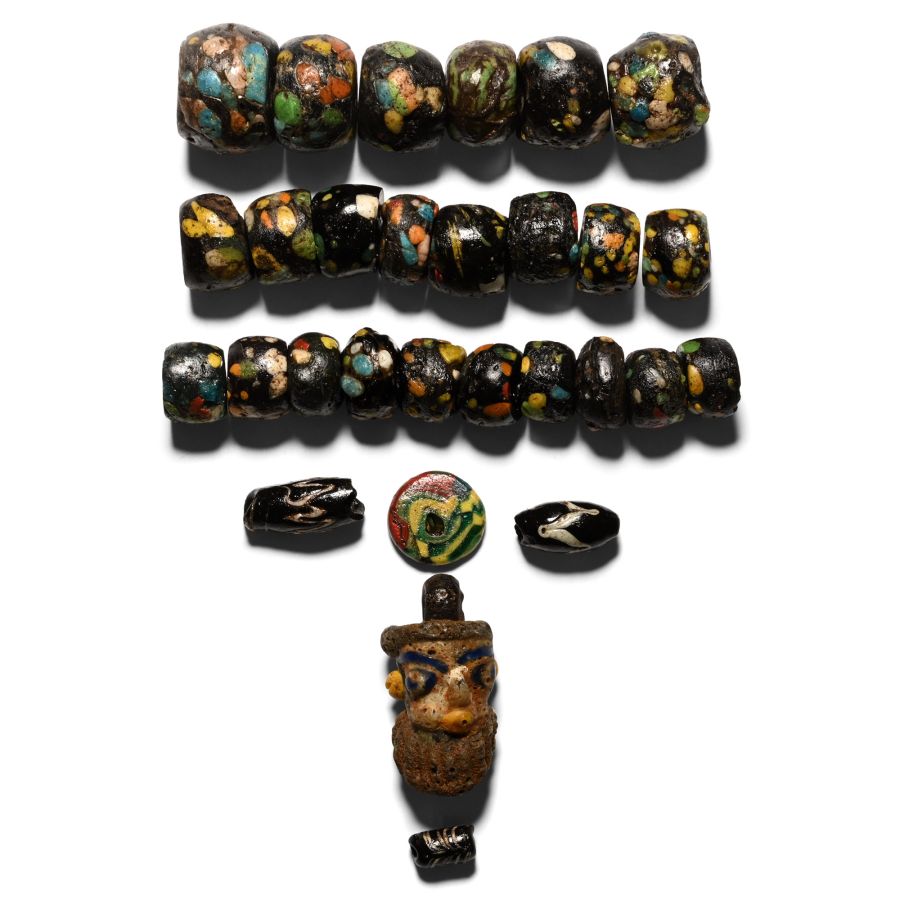
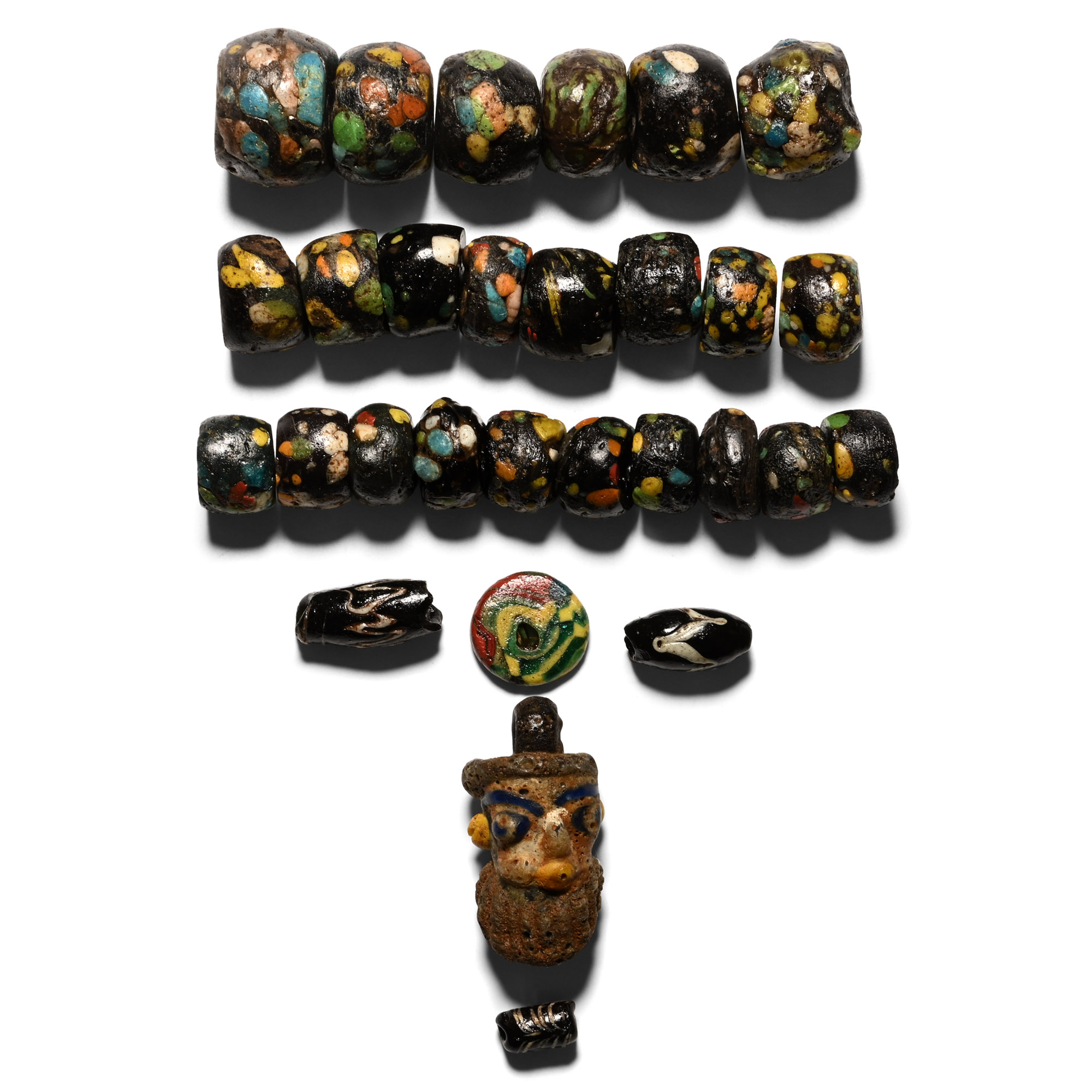
Phoenician Glass Bead Collection
6TH-3RD CENTURY B.C. OR LATER
1/2 - 1 5/8 in. (179 grams total, 12-42 mm).
Comprising a group of crumb-decorated polychrome oblate beads and a centrepiece pendant formed as a stylised bearded head. [29]
ProvenanceFrom the collection of a gentleman, acquired on the London art market in the 1990s.
This lot is accompanied by an illustrated lot declaration signed by the Head of the Antiquities Department, Dr Raffaele D'Amato.
Cf. Lightfoot, C. S., The Cesnola Collection of Cypriot Art: Ancient Glass, New York, 2017, pp. 310-328, for discussion and examples of Phoenician glass beads.
FootnotesThe Phoenicians, renowned seafarers and traders, were also skilled glassworkers. They produced a wide variety of glass beads using core-forming and winding techniques, with vivid colours and elaborate designs that reflect both technical mastery and cross-cultural influence. Among the most iconic Phoenician beads are glass 'head' beads, crafted in the form of stylised human or mythological faces. Typically, they feature exaggerated facial details like bulging eyes, large noses, beards, and headdresses, often with expressive or comic features.
They were possibly worn as amulets to ward off evil or attract protection, though they may also represent deities, ancestors, or foreigners.
These beads often incorporate Egyptian, Greek, and Near Eastern stylistic elements, reflecting the Phoenicians’ extensive trade networks.
TimeLine Auctions follows a vetting process to ensure the authenticity and legality of all items, reinforcing our commitment to integrity and responsible trading. Each antiquity, antique, and coin lot undergoes thorough examination by a vetting committee of at least ten external specialists, professional trade association members, scientists, and archaeologists: Our Vetting Process
AUCTIONS:
TimeLine is a leading auction house specialising in antiquities, ancient art, collectables, natural history, coins, medals, and books. Our auctions offer museums, collectors, historians, and enthusiasts the opportunity to acquire unique and historically significant pieces.
LOT 0551
Phoenician Glass Bead Collection
Estimate £1,000 - 1,400€1,160 - 1,620 (for guidance only)$1,350 - 1,890 (for guidance only)
-
Egyptian Hardstone Eye of Horus with Recumbent Lion
Late Period, 664-332 B.C.Estimate: £300 - 400 (+bp*)
Opening Bid: £150
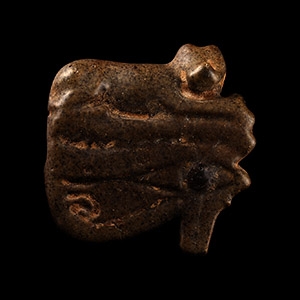
Wedjat-eye amulet with reclining lioness to the top, pierced for suspension. 6.79 grams, 29 mm
From an early 20th century collection. Ex London, UK, gallery. This lot is accompanied by an illustrated lot declaration signed by the Head of the Antiquities Department, Dr Raffaele D'Amato.
The wedjat-eye and lioness are potent, often intertwined symbols in ancient Egyptian mythology. The wedjat, representing Horus’s healed eye, signifies protection and healing, while the lioness—linked to the goddesses Sekhmet, Bastet, and Wadjet—embodies power and fierce defence as the “Eye of Ra”. Together in amulets, as in Egyptian art, they convey healing, protection, and strength. Sometimes the name of a specific goddess was inscribed on the back of the amulet, though here the recumbent lioness serves as the divine symbol. -
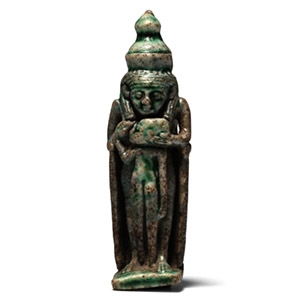
Egyptian Green Glazed Steatite Syncretic Amulet of Mut
Third Intermediate Period, circa 1069-735 B.C.Estimate: £2,000 - 3,000 (+bp*)
Opening Bid: £1,000
Modelled in the round, formed as the goddess standing before a high-backed throne cradling the head of a standing naked child to her chest; the goddess with tiered double-crown and tripartite wig; throne with low-relief figure of the lioness-headed goddess Sekhmet to the rear with spread wings forming the arms of the chair. 22.6 grams, 61 mm
with Jean-Phillipe Mariaud de Serres, Paris, France. Private collection, London, UK, acquired from the above in 1992. This lot has been checked against the Interpol Database of stolen works of art and is accompanied by a search certificate number no.12633-235083. This lot has been cleared against the Art Loss Register database, and is accompanied by an illustrated lot declaration signed by the Head of the Antiquities Department, Dr Raffaele D'Amato.
Mut was a prominent mother goddess in ancient Egyptian religion, associated with creation, motherhood, and the sky. She was the consort of the god Amun and the mother of Khonsu, forming the Theban triad with them in Thebes. Mut's name ("mother" in ancient Egyptian), reflects her role as a divine mother and patroness of motherhood. Sekhmet was revered as a powerful and fierce protector. Her presence was believed to ward off evil and safeguard the people from harm. In ancient Egyptian mythology, Sekhmet was also a manifestation of Hathor, another powerful birth goddess. -
.jpg)
Egyptian Amarna Sandstone Relief Fragment
New Kingdom, 18th Dynasty, 14th century B.C.Sold for (Inc. bp): £15,600
Rectangular in plan with irregular left and lower edge; carved in low-relief in two registers with narrow border; lower register - plain with cream-white pigment; upper register – a combat or possibly post battle or tribute scene depicting two profile male heads with stern features, lentoid eye, strong mouth and chin, wearing brow-bands, probably Western Asiatics; with the leg of a kneeling(?) figure to the right; the reverse dressed but undecorated; two modern mounting holes to the long edge. 5.11 kg, 33 cm
Private collection, 1980s. Private European collection, 2008. This lot has been checked against the Interpol Database of stolen works of art and is accompanied by a search certificate number no.12853-241665. This lot has been cleared against the Art Loss Register database, and is accompanied by an illustrated lot declaration signed by the Head of the Antiquities Department, Dr Raffaele D'Amato.
Scenes of captured enemies and especially foreign envoys in audience with the pharaoh depict figures in various humiliating, supplicatory poses, including prostration and kneeling.
