Loading, please wait...
LOT 0434
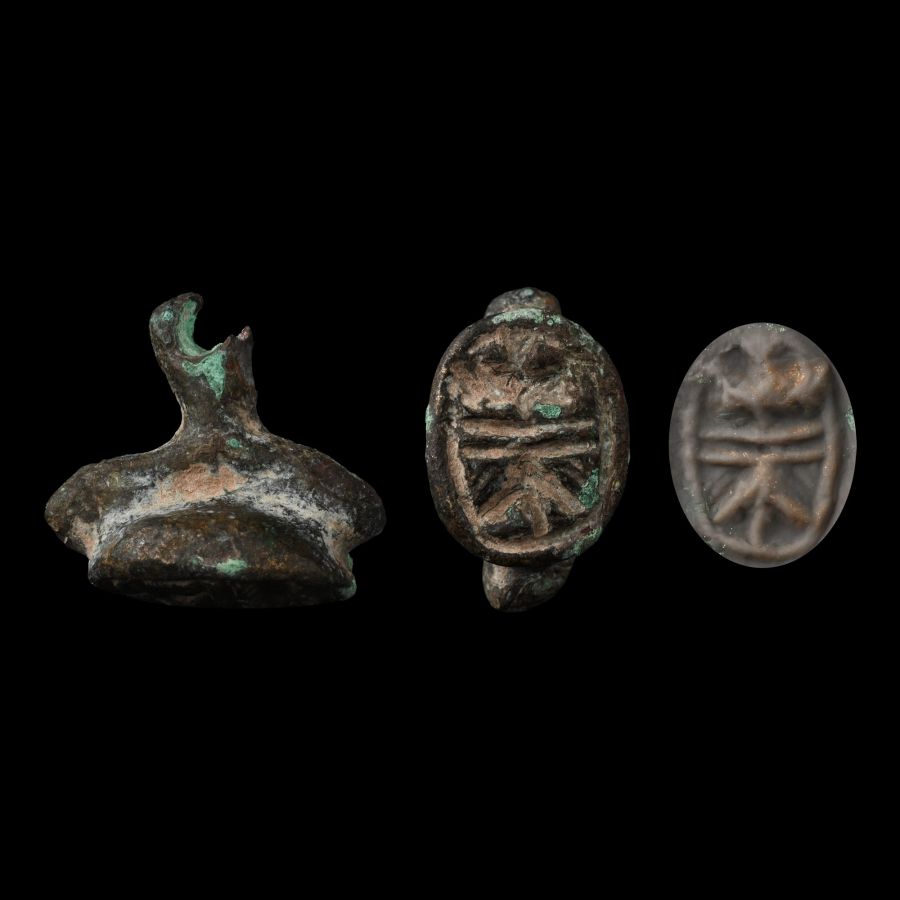
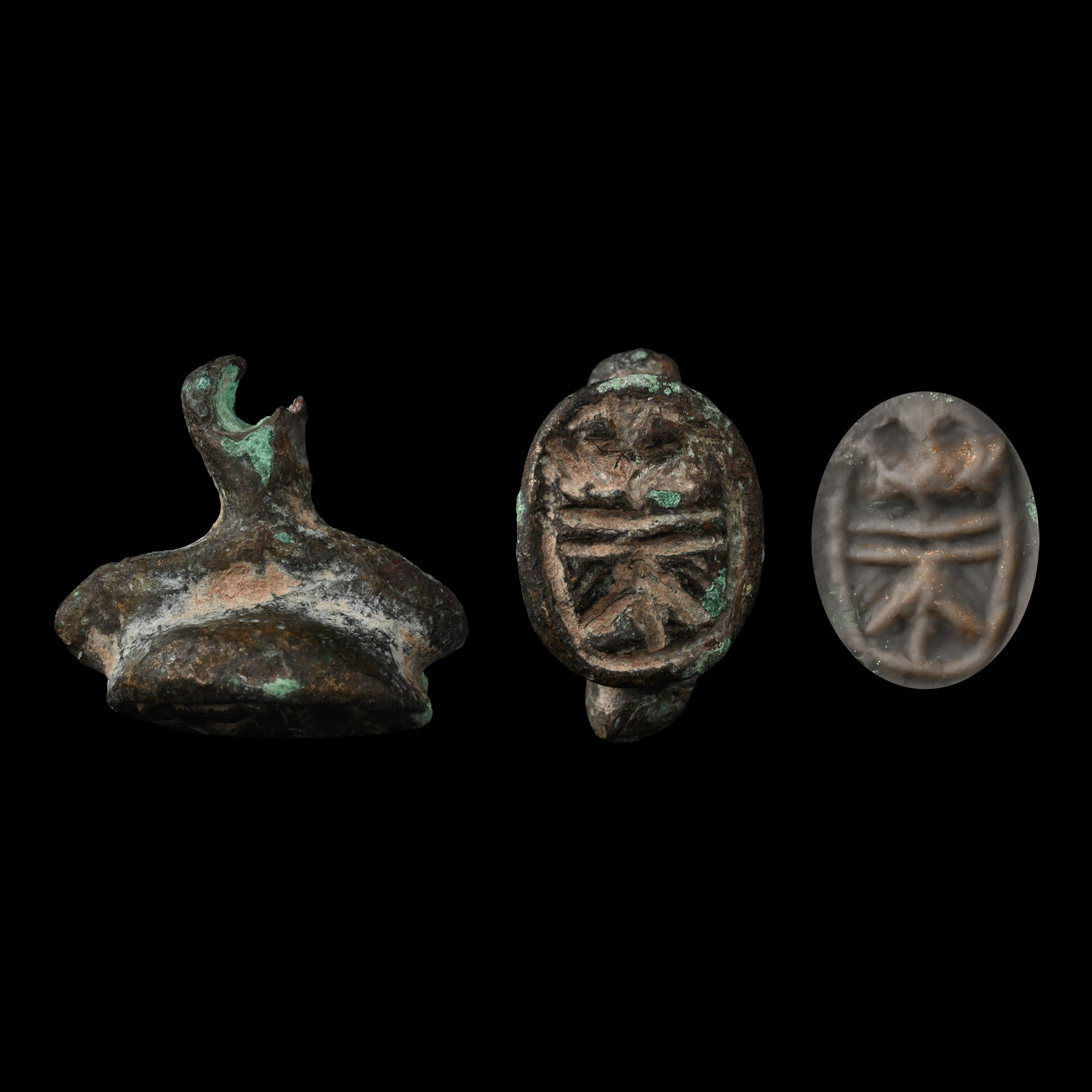
Phoenician Bronze Scaraboid Stamp Seal
6TH-4TH CENTURY B.C.
5/8 in. (4.67 grams, 16 mm).
With wire carrier loop and intaglio geometric motif to underside. [No Reserve]
ProvenanceEx London, UK, gentleman 1980-1990s.
This lot is accompanied by an illustrated lot declaration signed by the Head of the Antiquities Department, Dr Raffaele D'Amato.
TimeLine Auctions follows a vetting process to ensure the authenticity and legality of all items, reinforcing our commitment to integrity and responsible trading. Each antiquity, antique, and coin lot undergoes thorough examination by a vetting committee of at least ten external specialists, professional trade association members, scientists, and archaeologists: Our Vetting Process
AUCTIONS:
TimeLine is a leading auction house specialising in antiquities, ancient art, collectables, natural history, coins, medals, and books. Our auctions offer museums, collectors, historians, and enthusiasts the opportunity to acquire unique and historically significant pieces.
-
Large Egyptian Steatite Scarab
Late Period, 664-332 B.C.Sold for (Inc. bp): £520
Modelled body of a beetle with detailed carapace and legs; underside with two crocodiles enclosing a central sun disc flanked by two papyrus clumps atop neb signs. 19.8 grams, 38 mm
From the collection of a gentleman, acquired on the London art market in the 1990s. This lot is accompanied by an illustrated lot declaration signed by the Head of the Antiquities Department, Dr Raffaele D'Amato.
The design could be interpreted as ‘Sobek-Ra, lord of the Delta’. Sobek was mainly associated with water, fertility, and the Nile, as well as strength and military prowess. His worship spans much of ancient Egyptian history, from at least the Old Kingdom to the Roman period, and he was honoured not only as a force of nature but also as a god of healing, protection, and royal authority. He was associated with various other deities, most often with the sun god in the form of Sobek-Ra. His primary cult centres were situated in the Faiyum region, especially in the city of Crocodilopolis, and also at Kom Ombo in Upper Egypt. -
Egyptian Granite Seated Figure
Late Period, 664-332 B.C.Estimate: £3,500 - 4,500 (‡+bp*)
Opening Bid: £1,889
Fragment of a statue of an official, comprising the torso and legs clad in an ankle-length robe and seated on a rectangular-section seat with stepped base and short, curved backrest and rear dorsal pillar; the left hand carved with the palm resting along the thigh; the right hand similarly placed but with the hand gripping a folded piece of cloth of which the ends are draped over the lower thigh above the knee; traces of an old label to reverse. 4.1 kg, 18.7 cm
Private collection, Europe. with Bonhams & Brooks, 8th November 2001, no.265. Private collection, Europe. Accompanied by copies of the relevant Bonhams & Brooks catalogue pages. This lot has been checked against the Interpol Database of stolen works of art and is accompanied by a search certificate number no.12584-232097. This lot has been cleared against the Art Loss Register database, and is accompanied by an illustrated lot declaration signed by the Head of the Antiquities Department, Dr Raffaele D'Amato.
The official would have been shown wearing a longer cloak-like garment rather than a waist-height kilt, as the line of the folded edge is visible above where a waistband would typically be. -
Egyptian Limestone Bas-Relief Panel of Ptah Presiding Over the Smelting of Metals
Old Kingdom, 5th Dynasty, 2498-2345 B.C.Estimate: £80,000 - 100,000 (+bp*)
Opening Bid: £40,000
This expertly carved high-relief scene depicts three male figures with short hairstyles, each wearing a short kilt tied at the waist; the left and central figures carry a small furnace by curved handles, preparing to smelt copper; the central figure also holds a metal poker in his free hand; the figure on the left supports a large container at chest level with one hand; finely rendered hieroglyphic inscriptions in front of each figure record a dialogue among the three metalworkers; the leftmost figure, facing the others, declares “Ptah could not have done better”; the central figure responds with three lines of text “Ptah loves him to pour (into) the brazier of the flame”; the inscription before the rightmost figure reads “copper of the baskets”; together, the second and third texts may be interpreted as “Ptah would love him to pour copper from the baskets into the furnace”; the composition likely formed part of a larger scene illustrating metalworking activities; supplied with a custom-made stand. 21.35 kg total, 53.5 cm wide including stand
with Toufic Arakji, Hamburg, by circa 1980. Private collection, acquired from the above, circa 1980-1994. with Sotheby’s, New York, Antiquities and Islamic Art, 8 June 1994, no.23. Private collection, 1994-2010, acquired at the above sale. with David Aaron, London, UK, 2010-2011. with Daniel Katz Gallery, London, UK. UK private collection. Accompanied by an academic report by Egyptologist Sylvie Caroff. Accompanied by a copy of an Art Loss Register certificate no.S00142449. This lot has been cleared against the Art Loss Register database, and is accompanied by an illustrated lot declaration signed by the Head of the Antiquities Department, Dr Raffaele D'Amato.
The mention of Ptah – patron god of craftsmen – links this piece to Memphis, suggesting it came from the tomb of a high-ranking official or priest.