
Loading, please wait...

LOT 0437
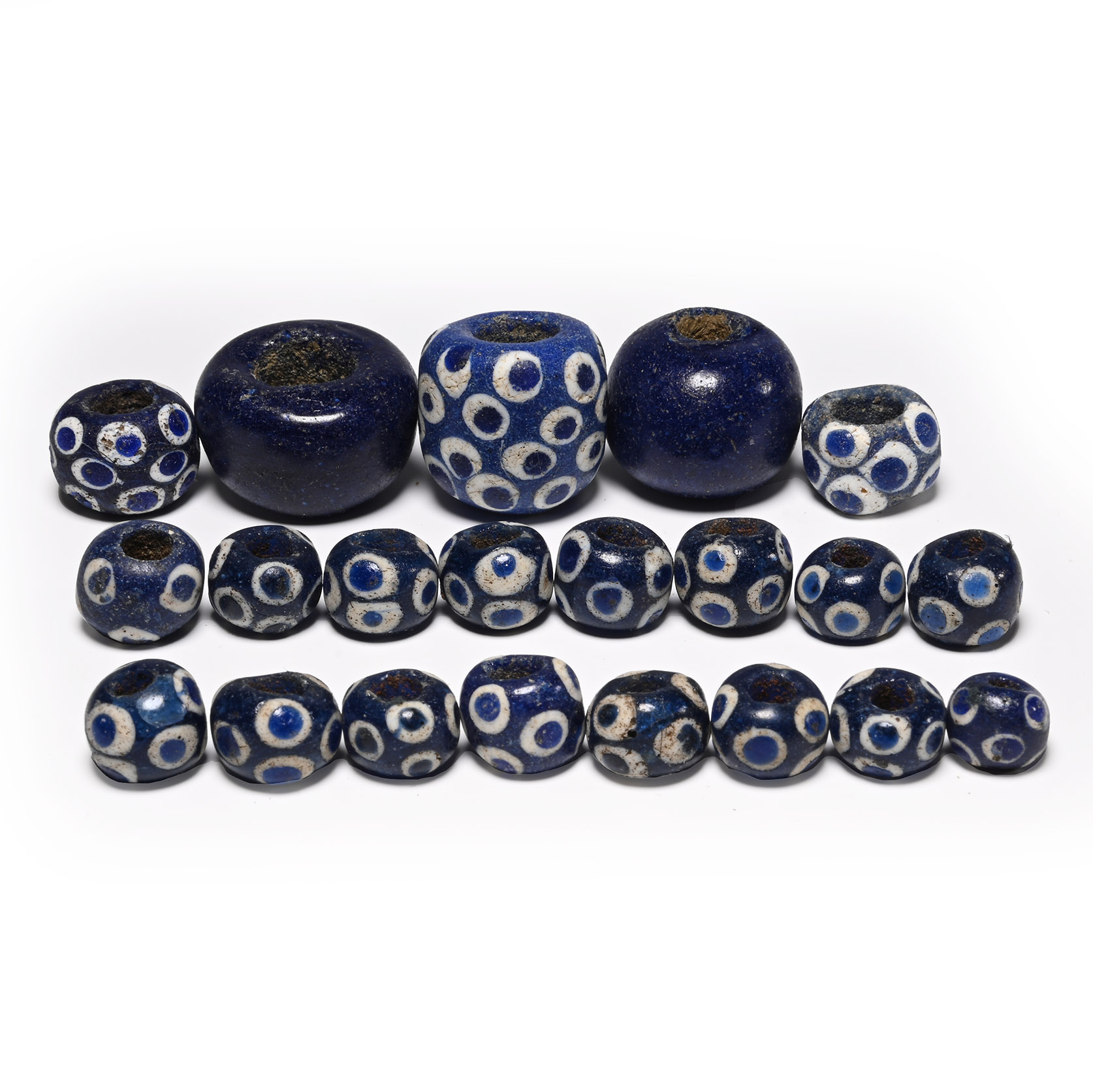
Phoenician Blue Glass Bead Group
6TH-3RD CENTURY B.C. OR LATER
3/8 - 1 in. (65 grams total, 10-25 mm).
Including drum-shaped types with marvered eye-motifs. [21, No Reserve]
ProvenanceUK gallery, early 2000s.
This lot is accompanied by an illustrated lot declaration signed by the Head of the Antiquities Department, Dr Raffaele D’Amato.
Cf. Costa, M., Barrulas, P., Arruda, A.M., Dias, L., Barbosa, R., Vandenabeele, P., Mirao, J., ‘An insight into the provenance of the Phoenician-Punic glass beads of the necropolis of Vinha das Calicas (Beja, Portugal)’ in Archaeological and Anthropological Sciences, (2021) 13, 149, pp.1-17, fig.2, nos.44, 75, for nearly identical beads.
FootnotesThe category belongs to the cylindrical turquoise eye beads with dark blue and white decorations. Pre-Roman glass beads of this type, generally dated to the Iron Age (end of the ninth century B.C. to 218 B.C.), have been found in significant amounts in the Iberian Peninsula and the Balearic Islands, especially in Phoenician and Punic burial contexts.
CONDITIONTimeLine Auctions follows a vetting process to ensure the authenticity and legality of all items, reinforcing our commitment to integrity and responsible trading. Each antiquity, antique, and coin lot undergoes thorough examination by a vetting committee of at least ten external specialists, professional trade association members, scientists, and archaeologists: Our Vetting Process
AUCTIONS:
TimeLine is a leading auction house specialising in antiquities, ancient art, collectables, natural history, coins, medals, and books. Our auctions offer museums, collectors, historians, and enthusiasts the opportunity to acquire unique and historically significant pieces.
-
Coptic Textile Fragment Collection
4th-6th century A.D.Sold for (Inc. bp): £494
Mixed group, mainly decorative elements (clavi, orbiculi, tabulae) from various tunics made in late Antiquity; decoration partly figural (animals and mythical hybrid creatures, mostly in a separate tondo or panel) and partly ornamental (interlace patterns, lozenges, pomegranate borders, chevrons, heart-shaped leaves). 450 grams total, 12.5-65.5 cm
with Christie's London, 27 April 1976, no.91 & 92. Accompanied by a copy of an Art Loss Register certificate no.S00136676. This lot is accompanied by an illustrated lot declaration signed by the Head of the Antiquities Department, Dr Raffaele D’Amato. -
Phoenician Stone Scaraboid Seal
Levant, circa 10th century B.C.Estimate: £400 - 600 (+bp*)
Opening Bid: £200
Engraved stylised detailing to the domed carapace, the underside with quadrupeds and caterpillars in exergue; pierced longitudinally; accompanied by a museum-quality impression. 3.35 grams, 18 mm
From the 'S' collection, acquired 1970-1990s. The collection was seen and studied by W.G. Lambert, late Professor of Assyriology at the University of Birmingham, 1970-1993. Accompanied by a copy of a report from Peter Gert Van der Veen, senior lecturer of Levantine Archaeology Johannes Gutenberg-Universität Mainz. This lot is accompanied by an illustrated lot declaration signed by the Head of the Antiquities Department, Dr Raffaele D’Amato. -
.jpg)
Egyptian Limestone Relief with the Figure of the God Hapi
Late-Ptolemaic Period, circa 664-30 B.C.Sold for (Inc. bp): £3,640
A relief depicting the upper half of the Nile divinity facing right, sporting a slender beard with curved end, wearing a tripartite wig surmounted by a floral crown in the form of a clump of papyrus with bent buds, and an elaborate multi-strand beaded broad collar; the pendulous breast characteristic of this type of figure; with both upper arms angled right towards traces of a libation vase and possible stem of a lotus flower; traces of a vertical register line behind the figure’s head; mounted on a custom-made display stand. 10.85 kg total, 38.5 cm high including stand
From the estate of the late designer Anthony Powell (1935-2021). This lot has been checked against the Interpol Database of stolen works of art and is accompanied by search certificate no.12497-230640. This lot has been cleared against the Art Loss Register database, and is accompanied by an illustrated lot declaration signed by the Head of the Antiquities Department, Dr Raffaele D’Amato.
Representations of fecundity figures can be traced from the Old Kingdom through to the Roman Period. These figures serve as divine embodiments of Egypt’s fertile productivity and are commonly depicted in series on the lower registers of temple walls, symbolising the fertility of each province. Historically, they have often been mistakenly referred to as the ‘Nile God’; however, the term Hapi, which sometimes identifies these figures, actually refers to the inundation rather than the River Nile itself, highlighting the source of Egypt’s fertility.
