
Loading, please wait...
_900x900.jpg "Phoenician Amethyst Scarab")
_200x200.jpg "Phoenician Amethyst Scarab")
.jpg "Phoenician Amethyst Scarab")
LOT 0022
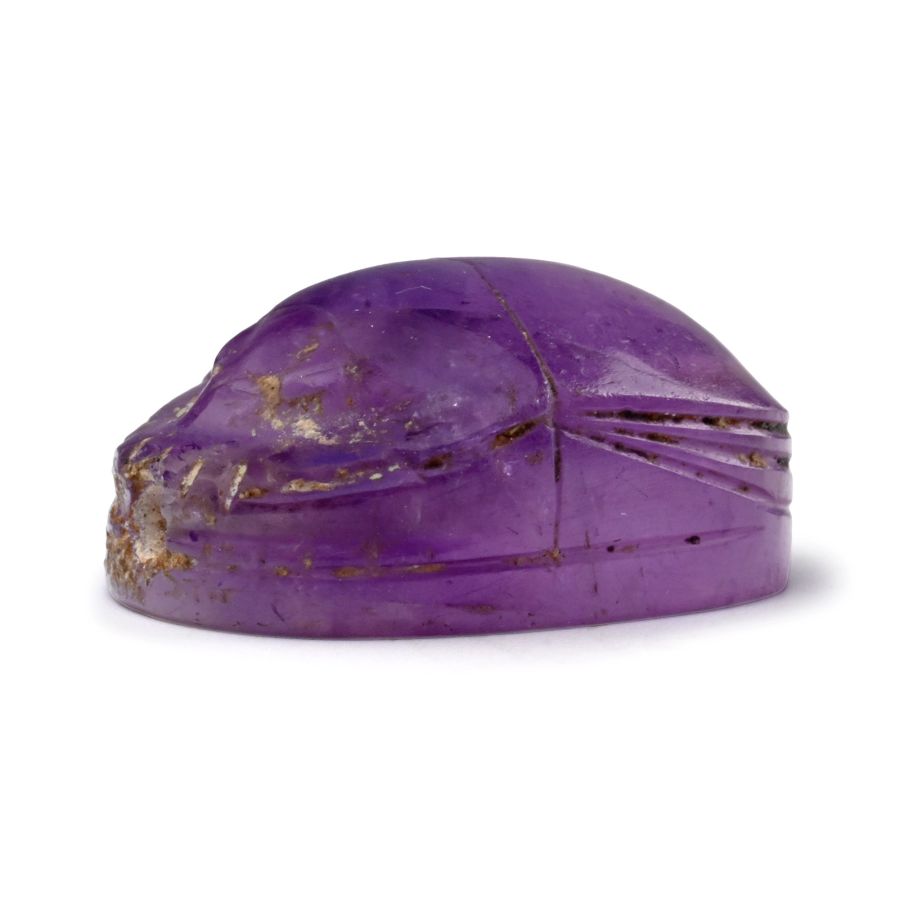
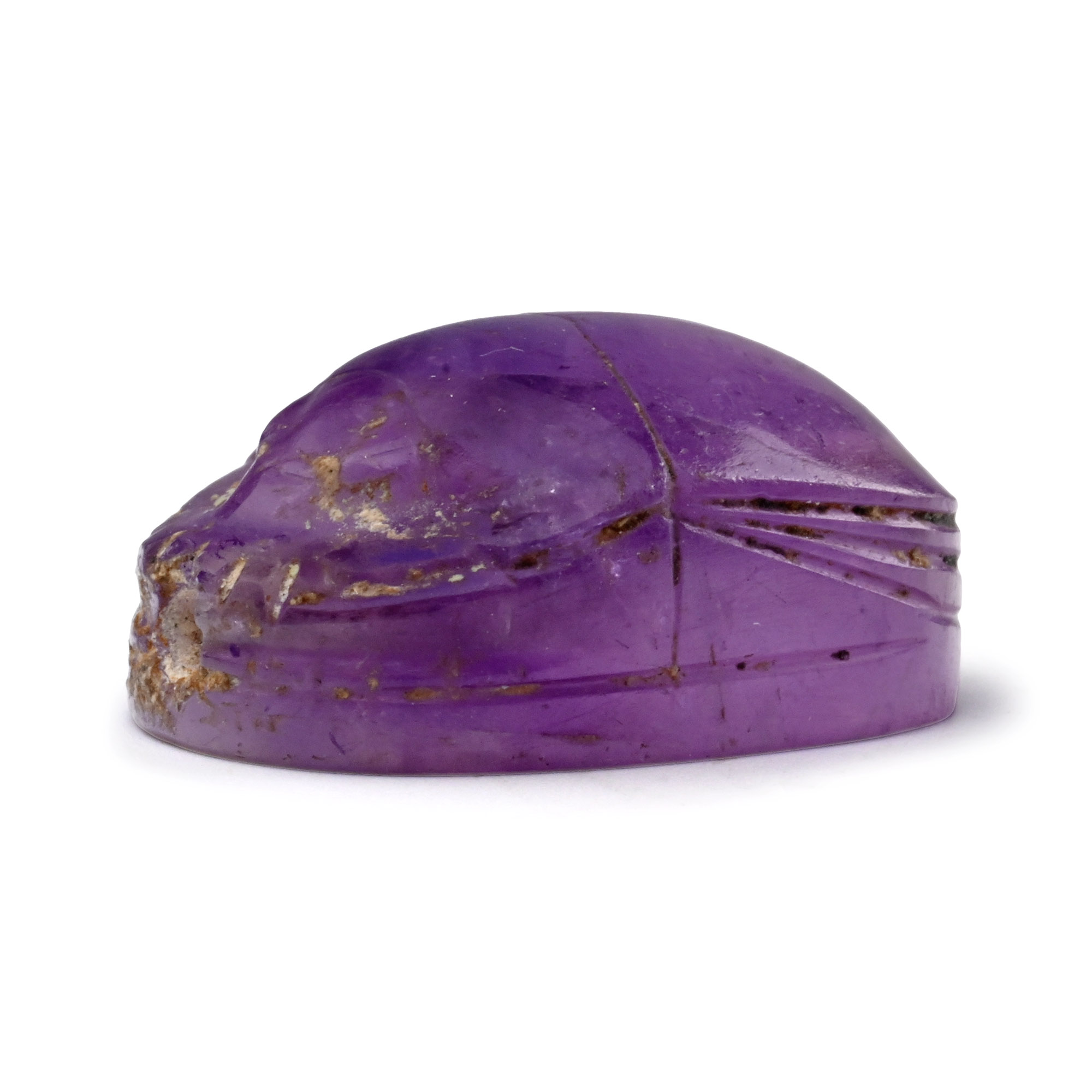
Phoenician Amethyst Scarab
8TH CENTURY B.C.
3/4 in. (3.21 grams, 18 mm).
Plano-convex in section with carved carapace to upper face; two lines of Phoenician script to underside.
ProvenanceAcquired in 1992.
Private collection, Switzerland, thence by descent.
Private collection, since the late 1990s.
This lot has been checked against the Interpol Database of stolen works of art and is accompanied by a search certificate number no.12851-241685.
This lot has been cleared against the Art Loss Register database, and is accompanied by an illustrated lot declaration signed by the Head of the Antiquities Department, Dr Raffaele D'Amato.
TimeLine Auctions follows a vetting process to ensure the authenticity and legality of all items, reinforcing our commitment to integrity and responsible trading. Each antiquity, antique, and coin lot undergoes thorough examination by a vetting committee of at least ten external specialists, professional trade association members, scientists, and archaeologists: Our Vetting Process
AUCTIONS:
TimeLine is a leading auction house specialising in antiquities, ancient art, collectables, natural history, coins, medals, and books. Our auctions offer museums, collectors, historians, and enthusiasts the opportunity to acquire unique and historically significant pieces.
-
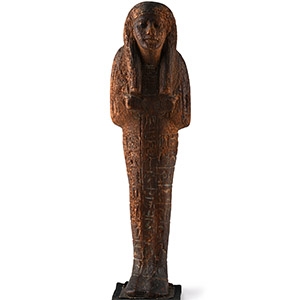
Egyptian Wooden Shabti with Hieroglyphic Inscription
New Kingdom, late 18th-19th Dynasty, circa 1350-1200 B.C.Sold for (Inc. bp): £3,120
Carved in the round with a detailed tripartite wig, segmented collar, and seed bag across the back, the figure has hands crossed at the chest, each holding a hoe, and wrists adorned with bracelets; eight bands of hieroglyphic text encircle the lower body, interrupted by a vertical column at the front, running from midriff to feet; mounted on a later copper base. 147 grams, 23 cm
From the collection of Mrs Kilvert, who fled from France to England during the French Revolution. Received by gift to the Hodge family from Mrs Kilvert at Bath in 1864-1865; thence by descent to the grandchildren of Mr John Hodge, a private London tutor. From the collection of a New Zealand family; thence by descent. This lot has been checked against the Interpol Database of stolen works of art and is accompanied by a search certificate number no.12845-239091. This lot has been cleared against the Art Loss Register database, and is accompanied by an illustrated lot declaration signed by the Head of the Antiquities Department, Dr Raffaele D'Amato. -
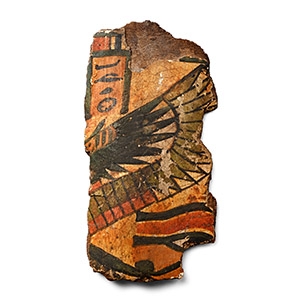
Egyptian Cartonnage Section with Eye and Wing
Third Intermediate Period, circa 1069-860 B.C.Sold for (Inc. bp): £416
Sub-rectangular in plan with irregular and fragmented edge; prepared plaster surface featuring a line-bordered column with four cursive hieroglyphs naming Behedet (bḥdt); a section of finely painted outstretched wing with feather detailing to lower edge in red and blue; below, a wedjat eye in black with red medial band; fabric back to reverse. 48 grams, 17 cm
Formerly from an old collection of a Wiltshire, UK, collector, acquired before 1980. Property of a private collector, West London, UK. This lot is accompanied by an illustrated lot declaration signed by the Head of the Antiquities Department, Dr Raffaele D'Amato.
This fragment most likely originates from the lower chest section of a so-called anthropoid 'yellow coffin' from the Third Intermediate Period. The wing belongs to a protective deity; as Behedet is a name given to several locations (Edfu, Tell el-Balamun, and Lepidotonpolis) associated with Horus, it seems probable that the wing belongs to the falcon form of this god. -
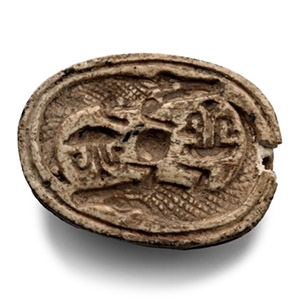
Large Egyptian Steatite Scarab
Late Period, 664-332 B.C.Sold for (Inc. bp): £520
Modelled body of a beetle with detailed carapace and legs; underside with two crocodiles enclosing a central sun disc flanked by two papyrus clumps atop neb signs. 19.8 grams, 38 mm
From the collection of a gentleman, acquired on the London art market in the 1990s. This lot is accompanied by an illustrated lot declaration signed by the Head of the Antiquities Department, Dr Raffaele D'Amato.
The design could be interpreted as ‘Sobek-Ra, lord of the Delta’. Sobek was mainly associated with water, fertility, and the Nile, as well as strength and military prowess. His worship spans much of ancient Egyptian history, from at least the Old Kingdom to the Roman period, and he was honoured not only as a force of nature but also as a god of healing, protection, and royal authority. He was associated with various other deities, most often with the sun god in the form of Sobek-Ra. His primary cult centres were situated in the Faiyum region, especially in the city of Crocodilopolis, and also at Kom Ombo in Upper Egypt.
