
.jpg "Philisita (Palestine), Uncertain mint AR Obol.")
LOT 3217
Philisita (Palestine), Uncertain mint AR Obol. Circa 353-333 BC. Imitating Athens.
Helmeted head of Athena to right / Owl standing to right, head facing; olive spray and crescent to left; [A]ΘΕ downwards before; all within incuse square. Gitler & Tal IX.1O. Near Very Fine. Cleaning scratches.(0.66gr, 9mm, 6h.).
ProvenanceFrom the collection of a gentleman, acquired on the London art market in the 1990s.
TimeLine Auctions follows a vetting process to ensure the authenticity and legality of all items, reinforcing our commitment to integrity and responsible trading. Each antiquity, antique, and coin lot undergoes thorough examination by a vetting committee of at least ten external specialists, professional trade association members, scientists, and archaeologists: Our Vetting Process
AUCTIONS:
TimeLine is a leading auction house specialising in antiquities, ancient art, collectables, natural history, coins, medals, and books. Our auctions offer museums, collectors, historians, and enthusiasts the opportunity to acquire unique and historically significant pieces.
-
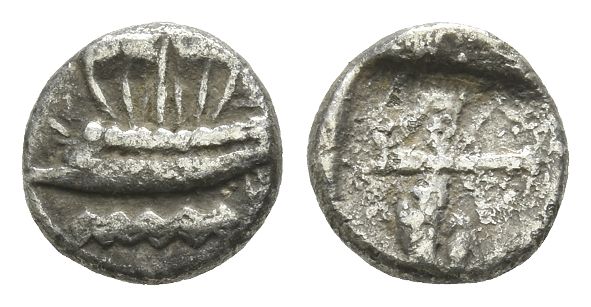
Phoenicia, Sidon. Uncertain king AR 1/16 Shekel. Circa 435-425 BC.
Sold for (Inc. bp): £20
Phoenician galley under sail to left; waves below / Persian king or hero in kneeling-running stance to right, drawing bow, within incuse square. E&E-S Group II.4; HGC 10, 217. 0.79gr, 9mm, 12h.
Near Very Fine.
From the collection of a gentleman, acquired on the London art market in the 1990s. -
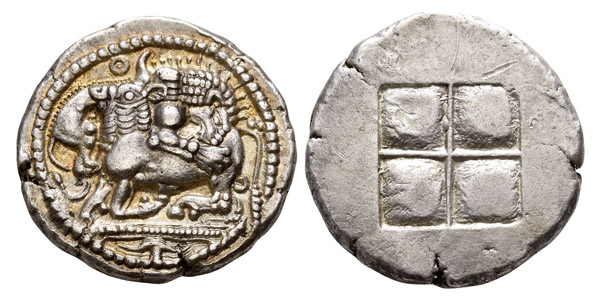
Macedon, Akanthos AR Tetradrachm. Circa 525-470 BC.
Estimate: £5,000 - 7,000 (‡+bp*)
Opening Bid: £2,500
Attic standard. Lion attacking to right, biting into the hindquarter of bull kneeling to left and biting the leg of the lion; Θ above, three ground lines below, the middle composed of pellets; stylised acanthus flower ιn exergue / Quadripartite incuse square. Desneux 59 (D57)(?); AMNG III/2, 5; HGC 3, 383. 17.19gr, 27mm.
Near Extremely Fine. Nicely toned with golden iridescence around the devices on obverse.
From collection of Dr G.W., Germany. Ex Gorny & Mosch, Auction 37, 13 May 1987. -
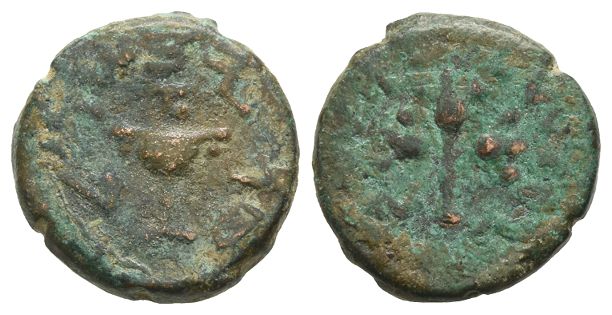
Judaea, First Jewish War AE Trial(?) Shekel. 1st century AD.
Sold for (Inc. bp): £1,170
Omer cup; date in Hebrew above; inscription in Hebrew around / Sprig of three pomegranates; inscription in Hebrew around. Cf. Meshorer 188; cf. Hendin 656; cf. Bromberg 60-1 (all for AR half shekels). 6.03gr, 19mm, 12h.
Near Very Fine.
From the collection of a gentleman, acquired on the London art market in the 1990s.
