
Loading, please wait...
_900x900.jpg "Persian Iron Dragon-Shaped Flint Striker")
_200x200.jpg "Persian Iron Dragon-Shaped Flint Striker")
.jpg "Persian Iron Dragon-Shaped Flint Striker")
LOT 0245
Persian Iron Dragon-Shaped Flint Striker
17TH-18TH CENTURY A.D.
4 1/2 in. (297 grams, 11.5 cm).
With a thick looped body and striking face to the outer edge; handle formed in openwork with stylised serpent-head, open mouth with recurved teeth, trident tail with similar pellet clusters; engraved and drilled detailing.
ProvenanceAcquired Christie's, The Longridge Collection, London, UK, 2010 (£1,276.00).
Personal collection of a Suffolk lady, UK.
Cf. Metropolitan Museum, New York, USA, object no.1977.419 (Purchase, Bequest of Florence L. Goldmark, Milton A. Rauh and Florence L. Goldmark Collection, by exchange, Norbert Schimmel Gift and Fletcher Fund, 1977), for an almost identical object.
FootnotesAmong the objects reflecting the continuation of traditional figural compositions in Indo-Iranian art, there are zoomorphic flint strikers, decorated with serpents, ducks or geese and hawks attacking birds, indicating the persistence of imperial and solar symbols.
CONDITIONTimeLine Auctions follows a vetting process to ensure the authenticity and legality of all items, reinforcing our commitment to integrity and responsible trading. Each antiquity, antique, and coin lot undergoes thorough examination by a vetting committee of at least ten external specialists, professional trade association members, scientists, and archaeologists: Our Vetting Process
AUCTIONS:
TimeLine is a leading auction house specialising in antiquities, ancient art, collectables, natural history, coins, medals, and books. Our auctions offer museums, collectors, historians, and enthusiasts the opportunity to acquire unique and historically significant pieces.
-
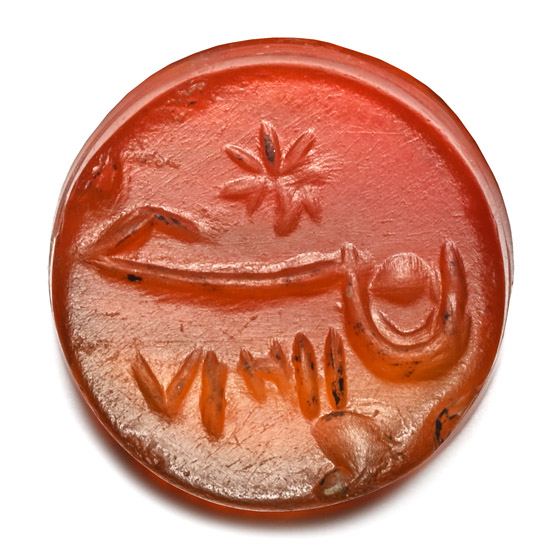
Western Asiatic Carnelian Gemstone with Calligraphic Text
Circa 18th-19th century A.D.Sold for (Inc. bp): £65
Tabular type with calligraphic Naskh script legend; supplied with a museum-quality impression. 2.13 grams, 15 mm
From the private collection of a European gentleman (1942-2024), formed since the 1970s. -
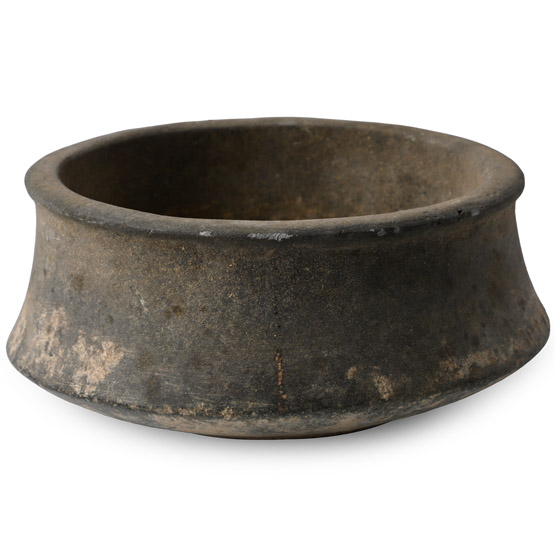
Western Asiatic Stone Vessel
2nd-1st millennium B.C.Estimate: £100 - 140 (+bp*)
Opening Bid: £56
With a broad squat body with carination and a flat rim to the mouth; basal ring. 396 grams, 11.6 cm wide
Ex London, UK, collection, 1988-1990s. -
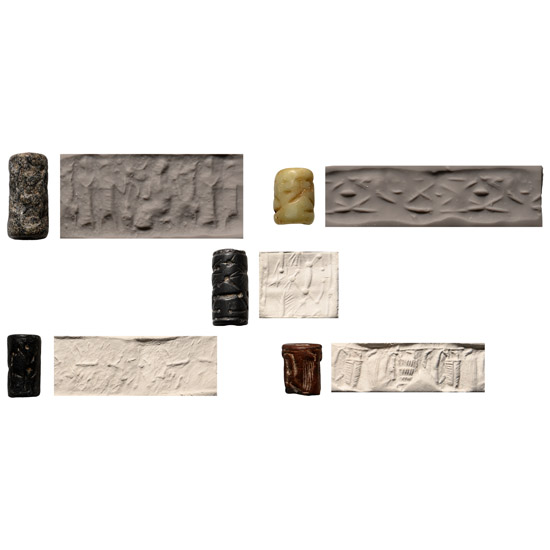
Western Asiatic Stone Cylinder Seal Group
2nd-1st millennium B.C.Sold for (Inc. bp): £169
Comprising: a steatite seal with three figures to the right offering to a deity on a throne, filler motifs including a sun disc; a light green soapstone with a stylised eagle or a winged sun disc; a red jasper seal with four people in varied clothing; a steatite seal with two gazelles back to back, and a tree as a filler motif; a hematite seal with a stag looking back, fish and other motifs; supplied with museum-quality impressions. 21 grams total, 14-24 mm
From the private collection of a European gentleman (1942-2024), formed since the 1970s. Accompanied by previous typed catalogue slips with collection nos.33, 35, 40, 66 & 77.
