
Loading, please wait...
_900x900.jpg "Persian Chalcedony Stamp Seal of a Persian King Gripping the Horns of Two Goats")
_200x200.jpg "Persian Chalcedony Stamp Seal of a Persian King Gripping the Horns of Two Goats")
.jpg "Persian Chalcedony Stamp Seal of a Persian King Gripping the Horns of Two Goats")
LOT 0237
Persian Chalcedony Stamp Seal of a Persian King Gripping the Horns of Two Goats
5TH-4TH CENTURY B.C.
1 in. (14.7 grams, 26.64 mm).
Thimble-shaped seal with engraved imagery; accompanied by an old scholarly note, typed and signed by W.G. Lambert, late Professor of Assyriology, University of Birmingham, 1970-1993, which states: 'Stamp Seal of Chalcedony 19.5 x 20 x 27 mm. This is a conoid with nearly round slightly convex face, pierced diagonally. The design shows the Achaemenid Persian king in tunic and Persian 'trousers' gripping in each hand the horn of a rearing antelope or similar animal which turns its head backwards. The king wears a crown. This is an Achaemenid Persian seal, c.500-350 B.C., from some part of the Persian empire. It is in a distinctive style, but so fare [sic] there has not been enough study to say exactly where this was made. The scene symbolises the Persian king's victories over his enemies. The seal is a little chipped, but generally in good condition'; accompanied by a museum-quality impression.
ProvenanceEx Dr Elie Browski.
with Christie's, London, 13 June 2000, no.609 [Part].
Accompanied by a copy of a scholarly note, typed and signed by Professor Wilfrid George Lambert in July 2000.
Accompanied by copies of the relevant Christie's catalogue pages.
This lot has been cleared against the Art Loss Register database, and is accompanied by an illustrated lot declaration signed by the Head of the Antiquities Department, Dr Raffaele D'Amato.
TimeLine Auctions follows a vetting process to ensure the authenticity and legality of all items, reinforcing our commitment to integrity and responsible trading. Each antiquity, antique, and coin lot undergoes thorough examination by a vetting committee of at least ten external specialists, professional trade association members, scientists, and archaeologists: Our Vetting Process
AUCTIONS:
TimeLine is a leading auction house specialising in antiquities, ancient art, collectables, natural history, coins, medals, and books. Our auctions offer museums, collectors, historians, and enthusiasts the opportunity to acquire unique and historically significant pieces.
LOT 0237
Persian Chalcedony Stamp Seal of a Persian King Gripping the Horns of Two Goats
Sold for (Inc. bp): £1,690
-
.jpg)
Mesopotamian Decorated Calcite Jar
Circa 3rd millennium B.C.Estimate: £2,000 - 3,000 (‡+bp*)
Opening Bid: £1,111
Carved squat-bodied vessel with a broad, rounded shoulder and narrow flat base, short neck and everted rim, four pierced lugs to the shoulders incorporated into a circumferential band of engraved cross-hatching. 746 grams, 11.8 cm
From a British collection, acquired in 1993. This lot has been checked against the Interpol Database of stolen works of art and is accompanied by search certificate number no.11835-206783. This lot has been cleared against the Art Loss Register database, and is accompanied by an illustrated lot declaration signed by the Head of the Antiquities Department, Dr Raffaele D'Amato. -
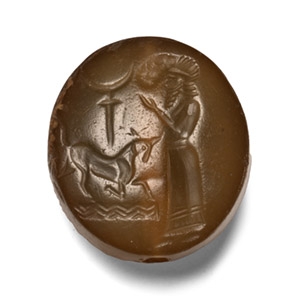
Neo Babylonian Chalcedony Stamp Seal with Worshipper and Prancing Bull
5th-4th century B.C.Sold for (Inc. bp): £1,300
Discoid in plan with convex upper face; accompanied by an old scholarly note, typed and signed by W.G. Lambert, late Professor of Assyriology, University of Birmingham, 1970-1993, which states: 'Stamp Seal of Amber Chalcedony 21 x 19 x 11 mm. This is a scaraboid pieced vertically. The design shows a standing worshipper in long robe raising one hand to a stand on which is a prancing bull on the back of which rises a pole surmounted with a lunar crescent. The stand is covered with wavey lines. This is a Late Babylonian seal, c. 600-350 B.C. from Mesopotamia or an adjacent area. The general design is typical for the period, but the stand with wavey lines and the prancing bull are rare and may be unique to this seal. The seal is worn and there is a chip by the head of the worshipper, but the design is entirely clear'; accompanied by a museum-quality impression. 6.33 grams, 20.92 mm
with Christie's, London, 13 June 2000, no.517 [Part]. Accompanied by a copy of a scholarly note, typed and signed by Professor Wilfrid George Lambert in July 2000. Accompanied by copies of the relevant Christie's catalogue pages. This lot has been cleared against the Art Loss Register database, and is accompanied by an illustrated lot declaration signed by the Head of the Antiquities Department, Dr Raffaele D'Amato. -
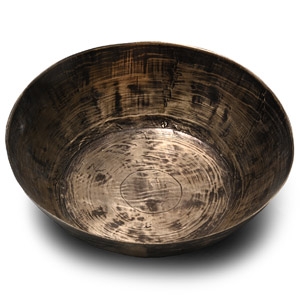
Sasanian High Tin Bronze Bowl
3rd-7th century A.D.Sold for (Inc. bp): £94
Broad profile with annular motif to base. 165 grams, 14.3 cm
Acquired 1980-2015. Ex Abelita family collection. This lot has been cleared against the Art Loss Register database, and is accompanied by an illustrated lot declaration signed by the Head of the Antiquities Department, Dr Raffaele D'Amato.
