
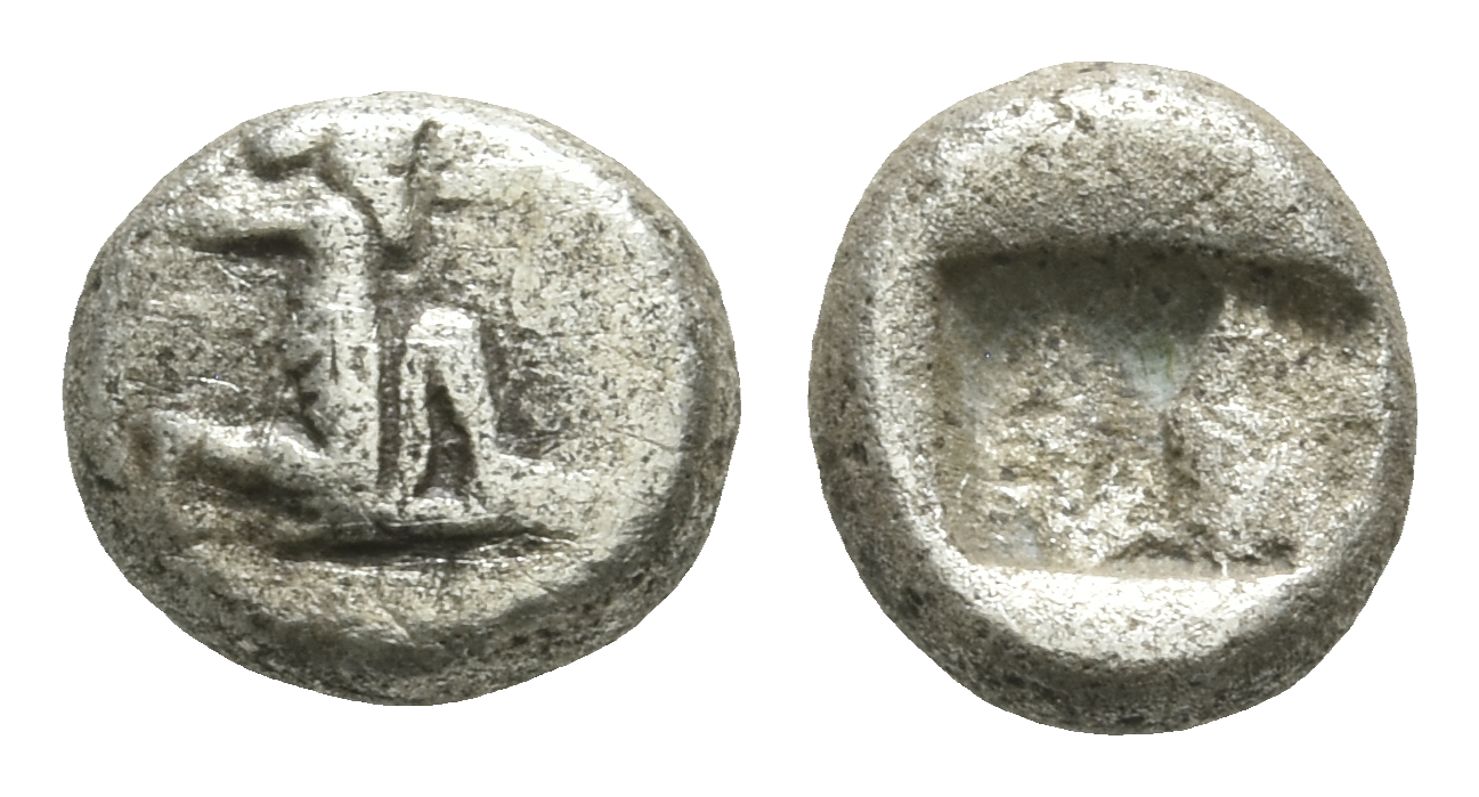
LOT 3352
Persia. Achaemenid Empire, Time of Darios I to Xerxes I AR Sixth Siglos. Circa 505-480 BC.
Lydo-Milesian standard. Sardes mint. Persian king or hero, wearing kidaris and kandys, quiver over shoulder, in kneeling-running stance to right, drawing bow / Incuse punch. Carradice Type II; Meadows, Administration -; BMC Arabia -; Brindley -; Klein -; Sunrise -. Near Very Fine.(0.82gr, 8mm.).
ProvenanceFrom the collection of a gentleman, acquired on the London art market in the 1990s.
TimeLine Auctions follows a vetting process to ensure the authenticity and legality of all items, reinforcing our commitment to integrity and responsible trading. Each antiquity, antique, and coin lot undergoes thorough examination by a vetting committee of at least ten external specialists, professional trade association members, scientists, and archaeologists: Our Vetting Process
AUCTIONS:
TimeLine is a leading auction house specialising in antiquities, ancient art, collectables, natural history, coins, medals, and books. Our auctions offer museums, collectors, historians, and enthusiasts the opportunity to acquire unique and historically significant pieces.
LOT 3352
Persia. Achaemenid Empire, Time of Darios I to Xerxes I AR Sixth Siglos.
Sold for (Inc. bp): £52
-
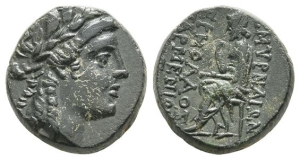
Ionia, Smyrna AE Homereion. After 190 BC. EΡΜΟΛΑΟΣ ΠΑΡΜΕΝΙΟΝΤΟΣ (Hermolaos, son of Parmenion), magistrate.
Sold for (Inc. bp): £143
Laureate head of Apollo to right / Homer seated to left, holding scroll, transverse sceptre behind; [Z]MYPNAIΩN to right, EPMOΛAOΣ ΠΑΡΜΕΝΙΟ[NΤΟΣ] in three lines to left. BMC -; SNG Copenhagen -; SNG von Aulock -; Milne (NC 1927) Pg. 88, No. 302. 8.84gr, 20mm, 12h.
Good Very Fine. Dark green patina. Extremely Rare.
Acquired on the UK market. Property of a London antiquarian.
Strabo mentions specifically this issue of bronze coinage from Smyrna when, discussing the city, he says "there is also a library; and the 'Homereum', a quadrangular portico containing a shrine and wooden statue of Homer; for the Smyrnaeans also lay especial claim to the poet and indeed a bronze coin of theirs is called a Homereum" (Strabo, Geographica XIV, I.37, transl. by H.C. Jones, The Geography of Strabo, VI [Loeb, 1960], pp. 245-247). -
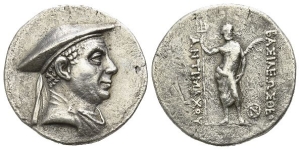
Greco-Baktrian Kingdom, Antimachos I Theos AR Tetradrachm. Circa 180-170 BC.
Sold for (Inc. bp): £494
Diademed and draped bust to right, wearing kausia / BAΣIΛEΩΣ ΘEOY to right, ΑNTIMAXOY to left, Poseidon, laureate, standing facing, holding trident in right hand and cradling filleted palm in left arm; N within circle to inner right. Bopearachchi 1D; Mitchiner 124b; SNG ANS 276-7; HGC 12, 106. 15.94gr, 31mm, 11h.
Very Fine. Porous.
Purchased from John Cummings Ltd (dealer's ticket included). From the private collection of a Canadian gentleman living in Essex, UK, formed since the 1920s-circa 1990. Property of an Essex lady until the late 1990s; thence by descent. From the private collection of an Essex gentleman since the late 1990s. -
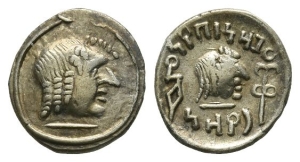
South Arabia. Himyar, 'Amdan Bayan Yahaqbid AR Unit. Circa AD 100-120. Raydan mint.
Sold for (Inc. bp): £78
Head to right within circular torque / Small head to right; yanaf-monogram to left, 'sceptre' to right. CAF 3.2ai; Huth 429. 1.26gr, 14mm, 5h.
Very Fine.
Private collection, acquired 1980–1985.
