
Loading, please wait...
LOT 0807
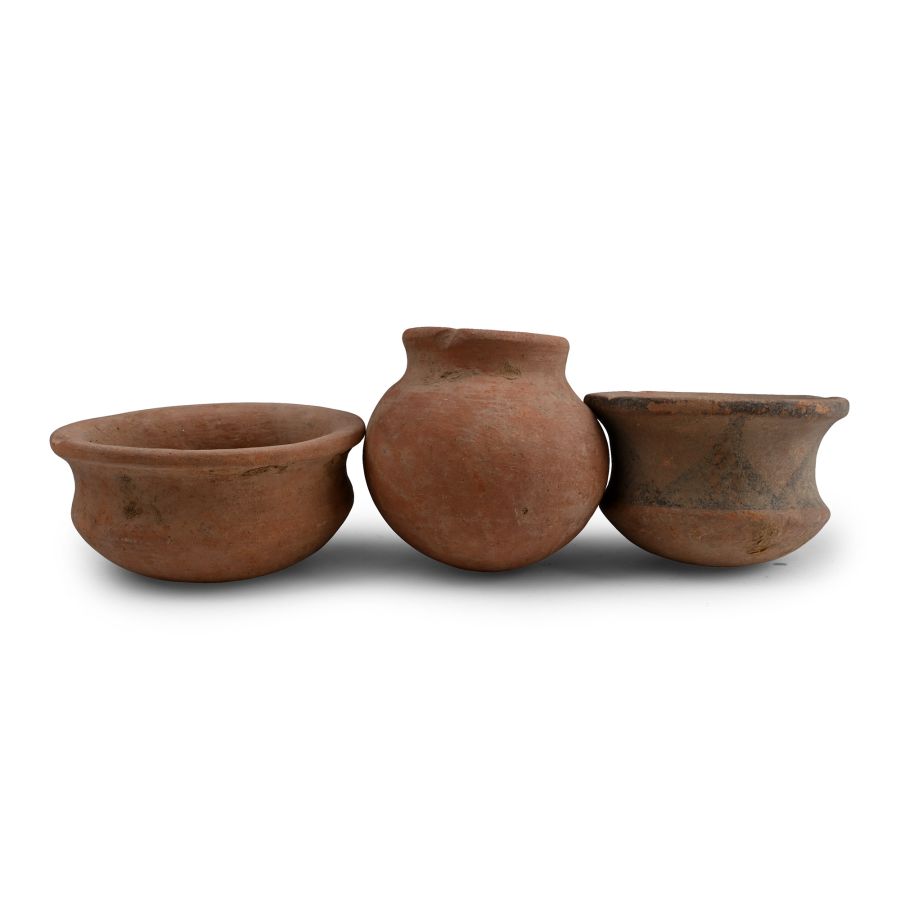
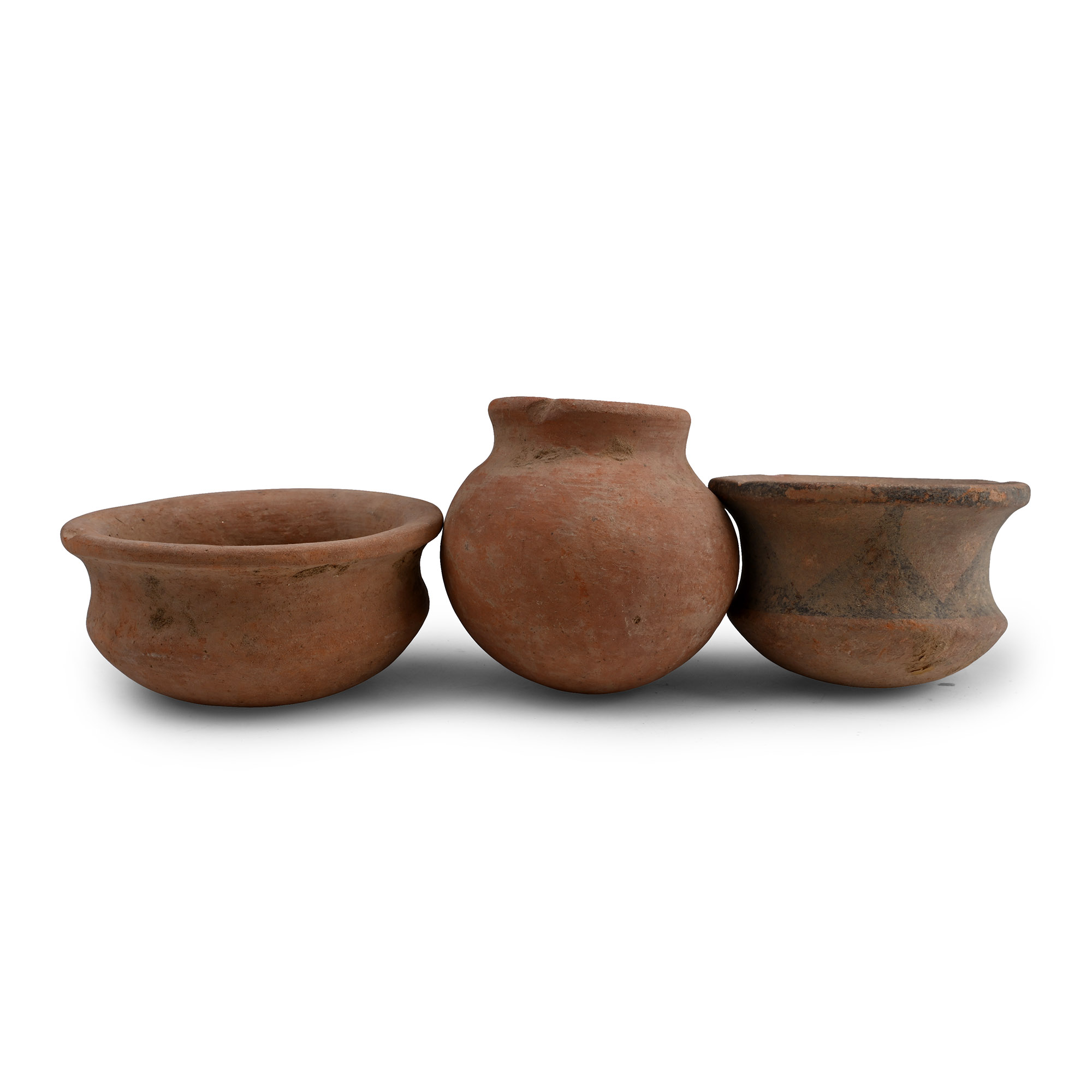
Parthian Terracotta Vessel Group
2ND CENTURY B.C.-2ND CENTURY A.D.
3 - 3 3/4 in. (198 grams total, 78-94 mm).
Comprising two palm-cups with broad everted rim to the mouth, and a bulbous jar with rounded rim. [3, No Reserve]
ProvenanceAcquired on the UK art market since the 1990s.
From the property of a late Lincolnshire, UK, gentleman; thence by descent.
TimeLine Auctions follows a vetting process to ensure the authenticity and legality of all items, reinforcing our commitment to integrity and responsible trading. Each antiquity, antique, and coin lot undergoes thorough examination by a vetting committee of at least ten external specialists, professional trade association members, scientists, and archaeologists: Our Vetting Process
AUCTIONS:
TimeLine is a leading auction house specialising in antiquities, ancient art, collectables, natural history, coins, medals, and books. Our auctions offer museums, collectors, historians, and enthusiasts the opportunity to acquire unique and historically significant pieces.
LOT 0807
Parthian Terracotta Vessel Group
Estimate £80 - 100€93 - 116 (for guidance only)$108 - 135 (for guidance only)
Opening Bid
£5 (EUR 6; USD 7) +BP*
-
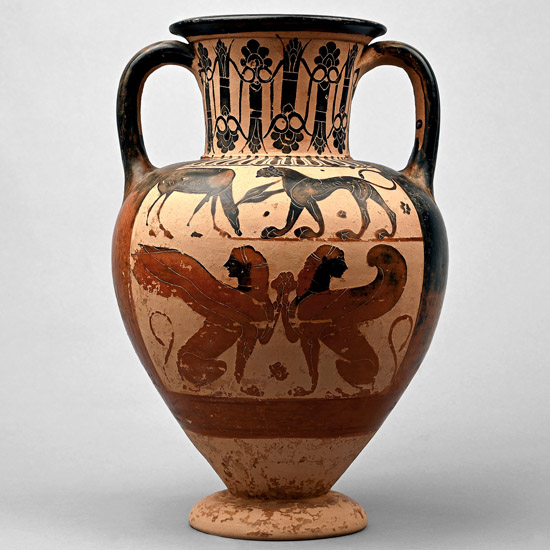
Greek Terracotta Amphora Attributed to the Phineus Painter
Chalcidian, circa 525 B.C.Estimate: £4,000 - 6,000 (‡+bp*)
Opening Bid: £2,000
Piriform body with splayed foot and narrow handles; the neck with slender lotus blossoms and palmettes, Side A) two opposing roosters with a lotus blossom in between, two standing swans flanking, below a youth on horseback holding the reins of a trotting horse, a man and a woman behind the horse; Side B) a grazing deer before an advancing panther looking back, two opposing sphinxes below with their heads turned back and front paws raised. 1.06 kg, 28 cm
Ex Münzen und Medaillen A.G., H. Cahn, Basel, 13 April 1985. Private collection, Bern, Switzerland. This lot has been checked against the Interpol Database of stolen works of art and is accompanied by a search certificate number no.12643-236366.
An important work by the leading master of the 'Chalcidian' workshop, which, despite the name, is not to be located in Chalkis itself but rather in a Chalcidian colony in Magna Graecia (possibly Rhegion). Within the oeuvre of Phineus, who is known for his neck-amphorae, examples with two image zones are very rare—see, for example, the fragmentary amphora in the Faina Collection in Orvieto, with similar sphinxes. -
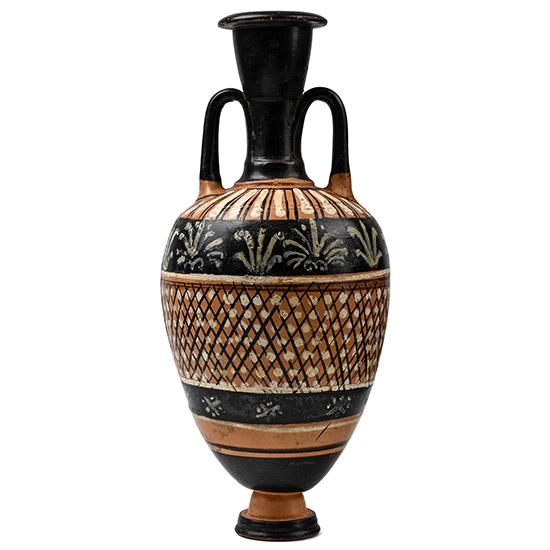
Greek Terracotta Amphoriskos with Fishnet Pattern
Attic, 4th century B.C.Estimate: £2,500 - 3,500 (‡+bp*)
Opening Bid: £1,275
Elongated piriform amphora shape with short pedestal foot, tubular neck and everted rim, applied round-section handles to the neck and body; decorated with polychrome palmettes, cross and net motif. 98 grams, 14.9 cm
Private collection, France, 1970s. with Marta Bryl, Galerie Keramion, Paris, 2019. -
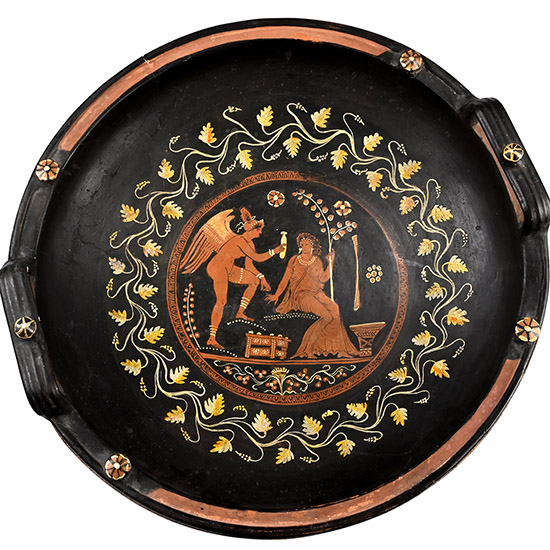
Very Large Greek Terracotta Kylix with Mythological Scene Attributed to the Darius Painter and His Circle
4th century B.C.Estimate: £20,000 - 30,000 (‡+bp*)
Opening Bid: £10,000
Featuring a monumental shallow bowl with two strap handles on the rim and a low foot; the inside of the bowl with a central scene featuring a nude winged male figure offering a lekythos to the woman (Psyche?) seated before him; the woman dressed in a chiton and wearing a double-row necklace, large earrings and a diadem indicated by pellets, holding a double branch with leaves in her left hand; a low altar on the foreground and foliate and floral decoration beneath the scene; the scene enclosed within a painted grapevine border; four raised conical bosses on the rim and one on top of each handle; the lower part of the rim decorated with ovules; underside with a band of Greek key motifs and large palmettes on the sides, Side A: mythological scene with a satyr standing on the left, a seated woman at the centre holding a wreath and an open cista, her head turned towards another woman behind her, holding a fan and a ritual object in her hands; Side B: a draped female on the left, holding a stalk and a cista, advancing to the left while gazing back towards an advancing nude winged figure of Eros; restored. 3.1 kg, 49.5 cm wide
Private collection, South of France, acquired in 1999. Accompanied by a printed copy of the Spanish cultural export licence no.1775-3178156. Accompanied by a copy of a thermoluminescence report issued by Alliance Science Art, no.612151. Accompanied by an academic report by Dr Raffaele D'Amato. This lot has been checked against the Interpol Database of stolen works of art and is accompanied by search certificate no.13460-261208.
The intricate designs and stylistic features of this kylix suggest it may belong to the followers of the renowned Darius Painter. The Darius Painter, active in Apulia (modern-day Southern Italy) during the late 4th century B.C., is known for his elaborate and finely detailed red-figure pottery. His works often depict complex mythological scenes and demonstrate a high level of artistic sophistication and technical skill. Key features that align this vessel with the Darius Painter and his workshop include the detailed mythological scene in the central medallion, the refined use of additional white and yellow pigments to highlight key elements, and the balanced composition of figures and decorative motifs. The presence of Eros and other mythological elements is also characteristic of the themes favoured by the Darius Painter.
