
Loading, please wait...
LOT 0525
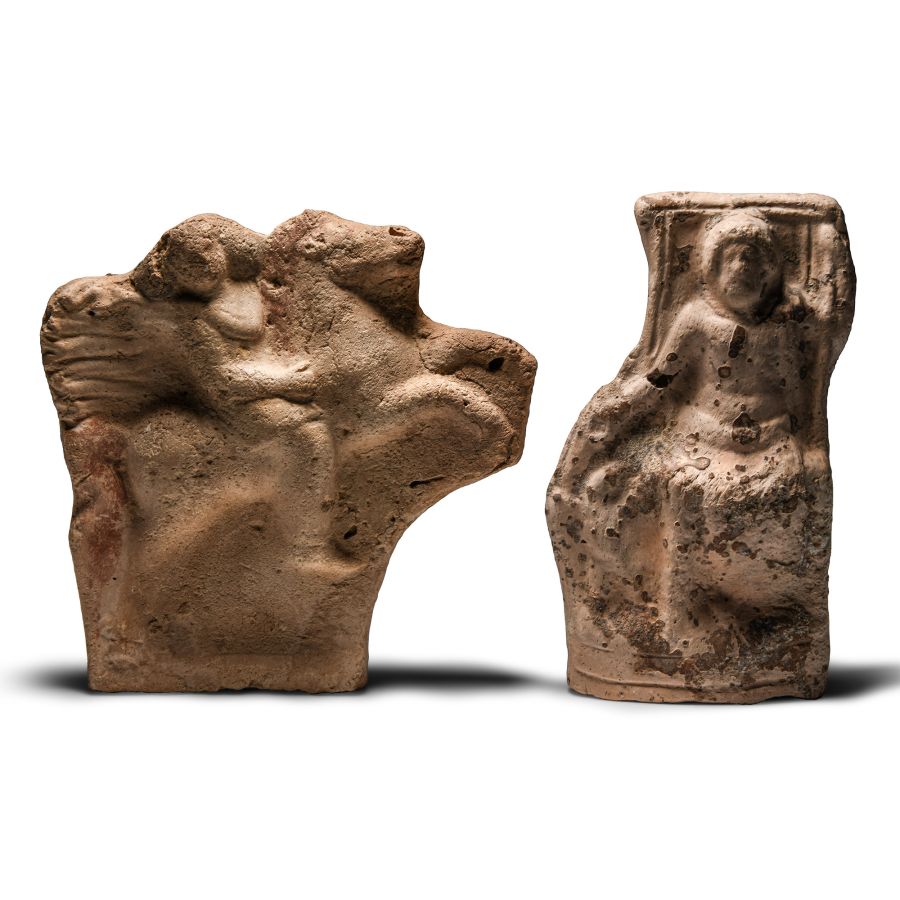
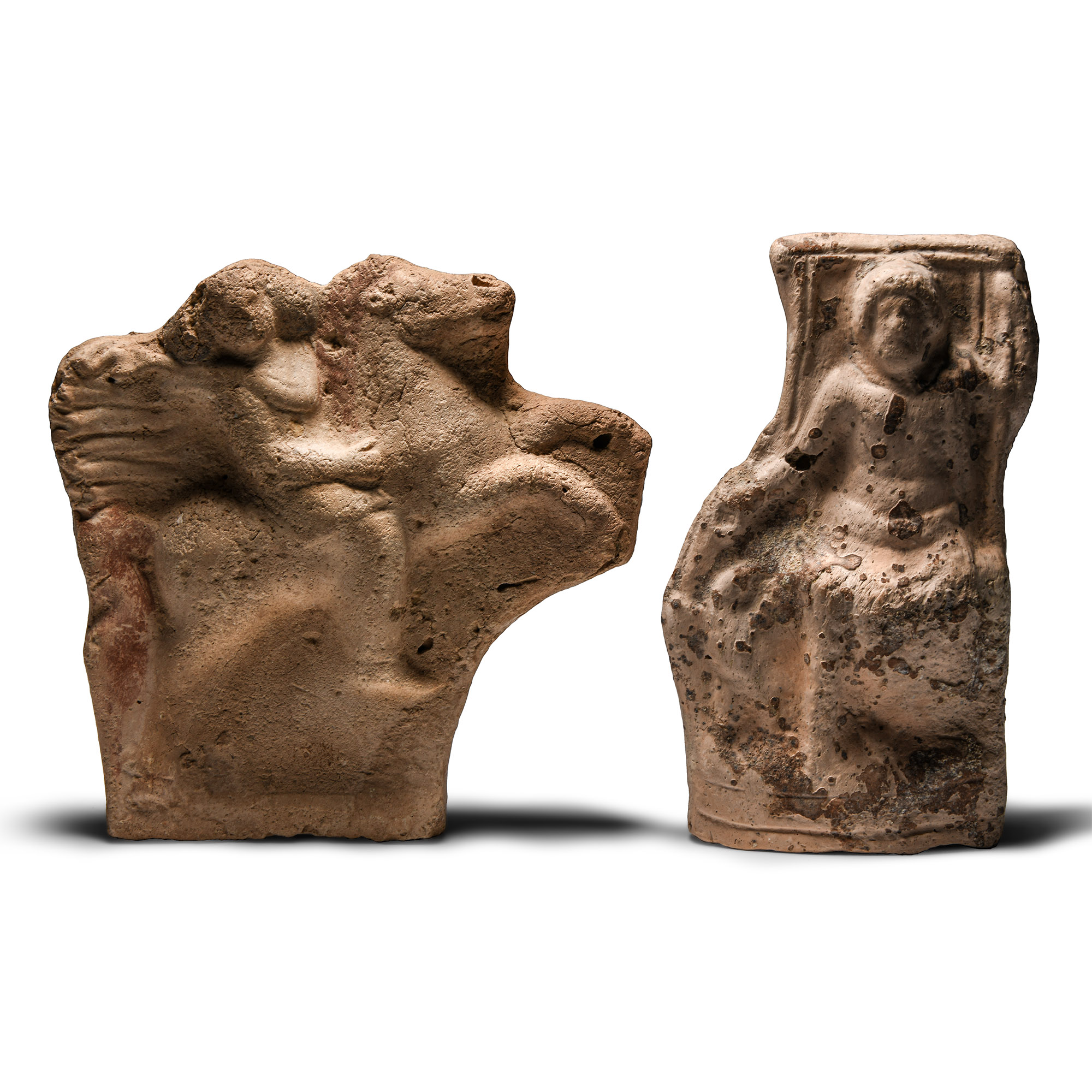
Parthian Terracotta Statuette Group
3RD CENTURY B.C.
6 1/4 in. (598 grams total, 15.5 cm each).
Hollow-formed, comprising: a rider on a rearing horse with chlamys extended in the wind, and wearing wide Persian trousers (saravara), red pigment in the field; Zeus enthroned, facing with an eagle at his feet, hole to the reverse. [2]
ProvenanceEx private European collection.
with Genève Enchères, 14 December 2017, lot 863.
Cf. Bel, N., Giroire, C., Gombert, F., Rutschowscaya, M.H., L'Orient romain et byzantin au Louvre, Arles / Paris, 2012, p.224, fig.205, for identical cavalryman (Louvre AO 10221).
FootnotesThe costume of Parthian nobles consisted of a tunic or wrapped jacket, trousers and boots/footwear, generally typical of a riding dress. Interestingly, the right side of the tunic was knee-length (such as those seen om early Sassanian noblemen depicted in the Persepolis graffiti) but the left side of the tunic, for many Parthian cavalrymen, appeared shorter and only reached to the upper thigh.
CONDITIONTimeLine Auctions follows a vetting process to ensure the authenticity and legality of all items, reinforcing our commitment to integrity and responsible trading. Each antiquity, antique, and coin lot undergoes thorough examination by a vetting committee of at least ten external specialists, professional trade association members, scientists, and archaeologists: Our Vetting Process
AUCTIONS:
TimeLine is a leading auction house specialising in antiquities, ancient art, collectables, natural history, coins, medals, and books. Our auctions offer museums, collectors, historians, and enthusiasts the opportunity to acquire unique and historically significant pieces.
-
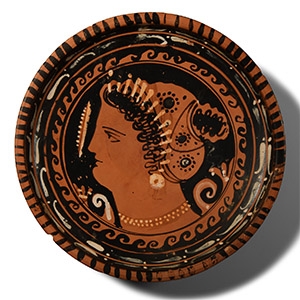
Greek Red Figure Dish with Lady of Fashion
South Italian, circa 380-350 B.C.Sold for (Inc. bp): £611
With pedestal foot, decorated with radiating strokes to the rim, band of leaf ornament surrounding the central profile of a lady of fashion facing left, her hair dressed in a ribboned sakkos with stephane; earrings and necklace in white and ochre. 187 grams, 16.5 cm wide
Acquired by the vendor's father in the 1950s or before; thence by descent 2003. -
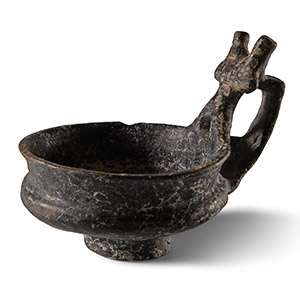
Villanovan Terracotta Kyathos with Zoomorphic Handle
Circa 7th century B.C.Sold for (Inc. bp): £312
Small impasto kyathos with carinated profile, basal ring, zoomorphic handle with spurs above. 113 grams, 10 cm wide
Belgium (Uccle) – Haynault Ventes Publiques, Collectibles Auction, 21 September 2021, lot 15. Property of a South Australian private collector, with collection reference 21.100. Accompanied by a detailed collector's catalogue page including description and photograph.
Villanovan culture is often regarded as the earliest phase of Etruscan civilisation in the Iron Age. -
.jpg)
Cypriot Terracotta Figurine
6th-5th century B.C.Sold for (Inc. bp): £780
Modelled in the half-round, the figure wearing a conical hood with open front, detailed facial features and ribbed beard, left arm bent, right arm drawn across the body in the folds of a mantle, vertical border to the left chest; mounted on a custom-made stand. 48 grams, 83 mm (69 grams total, 10.9 cm high including stand)
Ex Julien Gréau (1810–1895) who was an omnivorous French collector with a predilection for antiquities. Collection of Louis-Gabriel Bellon (1819-1899), Saint-Nicolas-lez-Arras and Rouen, thence by descent. with Millon & Associes Auctions, Paris, 6th December 2021, lot 41 [Part]. Accompanied by a copy of Collection J. Gréau, Terres Cuites Grecques, by H. Hoffmann, 1891, where this piece is published.
