
Loading, please wait...
LOT 0534
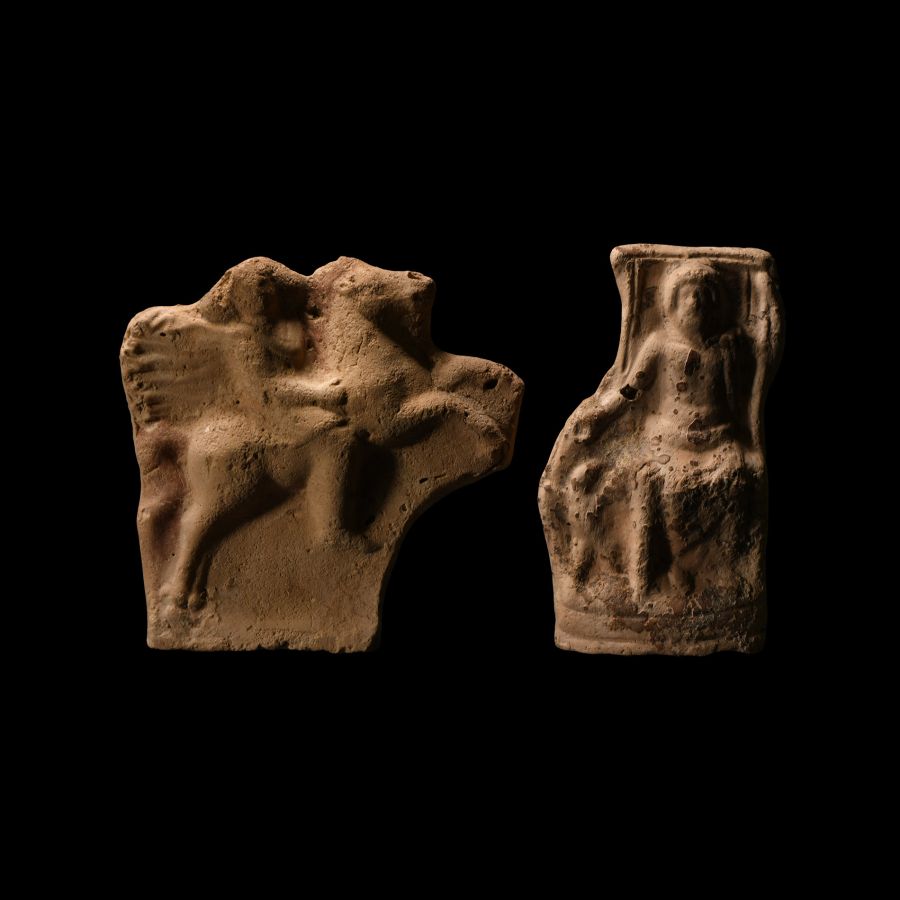
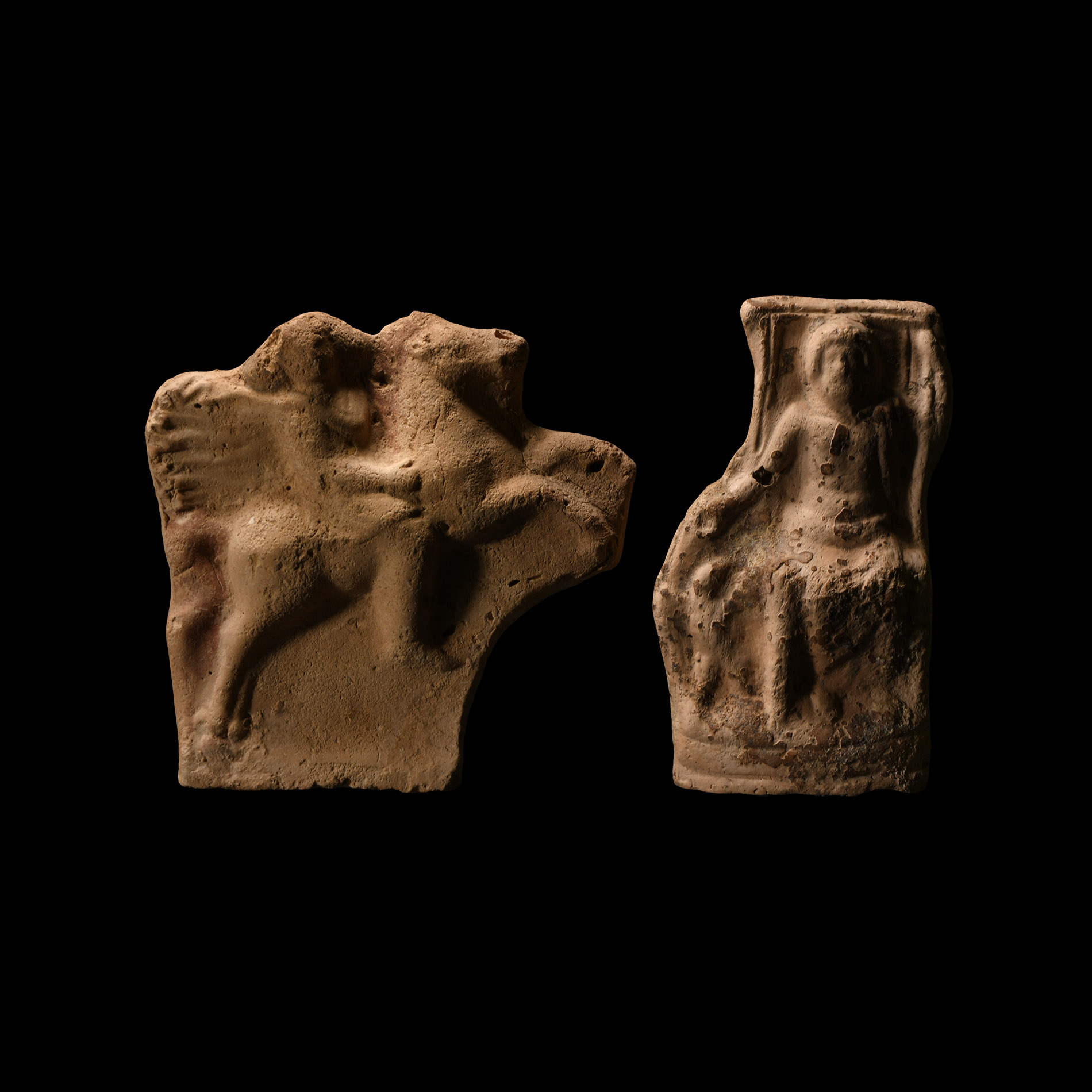
Parthian Terracotta Statuette Group
3RD CENTURY B.C.
6 1/4 in. (598 grams total, 15.5 cm each).
A pair of hollow-formed terracotta statuettes comprising: a rider on a rearing horse with chlamys extended in the wind, and wearing wide Persian trousers (saravara), red pigment in the field; Zeus enthroned, facing with an eagle at his feet, hole to the reverse. [2]
ProvenanceEx private European collection.
with Genève Enchères, 14 December 2017, lot 863.
Cf. Bel, N., Giroire, C., Gombert, F., Rutschowscaya, M.H., L'Orient romain et byzantin au Louvre, Arles / Paris, 2012, p.224, fig.205, for identical cavalryman (Louvre AO 10221).
FootnotesThe costume of Parthian nobles consists of a tunic or wrapped jacket, trousers and boots/footwear, generally typical of a riding dress. Interestingly, the right side of the tunic was knee-length (consistent with those seen with early Sassanian noblemen depicted at the Persepolis graffiti) but the left side of the tunic, for many Parthian cavalrymen, appears shorter and only reaches to the upper thigh.
CONDITIONTimeLine Auctions follows a vetting process to ensure the authenticity and legality of all items, reinforcing our commitment to integrity and responsible trading. Each antiquity, antique, and coin lot undergoes thorough examination by a vetting committee of at least ten external specialists, professional trade association members, scientists, and archaeologists: Our Vetting Process
AUCTIONS:
TimeLine is a leading auction house specialising in antiquities, ancient art, collectables, natural history, coins, medals, and books. Our auctions offer museums, collectors, historians, and enthusiasts the opportunity to acquire unique and historically significant pieces.
LOT 0534
Parthian Terracotta Statuette Group
Estimate £400 - 600€460 - 700 (for guidance only)$540 - 810 (for guidance only)
-
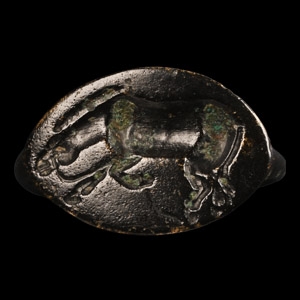
Greek Seal Ring with Antelope
Circa 5th century B.C.Estimate: £150 - 200 (+bp*)
Opening Bid: £75
A bronze ring with slender hoop and elliptical bezel engraved with an antelope. 4.02 grams, 22.50 mm overall, 18.90 mm internal diameter (approximate size British P, USA 7 1/2, Europe 16.23, Japan 15)
Acquired before 2000. From the collection of a European gentleman living in the UK. -
.jpg)
Campanian Red-Figure Bail Amphora from a Cumae Workshop
330-300 B.C.Sold for (Inc. bp): £4,680
A ceramic red-figure bail amphora with round-section strap handle and pierced lug at the apex, tall waisted neck with vertical rib detailing, rounded shoulder with running wave pattern ornament, tapering body with figural designs of standing females wearing a himation and a stephane in red and white on black ground, one figure holding a thyrsus and the other an ear of corn, with accessories in the field; flared base; from a workshop in Cumae. 862 grams, 37 cm high
Ex collection H.& P. Payot, Clarens, by descent. Accompanied by an academic report by Dr Raffaele D’Amato. This lot has been checked against the Interpol Database of stolen works of art and is accompanied by search certificate number no.11577-199027. Accompanied by an original thermoluminescence analysis report no.QED2223/SG0-0105 from QED Laboratoire.
The bail amphora, named for the tall handle arching over the mouth, was a shape made primarily in Campania, where red-figure vases were produced at both Capua and Cumae in the 4th century B.C. The decoration offered a remarkable range of subjects associated not only with mythological images, but with representations of the local life, costumes and customs. The simple, single figure compositions decorating each side of this vase are also characteristic of the style, which tended to avoid complex mythological scenes often found on much larger vessels like volute craters, favouring representation of the daily life of south Italic people. -
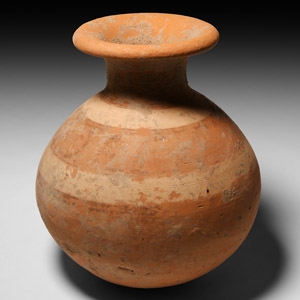
Greek Geometric Storage Vessel
Late 1st millennium B.C.Sold for (Inc. bp): £143
A bulbous ceramic vessel with waisted neck and rolled rim, polychrome painted circumferential bands to the shoulder and neck. 703 grams, 17 cm high
Acquired 1990s. English private collection. Property of an Essex gentleman.
