
Loading, please wait...
_900x900.jpg "Parthian Terracotta Horse-Head Finial")
_200x200.jpg "Parthian Terracotta Horse-Head Finial")
.jpg "Parthian Terracotta Horse-Head Finial")
LOT 0612
Parthian Terracotta Horse-Head Finial
2ND-3RD CENTURY A.D.
3 in. (62 grams, 79.5 mm).
A hollow-formed horse-head finial with ribbed mane to the arched neck, elaborate bridle strap detail.
ProvenanceFrom an important central London collection formed since the mid 1960s; thence by descent.
From the private collection of John Meredith, acquired since the 1990s; thence by descent.
TimeLine Auctions follows a vetting process to ensure the authenticity and legality of all items, reinforcing our commitment to integrity and responsible trading. Each antiquity, antique, and coin lot undergoes thorough examination by a vetting committee of at least ten external specialists, professional trade association members, scientists, and archaeologists: Our Vetting Process
AUCTIONS:
TimeLine is a leading auction house specialising in antiquities, ancient art, collectables, natural history, coins, medals, and books. Our auctions offer museums, collectors, historians, and enthusiasts the opportunity to acquire unique and historically significant pieces.
-
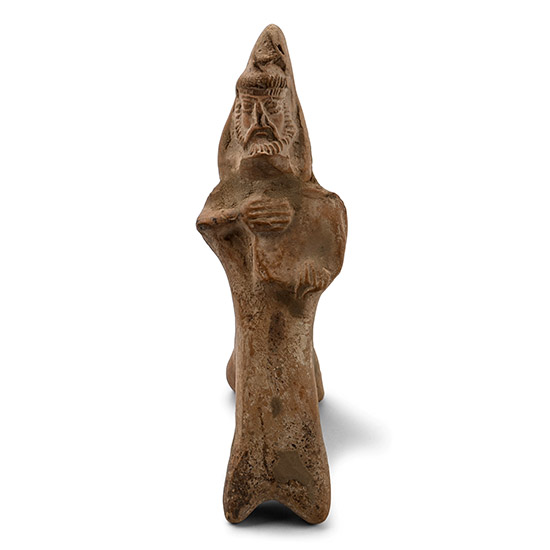
Parthian Horse and Rider Figurine
1st century B.C.-3rd century A.D.Estimate: £150 - 200 (+bp*)
Opening Bid: £75
Formed as a stylised horseman on four splayed legs, with finely modelled facial features and beard; the head of the horse integrated into the rider's body. 97 grams, 12.9 cm
Acquied on the UK art market. Private collection, London, UK. -
.jpg)
Greek Terracotta Figure of Eros, the God of Love
Hellenistic, 3rd-1st century B.C.Estimate: £10,000 - 14,000 (‡+bp*)
Opening Bid: £5,000
Modelled nude in a dynamic pose with his wings spread open, the left leg slightly advanced, and the right arm extended with open palm, a diadem or a fillet on his head; circular socket between the wings; accompanied by a display stand. 808 grams total, 31 cm including stand
Louis-Gabriel Bellon (1819-1899) collection, France. European private collection, 2009. Accompanied by an academic report by Dr Raffaele D’Amato. This lot has been checked against the Interpol Database of stolen works of art and is accompanied by search certificate number no. 13014-246790.
In classical times, Eros was usually depicted as a handsome adolescent, with only his wings distinguishing him from other kaloi and young athletes. Sometimes he was depicted younger and with less masculine features: Lysippos, in the famous statue of Eros of Thespiae, depicted him as a youth. -
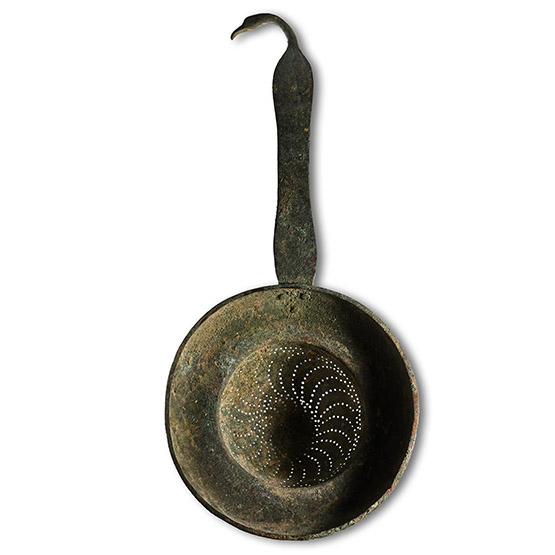
Greek Bronze Swan-Headed Wine Strainer
5th century B.C.Estimate: £2,500 - 3,500 (‡+bp*)
Opening Bid: £1,250
Cup-shaped body with flared and curved rim, flat-section handle with swan-head finial; the body with pierced rosette pattern. 159 grams, 27.4 cm
Acquired in the mid 1980s-1990s. Private collection, Switzerland, thence by descent. Private collection, since the late 1990s. This lot has been checked against the Interpol Database of stolen works of art and is accompanied by search certificate number no.12233-222331.
The Agora excavations in Athens have yielded a large number of funnels, Hellenistic and Roman, which tend to be of a basically similar type, though of course with variations. Perhaps the most important feature of all these funnels is that they were made for use and not for show. The bronze specimen found in Galaxidi is very similar to our strainer.
