
Loading, please wait...
LOT 0052
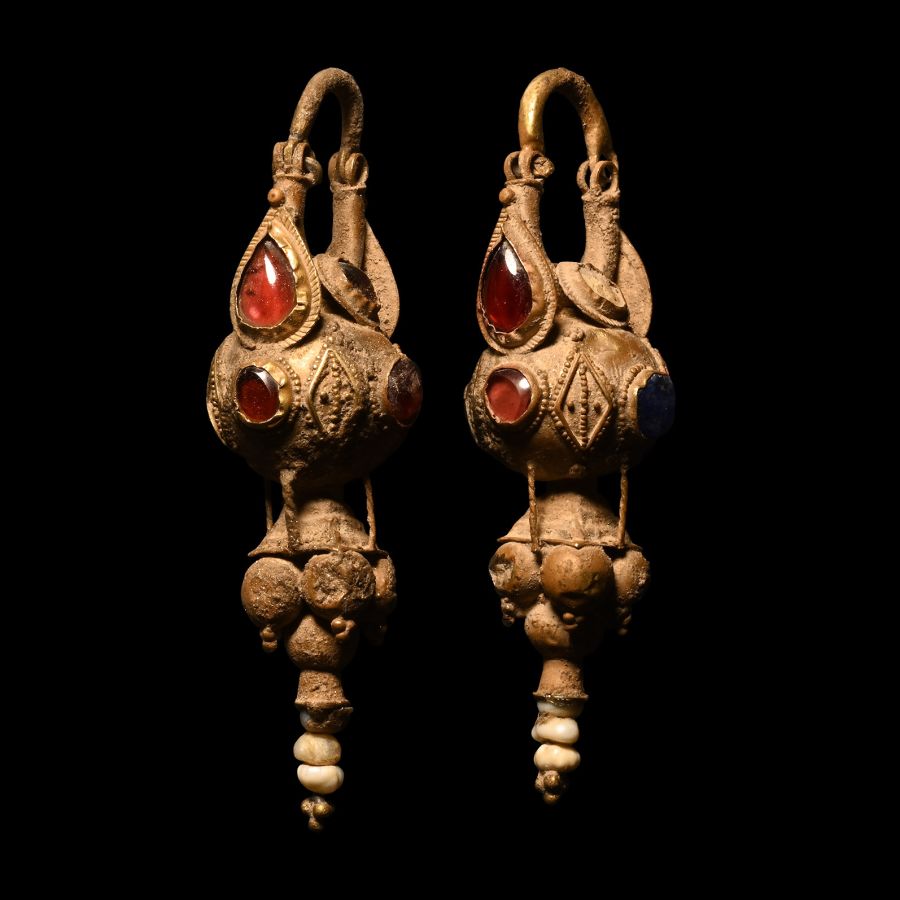
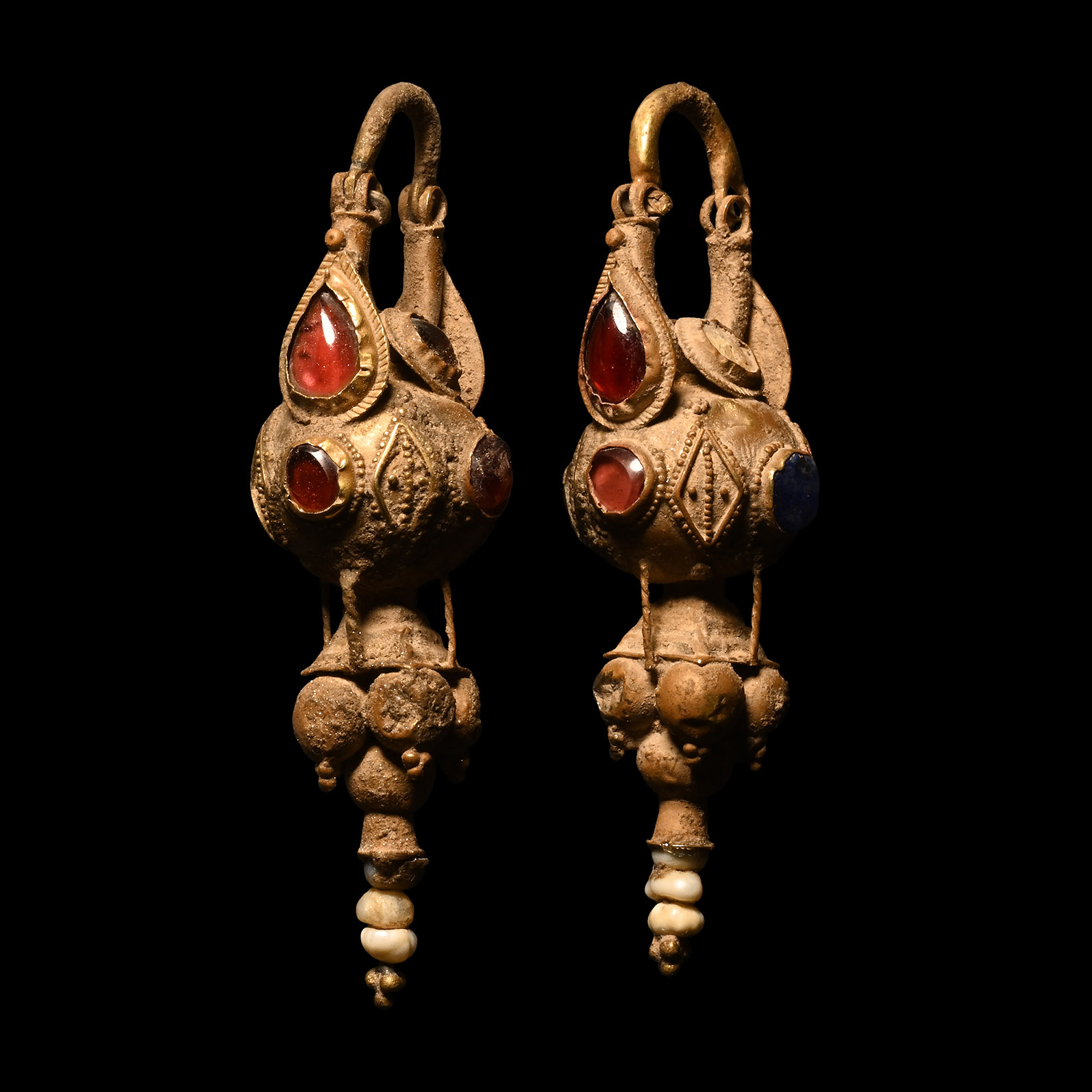
Parthian Gold and Garnet Earrings
2ND-3RD CENTURY A.D.
2 1/4 in. (9.6 grams total, 57 mm each).
A matched pair of gold earrings each a hinged hoop with lateral teardrop cells set with cabochon garnets and disc cells to the apex with similar; bulbous central section with filigree and granulation detailing, cells with lapis lazuli and garnet cloisons; attached with four vertical filigree stringers to a stepped octahedral lower section with applied bosses and pearl seed-beads, granule cluster finial. [2]
ProvenanceAcquired in the late 1980s-early 1990s.
Important North West London collection.
This lot has been checked against the Interpol Database of stolen works of art and is accompanied by search certificate no.11609-199711.
Cf. Marshall, F.H., Catalogue of the Jewellery, Greek, Etruscan and Roman, in the Department of Antiquities, British Museum, London, 1911, item 2587, for type.
CONDITIONTimeLine Auctions follows a vetting process to ensure the authenticity and legality of all items, reinforcing our commitment to integrity and responsible trading. Each antiquity, antique, and coin lot undergoes thorough examination by a vetting committee of at least ten external specialists, professional trade association members, scientists, and archaeologists: Our Vetting Process
AUCTIONS:
TimeLine is a leading auction house specialising in antiquities, ancient art, collectables, natural history, coins, medals, and books. Our auctions offer museums, collectors, historians, and enthusiasts the opportunity to acquire unique and historically significant pieces.
LOT 0052
Parthian Gold and Garnet Earrings
Estimate £2,500 - 3,500€2,900 - 4,060 (for guidance only)$3,380 - 4,730 (for guidance only)
-
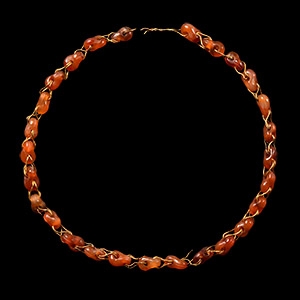
Greek Gold and Carnelian Necklace
1st century B.C.-1st century A.D.Estimate: £3,000 - 4,000 (‡+bp*)
Opening Bid: £1,500
A section of a necklace of carnelian drop-shaped beads, each pierced in two planes and linked loop-in-loop with thin twisted gold wires, possibly later. 8.16 grams, 26 cm long
The Gans collection, Hebling Dec, Berlin, 1929. with Christie's, New York, 8 December 1999, lot 51. Accompanied by a copy of the relevant Christie's catalogue pages. This lot has been checked against the Interpol Database of stolen works of art and is accompanied by search certificate no.11608-198969. -
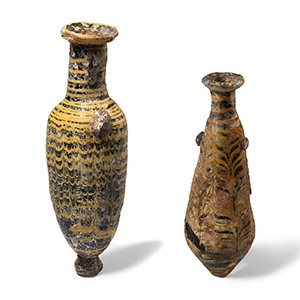
Greek Trailed Glass Vessel Group
2nd-1st century B.C.Estimate: £500 - 700 (‡+bp*)
Opening Bid: £250
A pair of glass vessels with polychrome decoration and iridescent surfaces: an alabastron with fusiform body, conical foot and ledge handles, decorated with yellow feathering and trails; a blue amphoriskos with yellow festooning and trails, knop foot and everted rim; fragmentary. 197 grams total, 11.3-15 cm high
Acquired early 1990s. Ex private American collection; thence by descent. Private collection since 1998. -
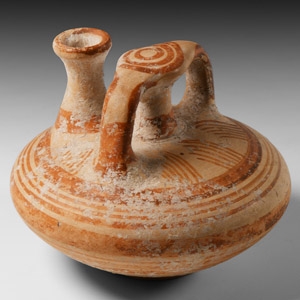
Mycenaean Pottery Stirrup Jar
1400-1200 B.C.Sold for (Inc. bp): £1,430
A pottery vessel formed with a squat carinated body, slender waisted neck and similar central stem with two flanking handles; painted geometric ornament composed of concentric bands and clusters of lines. 154 grams, 91 mm wide
with Christie's, London, South Kensington, 12 December 1989, lot 220.
