
Loading, please wait...
LOT 0080
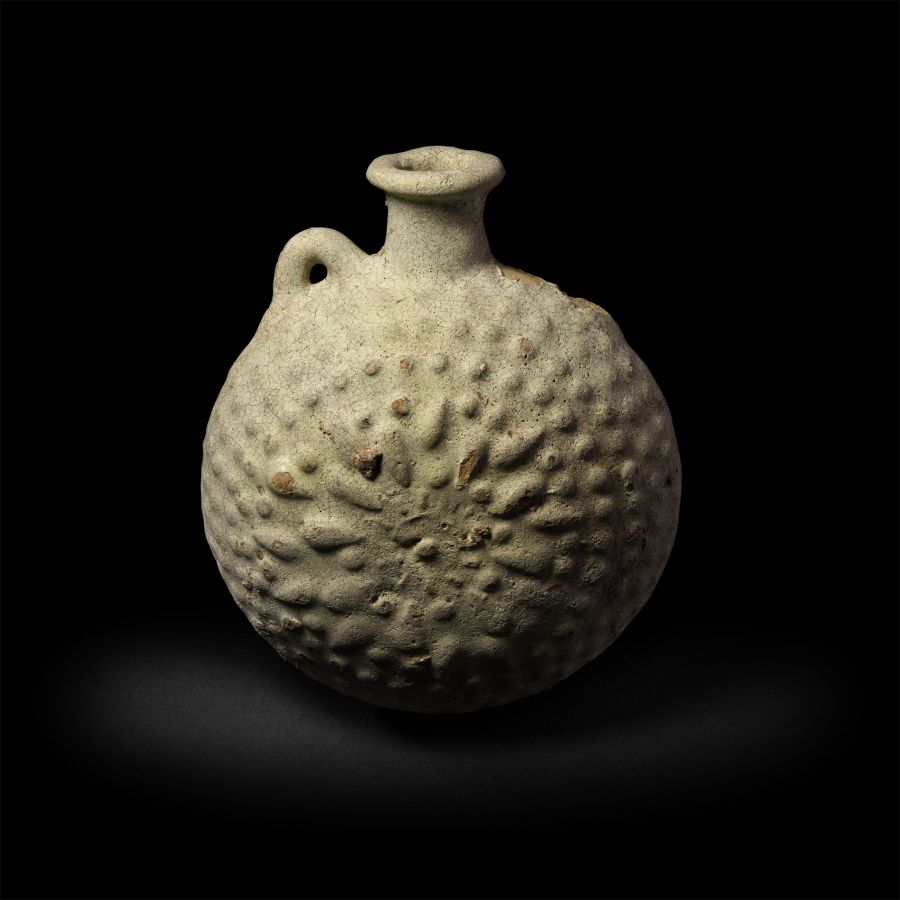
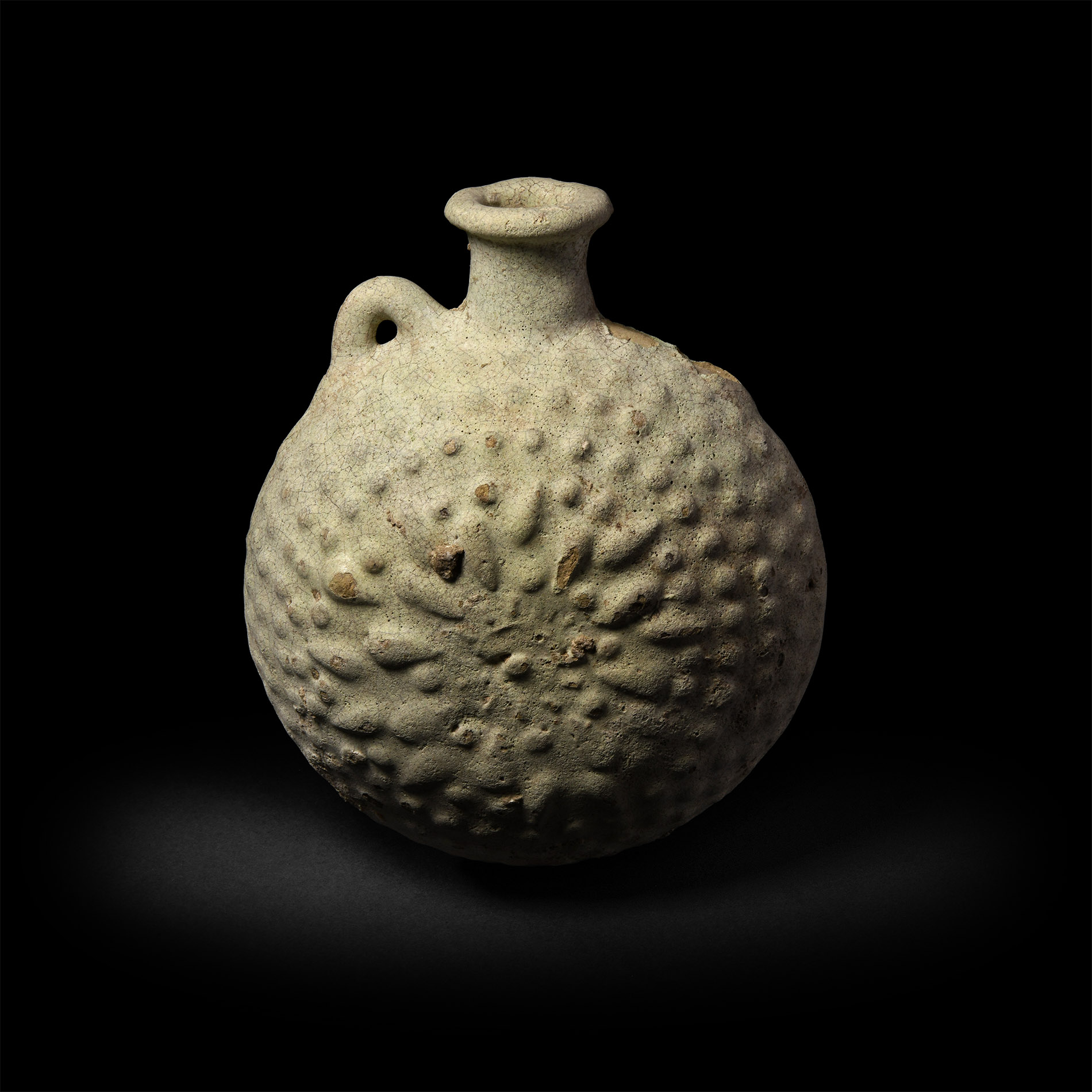
Parthian Faience Pilgrim's Flask
2ND-3RD CENTURY A.D.
7 1/2 in. (812 grams, 19 cm high).
A faience pilgrim’s flask with slender neck and loop handle, raised geometric or floral pattern to both faces; remains of glaze; second loop handle now absent.
ProvenanceAcquired in 1998.
Ex private American collection; thence by descent.
Private Swiss collection since 1998.
Cf. The British Museum, museum number 92024 'pilgrim flask', for a comparable example.
CONDITIONTimeLine Auctions follows a vetting process to ensure the authenticity and legality of all items, reinforcing our commitment to integrity and responsible trading. Each antiquity, antique, and coin lot undergoes thorough examination by a vetting committee of at least ten external specialists, professional trade association members, scientists, and archaeologists: Our Vetting Process
AUCTIONS:
TimeLine is a leading auction house specialising in antiquities, ancient art, collectables, natural history, coins, medals, and books. Our auctions offer museums, collectors, historians, and enthusiasts the opportunity to acquire unique and historically significant pieces.
LOT 0080
Parthian Faience Pilgrim's Flask
Estimate £1,000 - 1,400€1,160 - 1,620 (for guidance only)$1,350 - 1,890 (for guidance only)
-
.jpg)
Hellenistic Gold Ring with Figural Gemstone of Ares
Late 1st century B.C.Estimate: £1,500 - 2,000 (+bp*)
Opening Bid: £750
A hollow-formed gold finger ring with inset carnelian intaglio of a nude Ares wearing a plumed helmet, stooping to fill an amphora. 1.83 grams, 21.79 mm overall, 16.25 mm internal diameter (approximate size British K, USA 5 1/4, Europe 9.95, Japan 9)
Ex private European collection, Mr. W., 1950s-1990s. Acquired in 1998. with Antiquarium Ltd, New York, USA. English private collection. Accompanied by a copy of certificate of authenticity from Antiquarium Ltd, Fine Ancient Arts Gallery, dated 15 December 2016. -
Greek Lock Plate Herm Figure
Circa 3rd century B.C.Sold for (Inc. bp): £130
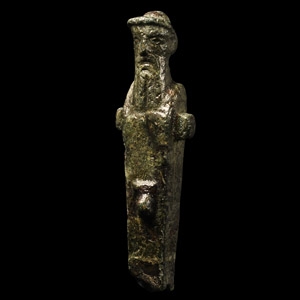
A lock plate formed as a herm figure with tapering square-section body, stylised head and genitals, stub arms. 19.1 grams, 54 mm
German art market, 1990s. Mr A.H., a North American collector living in the UK. -
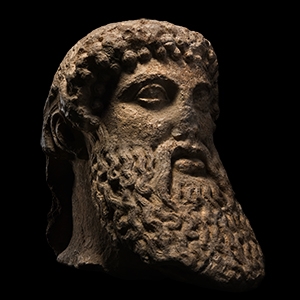
Greek Bearded Hermes Head
1st -2nd century A.D.Estimate: £40,000 - 60,000 (+bp*)
Opening Bid: £20,000
A carved marble head of Hermes with densely curled hair, stern facial expression beneath a broad brow, luxuriant curled beard falling in waves and cut square at the lower edge; mounted on a custom-made display stand; a Roman copy after a 5th century B.C. Greek original. 32.2 kg total, 52 cm high including stand
Slot to top of head.
with Chaucer Fine Arts Ltd, 1980s. English private collection. Accompanied by an academic report by Dr Marina Mattei and Dr Laura Maria Vigna. This lot has been checked against the Interpol Database of stolen works of art and is accompanied by search certificate no.11615-199747.
This type of this archaic sculpture can be traced back to the original of which many copies and variants have been preserved: the Hermes Propylaios by the Attic sculptor Alkamenes, a pupil of Phidias, active in the second half of the 5th century B.C. According to some theories, the herma was created for the Propylaea of the acropolis of Athens, as patron deity of doors and entrances; according to others, this type of bearded Hermes is not to be located at the Propylaea, but in various possible places inside the Acropolis.
