
Loading, please wait...
_900x900.jpg "Parthian Bronze Satyr Oil Lamp Section")
_200x200.jpg "Parthian Bronze Satyr Oil Lamp Section")
.jpg "Parthian Bronze Satyr Oil Lamp Section")
LOT 0099
Parthian Bronze Satyr Oil Lamp Section
1ST CENTURY B.C.-1ST CENTURY A.D.
8 1/4 in. (799 grams, 21 cm).
Fragment comprising: tubular body with raised neck to the filler hole, everted rim and spur to reverse; raised tubular neck and head with pelletted collar, hair and bead, pinched nose, pellet eyes, crescent brow, goat's horn extending above in an arch to meet lateral extension from the brow and remains of similar to the other side; goat's legs below the body with hooves, pelletted bracket at the thigh and part of an arched extension connecting to the brow; nozzle to the forward edge and ovoid everted rim.
ProvenanceAcquired before 1983.
Ex London gallery, 1990s.
Private collection, London, UK.
The theme of the item is similar to the classical satyr, part human and part goat.
CONDITIONTimeLine Auctions follows a vetting process to ensure the authenticity and legality of all items, reinforcing our commitment to integrity and responsible trading. Each antiquity, antique, and coin lot undergoes thorough examination by a vetting committee of at least ten external specialists, professional trade association members, scientists, and archaeologists: Our Vetting Process
AUCTIONS:
TimeLine is a leading auction house specialising in antiquities, ancient art, collectables, natural history, coins, medals, and books. Our auctions offer museums, collectors, historians, and enthusiasts the opportunity to acquire unique and historically significant pieces.
LOT 0099
Parthian Bronze Satyr Oil Lamp Section
Estimate £600 - 800€700 - 930 (for guidance only)$810 - 1,080 (for guidance only)
-
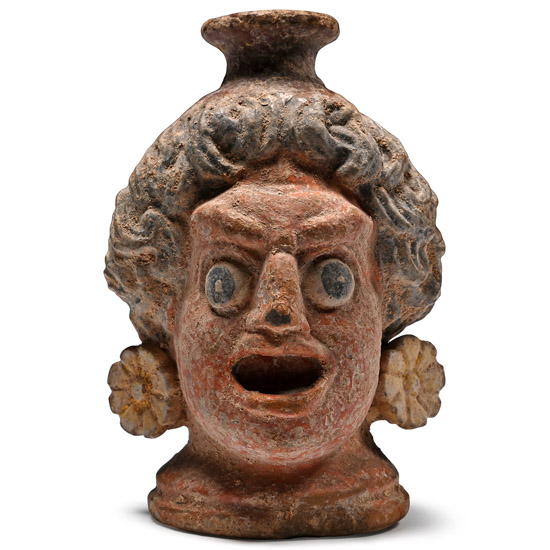
Greek Terracotta Head of an Actor Vase
Circa 4th century B.C.Sold for (Inc. bp): £2,730
An expressive polychrome vase formed as the head of an actor wearing rosette earrings, open mouth and applied pupils, short neck with everted rim above and a small strap handle to the rear. 69.3 grams, 75 mm
Ex Louis-Gabriel Bellon, France, (1819-1899). with Galerie Rhéa, Zurich, Switzerland. This lot has been checked against the Interpol Database of stolen works of art and is accompanied by a search certificate number no.12667-236389.
In Greek theatre, actors wore masks made from materials like linen and leather, which amplified expressions and helped actors take on multiple roles within a single play. Aristotle, in his Poetics, highlighted the importance of masks in conveying emotion and character, especially in large outdoor theatres. This terracotta, representing the satirical mask of a woman, with its lively and expressive features, would have brought both humour and recognisable character traits to the stage, engaging audiences with the playful spirit of Greek comedy. -
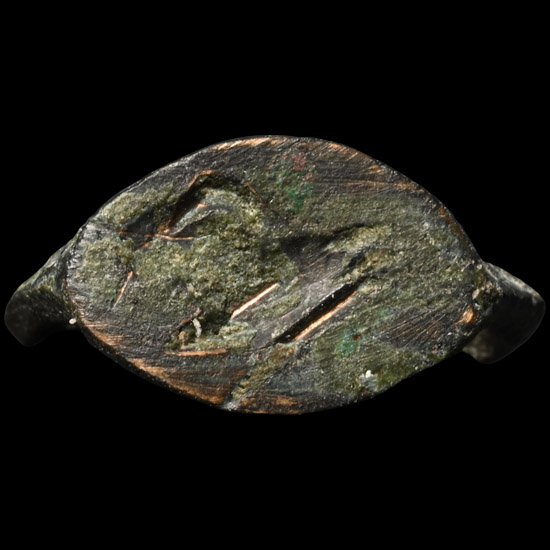
Greek Bronze Child's Ring
Circa 4th-2nd century B.C.Sold for (Inc. bp): £33
Featuring a slender round-section hoop and a lentoid bezel with a reclining ibex. 0.82 grams, 13.19 mm overall, 10.53 mm internal diameter
From the private collection of a European gentleman (1942-2024), formed since the 1970s. -
.jpg)
Greek Agate Gemstone with Running Hound
Circa 300-200 B.C.Sold for (Inc. bp): £59
With intaglio running hound; chipped; supplied with a museum-quality impression. 0.53 grams, 11.01 mm
From the private collection of a European gentleman (1942-2024), formed since the 1970s.
