
Loading, please wait...
_900x900.jpg "Paper Qur'an Page")
_200x200.jpg "Paper Qur'an Page")
_900x900.jpg "Paper Qur'an Page")
_200x200.jpg "Paper Qur'an Page")
.jpg "Paper Qur'an Page")
.jpg "Paper Qur'an Page")
LOT 1362
Paper Qur'an Page
CIRCA 18TH-19TH CENTURY A.D.
13 1/2 x 8 1/2 in. (11 grams, 34.4 x 21.5 cm).
With thirteen lines of Naskh script text to each side, red interlinear diacritics, rosettes, and handwritten note at bottom. [No Reserve]
ProvenanceFrom the private collection of M. Cummings, Lincolnshire, UK, 1990s.
This lot has been cleared against the Art Loss Register database, and is accompanied by an illustrated lot declaration signed by the Head of the Antiquities Department, Dr Raffaele D'Amato.
TimeLine Auctions follows a vetting process to ensure the authenticity and legality of all items, reinforcing our commitment to integrity and responsible trading. Each antiquity, antique, and coin lot undergoes thorough examination by a vetting committee of at least ten external specialists, professional trade association members, scientists, and archaeologists: Our Vetting Process
AUCTIONS:
TimeLine is a leading auction house specialising in antiquities, ancient art, collectables, natural history, coins, medals, and books. Our auctions offer museums, collectors, historians, and enthusiasts the opportunity to acquire unique and historically significant pieces.
-
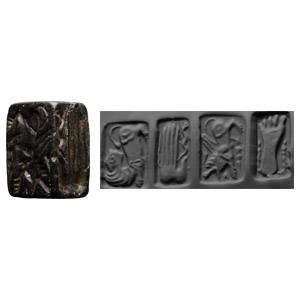
Urartian Black Stone Four-Sided Stamp Seal
Circa 8th-7th century B.C.Sold for (Inc. bp): £468
A cuboid seal with longitudinal piercing, each side with a different motif: a roaring lion(?), a foot imprint, a crouching lion, and a hand with snake to the side; accompanied by a museum-quality impression. 17.9 grams, 26 mm
From the 'S' collection, acquired 1970-1990s. The collection was seen and studied by W.G. Lambert, late Professor of Assyriology at the University of Birmingham, 1970-1993. Accompanied by a copy of a report from Peter Gert Van der Veen, senior lecturer of Levantine Archaeology Johannes Gutenberg-Universität Mainz. This lot has been cleared against the Art Loss Register database, and is accompanied by an illustrated lot declaration signed by the Head of the Antiquities Department, Dr Raffaele D'Amato. -
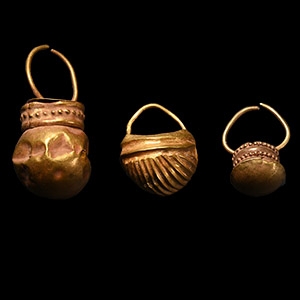
Western Asiatic Gold Earring Group
1st millennium B.C.Estimate: £250 - 350 (+bp*)
Opening Bid: £125
Comprising: one with domed underside, two beaded collars; one with bulbous body and repoussé pellets to the collar; one shell-shaped with ribbing. 3.05 grams total, 17-27 mm
Ex property of a late Japanese collector, 1970-2000s. This lot has been cleared against the Art Loss Register database, and is accompanied by an illustrated lot declaration signed by the Head of the Antiquities Department, Dr Raffaele D'Amato. -
.jpg)
Syro-Hittite Silver Fertility Goddess
Circa early 2nd millennium B.C.Sold for (Inc. bp): £3,900
Sheet-silver female figure with tall lobed headdress, domed knees, breasts and navel, loincloth, parallel legs and tang beneath the feet; applied wire collar; the face with triangular nose and two pellet eyes; left arm detached in two pieces, with old repair. 32.1 grams total, 1.7-12.7 cm
UK private collection, formed in the 1980s. with Bonhams, London, 24 October 2012, no.271 (£8,000-£10,000). Accompanied by copies of the relevant Bonham's catalogue pages. This lot has been checked against the Interpol Database of stolen works of art and is accompanied by a search certificate number no.12532-231395. This lot has been cleared against the Art Loss Register database, and is accompanied by an illustrated lot declaration signed by the Head of the Antiquities Department, Dr Raffaele D'Amato.
