
Loading, please wait...
LOT 0363
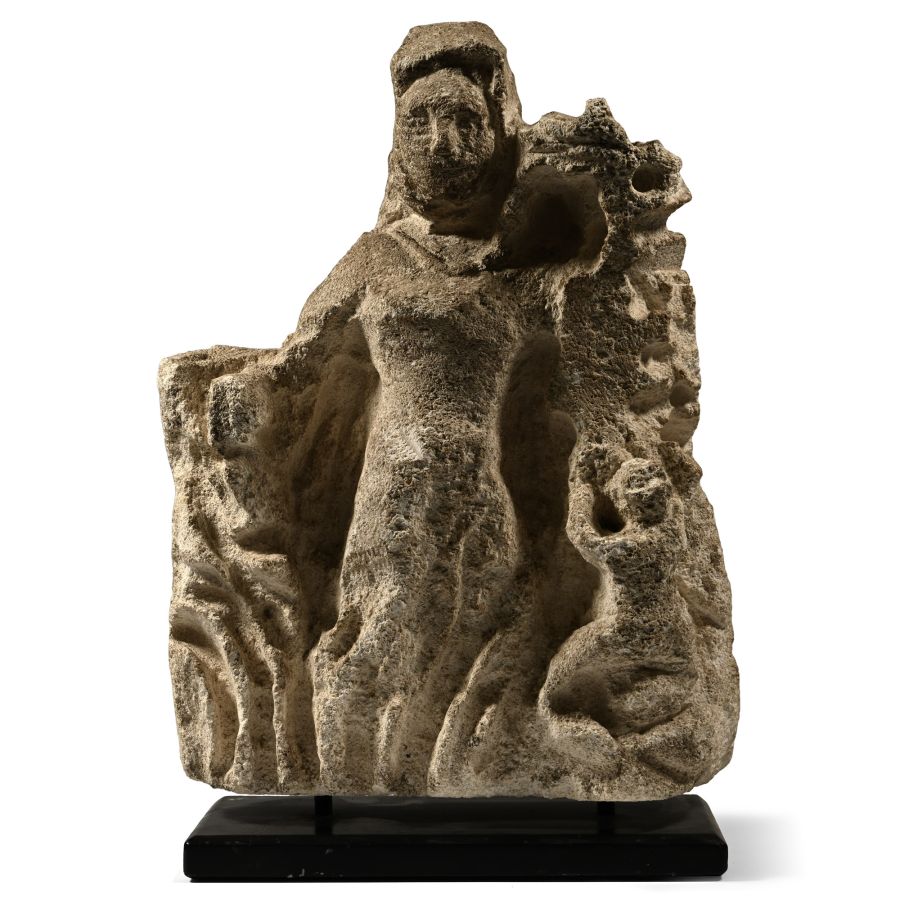
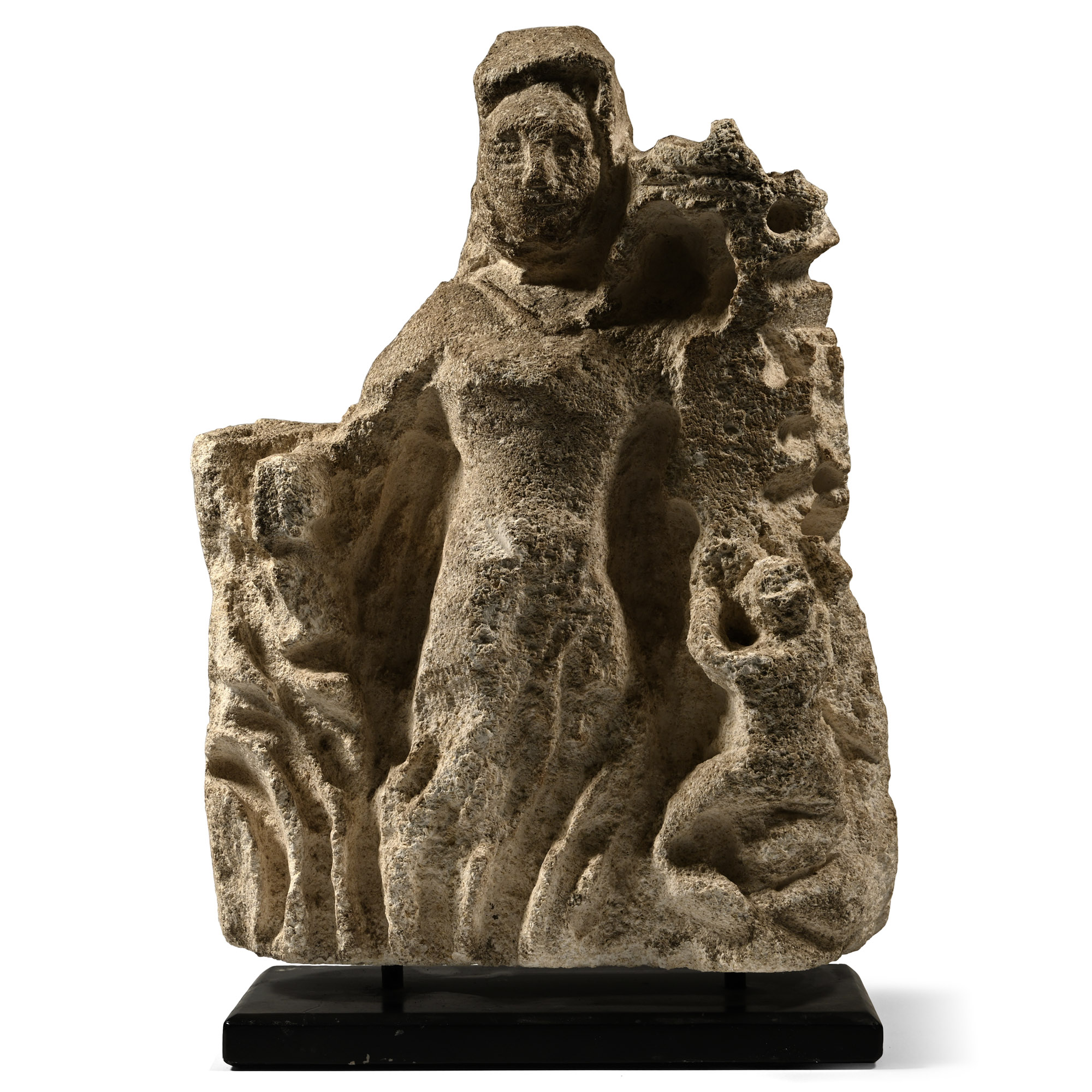
'Our Lady of the Flames' Figural Scene
15TH CENTURY A.D. OR LATER
14 7/8 in. (10.55 kg total, 37.7 cm including stand).
Carved in the half-round frieze fragment or devotional sculpture of the Madonna del Fuoco, facing female in wimple and long robe with her right arm bent forward, left arm extended above a child gripping the folds of her robe; billowing flames surrounding the pair; mounted on a custom-made stand.
ProvenanceAcquired Lukas Pearsie, Suffolk, 2012.
Property of a Kent collector.
From the N.J. collection, Leicester, UK.
This lot is accompanied by an illustrated lot declaration signed by the Head of the Antiquities Department, Dr Raffaele D’Amato.
TimeLine Auctions follows a vetting process to ensure the authenticity and legality of all items, reinforcing our commitment to integrity and responsible trading. Each antiquity, antique, and coin lot undergoes thorough examination by a vetting committee of at least ten external specialists, professional trade association members, scientists, and archaeologists: Our Vetting Process
AUCTIONS:
TimeLine is a leading auction house specialising in antiquities, ancient art, collectables, natural history, coins, medals, and books. Our auctions offer museums, collectors, historians, and enthusiasts the opportunity to acquire unique and historically significant pieces.
LOT 0363
'Our Lady of the Flames' Figural Scene
Estimate £500 - 700€580 - 810 (for guidance only)$680 - 950 (for guidance only)
-
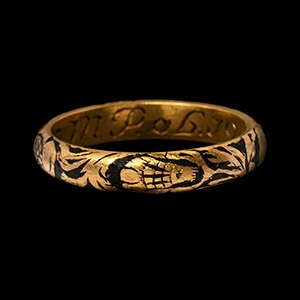
George I Engraved Gold Memento Mori Skull Ring with Black Enamel
Dated 1723 A.D.Sold for (Inc. bp): £3,120
D-shaped in section with black enamelled outer face and reserved skull, bones and foliage; engraving to inner face 'M.P. ob. 19 Aug .1723 aet 47' and maker's mark 'D.M'. 4.99 grams, 20.97 mm overall, 17.41 mm internal diameter (approximate size British N 1/2, USA 6 3/4, Europe 14.35, Japan 13)
Acquired on the UK art market. Property of an East Sussex collector. This lot has been checked against the Interpol Database of stolen works of art and is accompanied by a search certificate number no.12555-231633. This lot has been cleared against the Art Loss Register database, and is accompanied by an illustrated lot declaration signed by the Head of the Antiquities Department, Dr Raffaele D’Amato.
This maker's mark is not listed in the standard works, e.g. Jackson, Sir C.J., English Goldsmiths and Their Marks, London, 1921. -
.jpg)
Post Medieval Embroidered Mitre and Tooled Leather Case
France, circa 1700-1720 A.D.Sold for (Inc. bp): £1,950
Two boards from an episcopal mitre with linen facing and dense silver-thread foliage ornament to each; housed in a custom-made wooden case with linen lining, leather-covered with tooled and gilt detailing to both faces and sides, episcopal arms to upper face with Catholic episcopal headgear over a heater shield with three fleurs-de-lys in chief and a bend sinister lozengy; to the reverse, five radiating arms pierced to allow straps to pass beneath to secure the lid. 1.38 kg, 43 cm
Francesca Galloway Ltd, 2001. This lot is accompanied by an illustrated lot declaration signed by the Head of the Antiquities Department, Dr Raffaele D’Amato. -
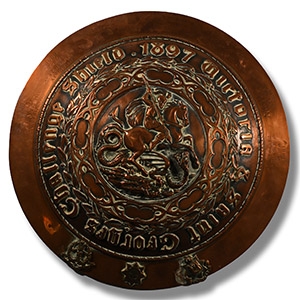
Victoria and St George's Rifles Challenge Shield
1897 A.D.Sold for (Inc. bp): £52
With embossed St. George and the Dragon, surrounded by '1897, Victoria & Saint Georges Challenge Shield', presented by Mrs. W. Clemence, with nine winners noted around the outer edge. 1.04 kg, 39.5 cm
Presented by Mrs W. Clemence in 1897. Property of a Stockport, UK, collector. This lot is accompanied by an illustrated lot declaration signed by the Head of the Antiquities Department, Dr Raffaele D’Amato.
The regiment was raised as the 1st (Victoria Rifle Club) Middlesex Rifle Volunteer Corps and became the 1st Middlesex Rifle Volunteer Corps on the formation of the Volunteer Force in 1860. By 1892 the 1st Middlesex and 6th (St George's) Rifle Volunteer Corps were joined together.
