
Loading, please wait...


LOT 2115
Original NASA Press Photograph Group
1960S A.D.
10 x 8 in. (74 grams total, 25.6 x 20.4 cm each).
Comprising: monochrome photographic print of a rocket on the launchpad, endorsed 'US Air Force Photo... 8-26-66 CKMYA Titan-Project OfficeSunrise Pre-Launch after Service Tower removal (Palm Tree in foreground) Unclassified'; monochrome photographic print of a rocket leaving the launchpad, endorsed 'US Air Force Photo..Air Force eastern Test [...] Photographic Laboratory Operated by RCA. CKMYA Titan-3C. Launch of Titan-3C Unclassified.'; monochrome photographic print of two rockets leaving their launchpads, endorsed 'US Air Force Photo / Air Force Eastern Test Range Photographic Laboratory Operated by RCA. NASA/GEMINI & Atlas Agena. Unclassified.'; monochrome photographic print of Apollo 9 capsule with flotation ring, endorsed 'John F. Kennedy Space Center. NASA Kennedy Space Center. Florida 32899. For Release March 13, 1969. Photo No. 108-KSC-69P-186 69-H-453. Aboard the USS Guadalcanal - The scorched Apollo 9 spacecraft, cradled in a foatation collar, is hoisted aboard the USS Guadalcanal. prime recovery ship, after safely carrying astronauts James A. McDivitt, David P. Scott and Russell L. Schweikart to splashdown in the Atlantic Ocean. The spacecraft shielded the astronauts from reentry temperatures which exceeded 2,000 degrees. They splashed down at 12:01 pm EST March 13, 1969, at the completion of their 10-day earth orbital mission to test a lunar module spacecraft. Ipact was less than 5 miles from the recovery ship and 780 nautical miles southast of Cape Kennedy. They were launched by an Apolo/Satrn V space vehicle March 3 from the Kennedy Space Center. The National Aeronautics and Space Administration directs the Apollo program. [copyright information.]' [4, No Reserve]
ProvenanceAcquired on the USA art market.
Property of a Harwich, UK, collector.
TimeLine Auctions follows a vetting process to ensure the authenticity and legality of all items, reinforcing our commitment to integrity and responsible trading. Each antiquity, antique, and coin lot undergoes thorough examination by a vetting committee of at least ten external specialists, professional trade association members, scientists, and archaeologists: Our Vetting Process
AUCTIONS:
TimeLine is a leading auction house specialising in antiquities, ancient art, collectables, natural history, coins, medals, and books. Our auctions offer museums, collectors, historians, and enthusiasts the opportunity to acquire unique and historically significant pieces.
-

Post Medieval Silver Ring with Eros, the God of Love Seated
Circa 18th-19th century A.D.Sold for (Inc. bp): £78
Flat-section hoop expanding towards the shoulders, a separately made rectangular bezel with seated winged Eros before a woven basket; the shoulder's stamped with '84' and 'A?'. 1.62 grams, 21.05 mm overall, 19.35 x 19.01 mm internal diameter (approximate size British Q 1/2, USA 8 1/4, Europe 18.12, Japan 17)
Acquired on the UK art market. Property of a Suffolk, UK, gentleman. -
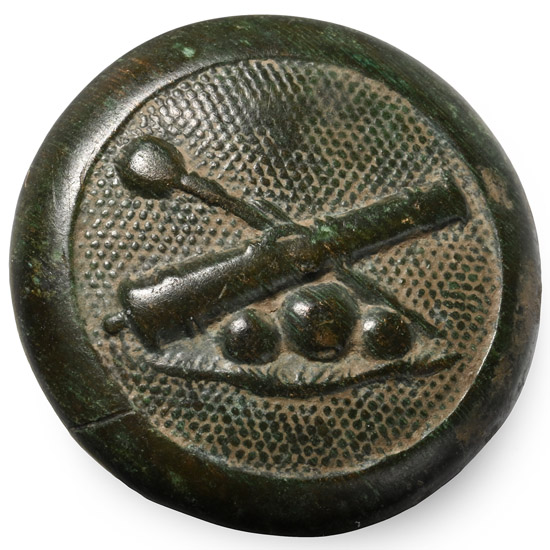
WWI Bronze Button with Cannon and Shot
20th century A.D.Sold for (Inc. bp): £20
Military uniform button, domed in profile with loop to reverse; low-relief cannon, ramrod and shot reserved against a hatched field; Austro-Hungarian field artillery regimen. 3.8 grams, 23 mm
From the private collection of Mr Brian Edwards, New Malden, Surrey, UK, formed from the late 1970s-early 1980s; thence by descent. Accompanied by the original collector's data sheet(s) with reference no.A95. -

Renaissance Gold Fob Seal with Carnelian Gemstone of a Herm and Figures
16th-19th century A.D.Estimate: £1,000 - 1,400 (+bp*)
Opening Bid: £500
An oval intaglio finely engraved with a classical scene, at the centre a herm upon a plinth, flanked by two figures: the woman on the left wearing a gown with loose drapery falling across her arms, while the figure to the right is shown nude, the body scarcely veiled by a fine transparent cloth; at the far right a sacrificial altar surmounted by a lyre, introducing a musical or poetic dimension to the scene and emphasising its votive character; mounted in an ornate 18th-century French gold fob mount, pierced with scrolling foliate ornament and stamped with duty marks; supplied with a museum-quality impression. 6.60 grams, 25 mm
Acquired on the European art market.
The gem, cut in the 16th century, reflects the Renaissance revival of antique glyptic art, where Roman prototypes were carefully studied and reinterpreted with elegance and precision. The finely executed incision and harmonious arrangement of clothed and unclothed figures highlight the engraver’s technical mastery and antiquarian erudition.
