
Loading, please wait...


LOT 2041
Original General Electric 'Frigéco' Poster
1950S A.D.
31 1/2 x 11 in. (17 grams, 80 x 28 cm).
Landscape-format commercial poster for the Francophone refrigerator market: white ground with overprinted green field, black and red detailing; ident number 'REF/263' to lower left. [No Reserve]
ProvenanceAcquired on the UK art market.
Property of a Harwich, UK, collector.
General Electric white goods were marketed in French-speaking markets by the Frigéco company in the post-WWII era.
CONDITIONTimeLine Auctions follows a vetting process to ensure the authenticity and legality of all items, reinforcing our commitment to integrity and responsible trading. Each antiquity, antique, and coin lot undergoes thorough examination by a vetting committee of at least ten external specialists, professional trade association members, scientists, and archaeologists: Our Vetting Process
AUCTIONS:
TimeLine is a leading auction house specialising in antiquities, ancient art, collectables, natural history, coins, medals, and books. Our auctions offer museums, collectors, historians, and enthusiasts the opportunity to acquire unique and historically significant pieces.
LOT 2041
Original General Electric 'Frigéco' Poster
Estimate £40 - 60€46 - 70 (for guidance only)$54 - 81 (for guidance only)
-
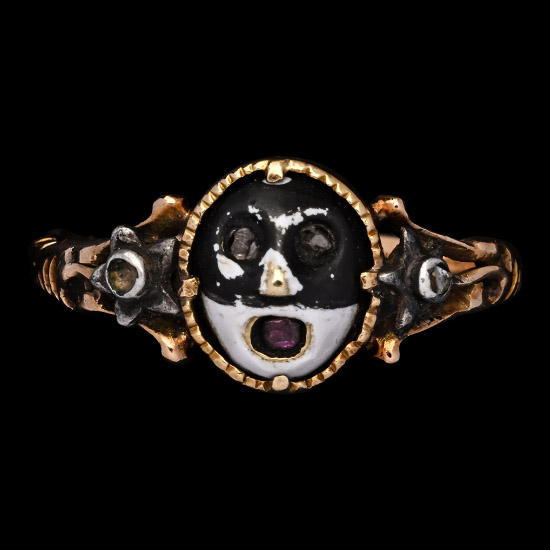
Gem-Set Gold Masquerade Ring with Love Inscription
Italy, circa 1760 A.D.Estimate: £5,000 - 7,000 (+bp*)
Current Winning Bid: £2,500
Finely modelled with a black-and-white enamelled mask, the features animated by rose-cut diamond eyes and a small ruby set into the open mouth; the head framed by a serrated gold collet and flanked by silver foliate clusters each set with a further rose-cut diamond; the shank formed as asymmetrical rococo scrolls with pierced and chased detailing throughout, the reverse of the bezel open, revealing white enamel engraved with faint traces of an original posy inscription. 2.28 grams, 21.10 mm overall, 17.45 x 16.35 mm internal diameter (approximate size British N, USA 6 1/2, Europe 13.72, Japan 13)
The enamel remains entirely original and unrestored.
Acquired on the European art market. This lot has been checked against the Interpol Database of stolen works of art and is accompanied by search certificate number no.13321-257909.
Though now largely worn, the underside of the bezel would likely have borne a concealed love sentiment, comparable to the formula Je cache mes amours ('I mask my love'), found on related rings of mid-18th-century manufacture. The theme of the masked lover, drawn from contemporary masquerade culture and its associations with flirtation, secrecy, and clandestine courtship, here transforms the jewel into a witty and intimate token. -

Gas / Petrol Station Original Poster Sign
1920-1940 A.D.Estimate: £80 - 100 (+bp*)
Opening Bid: £40
White coarse paper poster with red printed warning notice for a petrol station; to foot 'copies from Simpsons the Printers, Friar Gate, Derby'. 22 grams, 76.2 x 50.6 cm
Acquired on the UK art market. Property of a Harwich, UK, collector.
'Simpsons the Printers' was a local printing company specialising in postcards and photographic materials, active until the early 1960s. -
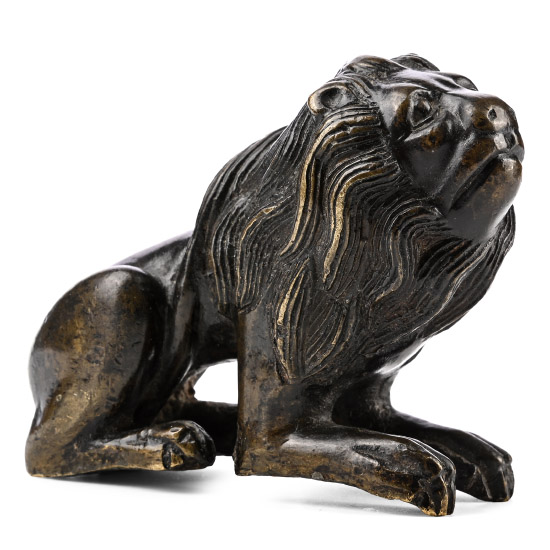
Nuremberg Brass Lion Statue
Germany, 16th century A.D.Estimate: £500 - 700 (+bp*)
Opening Bid: £250
Modelled in a half-seated pose, gazing upwards with compact body, broad forequarters, the mane rendered in long, parallel strands; the tail emerging from underneath the body and resting diagonally on top of the neck. 855 grams, 96 mm
Acquired on the European art market.
The treatment reflects the continuation of late Gothic conventions within German workshops, while also aligning with the more classicising tendencies found in North Italian bronze production of the period. The anatomical structure is simplified yet purposeful, characteristic of functional or cabinet bronzes produced across central Europe in the sixteenth century. Its scale and form correspond to small bronzes intended for Kunstkammer settings or as elements within larger composite objects such as inkstands or caskets, where the lion served as an emblem of vigilance, authority, and learned taste.
