
Loading, please wait...


LOT 2111
Original Copper Plate Engravings by Daniel Meisner and Others of Inca Rulers and Oliver Cromwell
17TH-18TH CENTURY A.D.
7 x 5 1/2 - 11 1/2 x 8 5/8 in. (114 grams total, 18 x 14 - 29.1 x 22 cm).
Comprising: buff paper page from Meisner's 'Thesaurus Philo-Politicus' (1625-1630) with engraved image of a city and cockerel in foreground, title 'Prospice Domui E100' and 'Beaumont', Latin and German rhymed couplets below; buff paper page with engraved image of a walled fortress and lion in foreground with Cupid, title 'Omnia Domat Amor G41' and 'Carlemont', Latin and German rhymed couplets below; two examples of buff paper page with engraved image of a city and river with fishermen holding a net in foreground, title 'Fraus et Ubique Dolus' and 'Rüssel', Latin and German rhymed couplets below, one numbered 'Ez' and the other '35'; portrait in three-quarter view of Oliver Cromwell with signature (Walker?) below, and legend above 'London, published 25 July 1881 by P.& D.Colnaghi & Co. 13 & 14 Pall Mall East'; print in card reveal with five busts of rulers, each with an axe and stepped headress, with legend 'Manco-Capac 1st Emperor of Peru', 'Sinchi-Roca. II Emp.', 'Loque-Yupanqui, III Emp.', Mayta-Capac, IV Emp.', 'Capac-Yupanqui. V Emp.', printed titled 'Gent.Mag. Nov.1751'. [No Reserve]
ProvenanceAcquired on the UK art market.
Property of a Harwich, UK, collector.
TimeLine Auctions follows a vetting process to ensure the authenticity and legality of all items, reinforcing our commitment to integrity and responsible trading. Each antiquity, antique, and coin lot undergoes thorough examination by a vetting committee of at least ten external specialists, professional trade association members, scientists, and archaeologists: Our Vetting Process
AUCTIONS:
TimeLine is a leading auction house specialising in antiquities, ancient art, collectables, natural history, coins, medals, and books. Our auctions offer museums, collectors, historians, and enthusiasts the opportunity to acquire unique and historically significant pieces.
LOT 2111
Original Copper Plate Engravings by Daniel Meisner and Others of Inca Rulers and Oliver Cromwell
Estimate £80 - 100€93 - 116 (for guidance only)$108 - 135 (for guidance only)
-
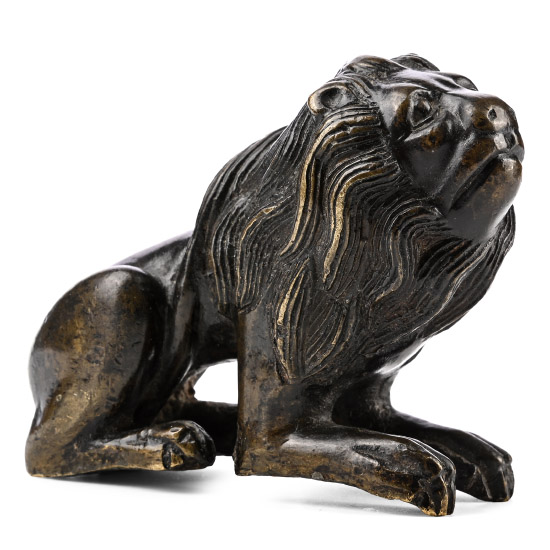
Nuremberg Brass Lion Statue
Germany, 16th century A.D.Estimate: £500 - 700 (+bp*)
Opening Bid: £250
Modelled in a half-seated pose, gazing upwards with compact body, broad forequarters, the mane rendered in long, parallel strands; the tail emerging from underneath the body and resting diagonally on top of the neck. 855 grams, 96 mm
Acquired on the European art market.
The treatment reflects the continuation of late Gothic conventions within German workshops, while also aligning with the more classicising tendencies found in North Italian bronze production of the period. The anatomical structure is simplified yet purposeful, characteristic of functional or cabinet bronzes produced across central Europe in the sixteenth century. Its scale and form correspond to small bronzes intended for Kunstkammer settings or as elements within larger composite objects such as inkstands or caskets, where the lion served as an emblem of vigilance, authority, and learned taste. -
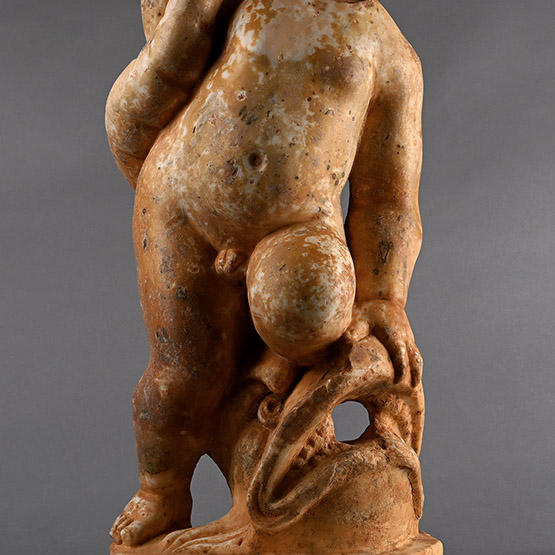
Marble Fountain Sculpture of a Putto Wrestling a Fish
Baroque, 17th century A.D.Sold for (Inc. bp): £598
Standing on an angular base resting his left knee on the open jaws of a fish, his left arm holding the jaws open, the body and tail held upright be the raised right hand (partly absent); with heavy sulphured patina. 20.75 kg, 48 cm
Acquired prior to 1970. From the estate of a Swiss gentleman, Ticino. Private collection, Zurich, Switzerland. This lot has been checked against the Interpol Database of stolen works of art and is accompanied by a search certificate number no.12790-240308.
In ancient Roman art and architecture, fountains were often decorated with sculptures of young boys or putti holding fish. These sculptures were known as 'putti with fish' or 'boy with fish' and were a popular motif in the decoration of fountains. The young boy or putto was shown holding a fish or a shell, which would spout water into the fountain basin below. The fish was a particularly popular motif because it symbolised abundance, fertility, and prosperity, which were all important values in ancient Roman society. Overall, the putti with fish sculptures are a notable example of the art and architecture of ancient Rome and have continued to be an enduring symbol of beauty, abundance, and prosperity throughout the centuries. Archaeological excavations in Pompeii have revealed many examples of sculptures of putti with fish. The putti with fish sculptures from Pompeii were usually made of bronze, marble, or terracotta. They were often placed in the centre of the fountain, surrounded by other decorative elements such as flowers, plants, and other sculptures. Many of these putti with fish sculptures are now on display in the National Archaeological Museum of Naples. The museum also houses a famous mosaic of a putto with a fish, which was discovered in the House of the Faun in Pompeii. The putti with fish sculptures from Pompeii and those in the Naples Museum provide valuable insights into the art and culture of ancient Rome. They demonstrate the importance of beauty and abundance in ancient Roman society and offer a glimpse into the everyday life of the people who lived in Pompeii over two thousand years ago. In the 17th and 18th centuries these sculptures were imitated and used to decorate the fountains of royal palaces and palaces. -
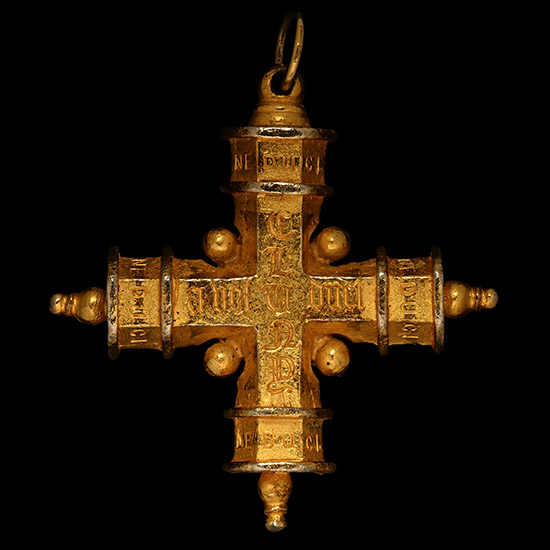
Spanish Silver-Gilt Cross Pendant
20th century A.D.Sold for (Inc. bp): £572
Hollow-formed with hexagonal-section arms, each with a raised collar bearing an incised legend 'ME DU CI TO CE LOS' and granule finial; granules between the arms; blackletter legend 'CLUNY' vertically and 'a vol duci' horizontally; suspension ring. 33.32 grams, 59 mm
Ex Cornish collection, UK. Property of a London, UK, antiquarian.
The Abbaye de Cluny is a site of pilgrimage, a former Benedictine monastery.
