Loading, please wait...
LOT 1319
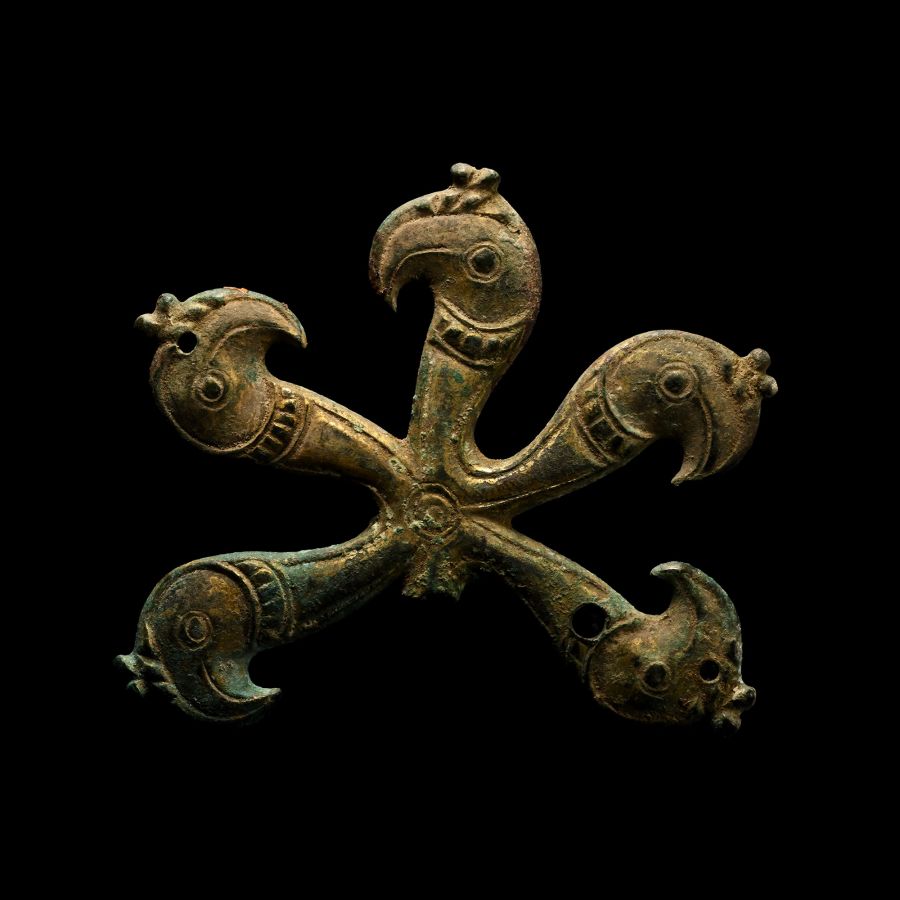
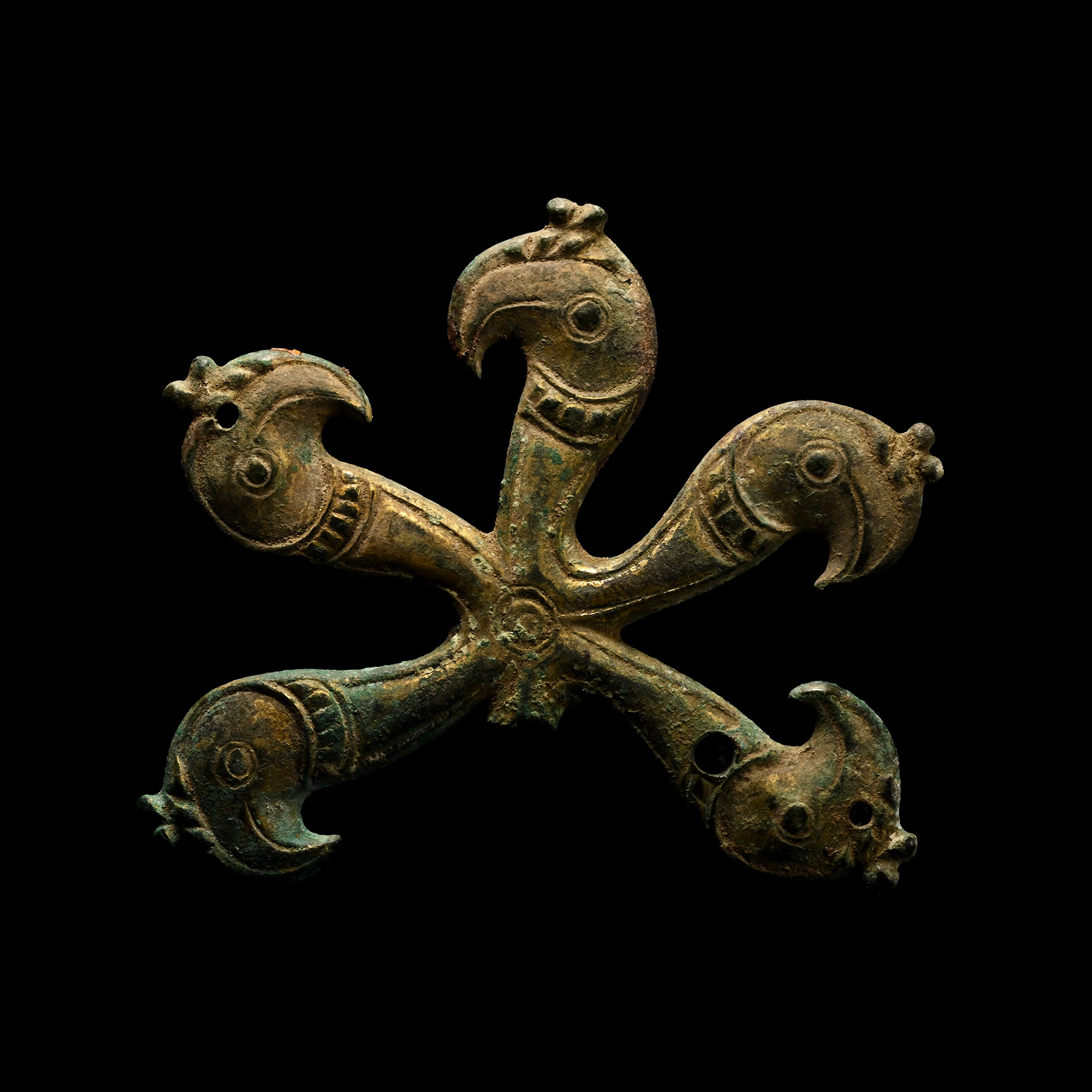
Ordos Gilt Bronze Zoomorphic Applique
CIRCA 4TH CENTURY B.C.
3 in. (44.5 grams, 77 mm).
Consisting of five (one absent) long-necked eagle heads facing in opposite directions, the beaked heads with raised eyes, necks decorated with a necklace imitating precious stones; three attachment holes.
ProvenanceAcquired in the mid 1980s-1990s.
Private collection, Switzerland, thence by descent.
Cf. for similar bird heads see plaques from Melgunov Kurgan, in Andreeva, P., Fantastic Beasts Of The Eurasian Steppes: Toward A Revisionist Approach to Animal-Style Art, Penn, 2018, fig.2.41, p.123.
FootnotesPossibly an applique from a quiver.
CONDITIONTimeLine Auctions follows a vetting process to ensure the authenticity and legality of all items, reinforcing our commitment to integrity and responsible trading. Each antiquity, antique, and coin lot undergoes thorough examination by a vetting committee of at least ten external specialists, professional trade association members, scientists, and archaeologists: Our Vetting Process
AUCTIONS:
TimeLine is a leading auction house specialising in antiquities, ancient art, collectables, natural history, coins, medals, and books. Our auctions offer museums, collectors, historians, and enthusiasts the opportunity to acquire unique and historically significant pieces.
-
Judean Silver Bracelet with Lion-Head Terminals Holding a Menorah
Circa 2nd-3rd century A.D.Sold for (Inc. bp): £624
Composed of two decoratively twisted hoops, terminals formed as two facing lion (or lioness) heads supporting the bezel, a twisted roundel, in their mouths, central bifacial swivel plaque displaying a menorah flanked by letters 'W-T' on both faces; articulate join between hoops and animal heads. 36.1 grams, 73 mm
Acquired before 1988. From the collection of a deceased collector. -
Sumerian Terracotta Bulla
4th millennium B.C.Sold for (Inc. bp): £468
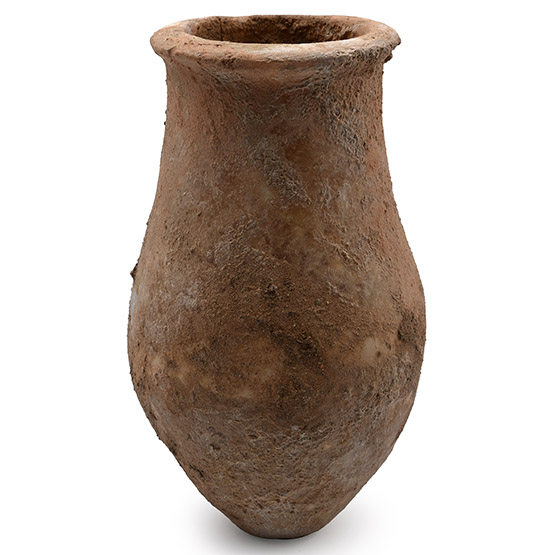
A bulla with oval stamped impression of two animals. 147 grams, 60 mm
Specialised collection of cuneiform texts, the property of a London gentleman and housed in London before 1988. Thence by descent to family members. Examined by Professor Wilfrid George Lambert FBA (1926-2011), historian, archaeologist, and specialist in Assyriology and Near Eastern archaeology, in the late 1980s and early 1990s. The collection is exceptional for the variety of types, including some very rare and well preserved examples. Accompanied by a copy of a previous catalogue page.
Small globular and hollowed clay balls are defined as 'bulla'. They are also known as ‘bulla-envelopes', some of which are plain and some displaying epigraphic, zoomorphic and/or figural decoration, impressed by either cylinder or stamp seals. Bulla first emerged in Mesopotamia and their earliest occurrence can be traced to circa 8000 B.C. Most know decorated bullae come from the Uruk area and offer an insight into its culture. This bulla represents a religious scene, indicated by the combination of the pyramid-shaped byre and the 'sacred herd', which are seen on the early Uruk seals. The symbol of the Mother-Goddess, presented in conjunction with the representations of sheep herd and byre, gave such imagery symbolic significance. The impression with two sheep depicted under the byre, might have been impressed by a stamp seal of the early Uruk period. -
Central Asian Bronze Stamp Seal with Stylised Four-Winged God
Circa 2300-2000 B.C.Sold for (Inc. bp): £208
Formed as three vertical bars joined near the base; accompanied by an old scholarly note, typed and signed by W.G. Lambert, late Professor of Assyriology, University of Birmingham, 1970-1993, which states: 'Stamp Seal of Bronze 54 x 48 x 26mm This bears the shape of the design, with flat face and flat back, on which is mounted a handle of angular shape with rounded top. The piece has roughly three parallel vertical segments, which join in the middle, the whole being surrounded by a rim. Each segment has a row of dots in it: four in the two outer segments, six in the middle one, which is longer. This comes from western central Asia and dates to c. 2300-2000 B.C. It is extremely rare for its design, which may be understood as a stylized depiction of a standing four-winged god, but this is not completely certain.The piece is generally in good condition, but is a little bent.' 25 grams, 53 mm
Ex S collection, deceased, London, UK, 1990s. Accompanied by an original scholarly note, typed and signed by Professor Wilfrid George Lambert.