
Loading, please wait...
_900x900.jpg "Old Babylonian Haematite Cylinder Seal")
_200x200.jpg "Old Babylonian Haematite Cylinder Seal")
.jpg "Old Babylonian Haematite Cylinder Seal")
LOT 1398
Old Babylonian Haematite Cylinder Seal
2ND MILLENNIUM B.C.
5/8 in. (3.24 grams, 15 mm).
Frieze depicting a kneeling huntsman with inverted spear and khopesh facing a rampant ibex with head turned away, crouching gryphon with forelegs raised, bird in flight preying on a recumbent ibex; supplied with a museum-quality impression.
ProvenanceFrom the 'S' collection, acquired 1970-1990s.
The collection was seen and studied by W.G.Lambert, late Professor of Assyriology at the University of Birmingham, 1970-1993.
This lot has been cleared against the Art Loss Register database, and is accompanied by an illustrated lot declaration signed by the Head of the Antiquities Department, Dr Raffaele D'Amato.
TimeLine Auctions follows a vetting process to ensure the authenticity and legality of all items, reinforcing our commitment to integrity and responsible trading. Each antiquity, antique, and coin lot undergoes thorough examination by a vetting committee of at least ten external specialists, professional trade association members, scientists, and archaeologists: Our Vetting Process
AUCTIONS:
TimeLine is a leading auction house specialising in antiquities, ancient art, collectables, natural history, coins, medals, and books. Our auctions offer museums, collectors, historians, and enthusiasts the opportunity to acquire unique and historically significant pieces.
-
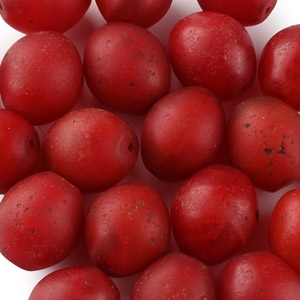
Glass Bead Group
20th century A.D.Sold for (Inc. bp): £7
Comprising twenty large crimson-coloured barrel-shaped beads. 246 grams total, 22 mm each
Ex collection of a late London gentleman, 1970-1990s. This lot has been cleared against the Art Loss Register database, and is accompanied by an illustrated lot declaration signed by the Head of the Antiquities Department, Dr Raffaele D'Amato. -
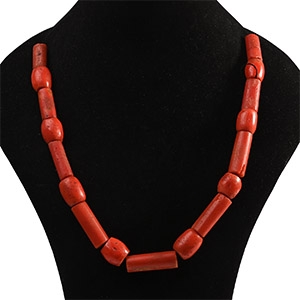
Glass Bead Necklace String
20th century A.D.Sold for (Inc. bp): £98
Composed of large coral pink-coloured cylindrical and ellipsoid beads; restrung. 170 grams, 46 cm
Ex collection of a late London gentleman, 1970-1990s. This lot has been cleared against the Art Loss Register database, and is accompanied by an illustrated lot declaration signed by the Head of the Antiquities Department, Dr Raffaele D'Amato. -
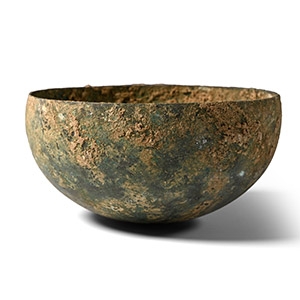
Luristan Bronze Bowl
1st millennium B.C.Sold for (Inc. bp): £104
Of a rounded profile with rounded base. 140 grams, 10.6 cm
Ex London, UK, collections, 1990s-2000s. This lot has been cleared against the Art Loss Register database, and is accompanied by an illustrated lot declaration signed by the Head of the Antiquities Department, Dr Raffaele D'Amato.
These kind of vessels, used found in the graves in the Luristan necropolises, were part of the gifts placed around and on the body.
