
Loading, please wait...
_900x900.jpg "Old Anatolian Stone Cylinder Seal")
_200x200.jpg "Old Anatolian Stone Cylinder Seal")
.jpg "Old Anatolian Stone Cylinder Seal")
LOT 0195
Old Anatolian Stone Cylinder Seal
2ND-1ST MILLENNIUM B.C.
1 1/2 in. (72.1 grams, 40 mm).
With frieze depicting a facing anthropomorphic figure placed tête-bêche with another; supplied with a museum-quality impression.
ProvenanceFrom the collection of the late S, London, UK, 1970-2000.
Examined by Professor Wilfrid George Lambert FBA (1926-2011), historian, archaeologist, and specialist in Assyriology and Near Eastern archaeology, in the 1990s.
This lot has been cleared against the Art Loss Register database, and is accompanied by an illustrated lot declaration signed by the Head of the Antiquities Department, Dr Raffaele D'Amato.
TimeLine Auctions follows a vetting process to ensure the authenticity and legality of all items, reinforcing our commitment to integrity and responsible trading. Each antiquity, antique, and coin lot undergoes thorough examination by a vetting committee of at least ten external specialists, professional trade association members, scientists, and archaeologists: Our Vetting Process
AUCTIONS:
TimeLine is a leading auction house specialising in antiquities, ancient art, collectables, natural history, coins, medals, and books. Our auctions offer museums, collectors, historians, and enthusiasts the opportunity to acquire unique and historically significant pieces.
-
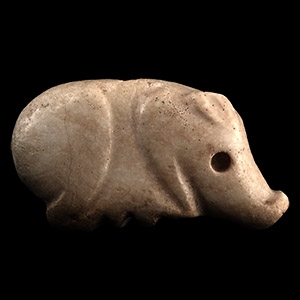
Mesopotamian Stone Pig Amulet
Uruk, 4th millennium B.C.Sold for (Inc. bp): £442
Reclining pig in profile with an elongated snout, circular recess for an eye insert, pierced through the centre; incised central line and three dots to each side on the reverse. 10.8 grams, 36 mm
From a Mayfair, London, UK, gallery, 1990s. From a private UK collection. This lot has been cleared against the Art Loss Register database, and is accompanied by an illustrated lot declaration signed by the Head of the Antiquities Department, Dr Raffaele D'Amato. -
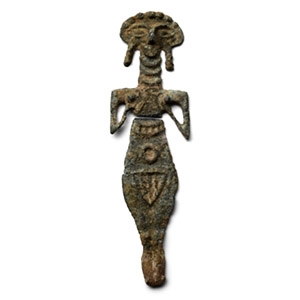
Syro-Hittite Lead Idol
12th-7th century B.C.Sold for (Inc. bp): £286
A figural plaque in two pieces depicting a stylised female, lentoid head with curly hair, pinched nose and large eyes, wearing long earrings, long neck adorned with torcs, her arms raised to hold the breasts, wide hips, legs held together, raised decoration to the pubic area. 6.05 grams, 62 mm
Fine condition, repaired.
Property of a Mayfair lady; formerly in an important London collection formed since 1965. From the private collection of John Meredith, acquired since the 1990s; thence by descent. This lot has been cleared against the Art Loss Register database, and is accompanied by an illustrated lot declaration signed by the Head of the Antiquities Department, Dr Raffaele D'Amato. -
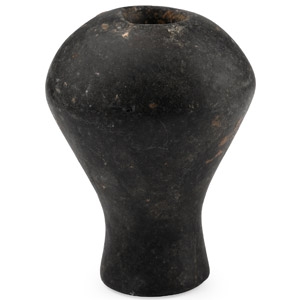
Western Asiatic Stone Macehead
3rd millennium B.C.Estimate: £100 - 140 (+bp*)
Opening Bid: £50
Piriform in profile with flared tubular socket. 408 grams, 88 mm
From a London, UK, collection, 2000s. This lot has been cleared against the Art Loss Register database, and is accompanied by an illustrated lot declaration signed by the Head of the Antiquities Department, Dr Raffaele D'Amato.
