
Loading, please wait...
_900x900.jpg "Northern Mesopotamian Black Stone Cylinder Seal with Rows of Horned Animals")
_200x200.jpg "Northern Mesopotamian Black Stone Cylinder Seal with Rows of Horned Animals")
.jpg "Northern Mesopotamian Black Stone Cylinder Seal with Rows of Horned Animals")
LOT 0228
Northern Mesopotamian Black Stone Cylinder Seal with Rows of Horned Animals
1300-1100 B.C.
1/4 - 1 in. (9.22 grams total, 8.1-28 mm).
Cylinder with cord and bead handles; accompanied by a copy of an old scholarly note, typed and signed by W.G. Lambert, late Professor of Assyriology, University of Birmingham, 1970-1993, which states: 'Cylinder seal of black stone flecked with light green, 28 x 13.5 mm., condition fine. Two rows of three horned animals, all recumbent, the upper row with antlers, the lower row with horns as of mouflons, the design between upper and lower rules. Though the animals somewhat resemble those on Jemdet Nasr seals of northern Mesopotamia, the stone and the rules point to north-west Iran c. 1300-1100 B.C. It is a rare style, with considerable elegance of depiction.'; accompanied by a museum-quality impression. [No Reserve]
ProvenanceUK private collection, acquired 1980-1983.
Accompanied by a copy of a scholarly note, typed and signed by Professor Wilfrid George Lambert in June 1991.
This lot has been cleared against the Art Loss Register database, and is accompanied by an illustrated lot declaration signed by the Head of the Antiquities Department, Dr Raffaele D'Amato.
TimeLine Auctions follows a vetting process to ensure the authenticity and legality of all items, reinforcing our commitment to integrity and responsible trading. Each antiquity, antique, and coin lot undergoes thorough examination by a vetting committee of at least ten external specialists, professional trade association members, scientists, and archaeologists: Our Vetting Process
AUCTIONS:
TimeLine is a leading auction house specialising in antiquities, ancient art, collectables, natural history, coins, medals, and books. Our auctions offer museums, collectors, historians, and enthusiasts the opportunity to acquire unique and historically significant pieces.
LOT 0228
Northern Mesopotamian Black Stone Cylinder Seal with Rows of Horned Animals
Sold for (Inc. bp): £286
-
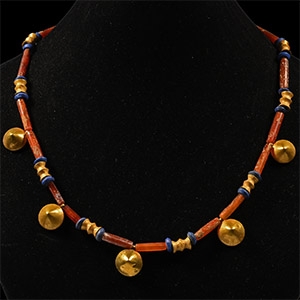
Elamite Carnelian Necklace with Gold Tubular Pendants
Late 2nd-early 1st millennium B.C.Sold for (Inc. bp): £3,640
Restrung necklace of tubular carnelian beads with interstitial ribbed gold and biconvex blue glass beads, five conical gold pendants each with inset gemstone cloison. 40.93 grams, 53.3 cm long
Acquired before 1983. Ex London gallery, 1990s. This lot has been checked against the Interpol Database of stolen works of art and is accompanied by a search certificate number no.12536-231962. This lot has been cleared against the Art Loss Register database, and is accompanied by an illustrated lot declaration signed by the Head of the Antiquities Department, Dr Raffaele D'Amato. -
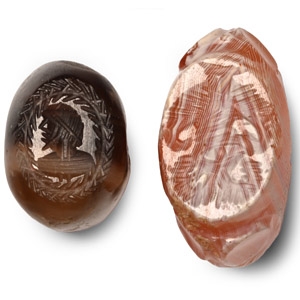
Sasanian Agate Seal Group
3rd-5th century A.D.Sold for (Inc. bp): £390
Comprising: banded agate seal with profile bust within a wreath; pink seal with reserved discs to the flanks. foliage and frond design; accompanied by museum-quality impressions. 7.03 grams total, 14-19 mm
From the collection of a London antiquarian, formed since the 1980s. This lot has been cleared against the Art Loss Register database, and is accompanied by an illustrated lot declaration signed by the Head of the Antiquities Department, Dr Raffaele D'Amato. -
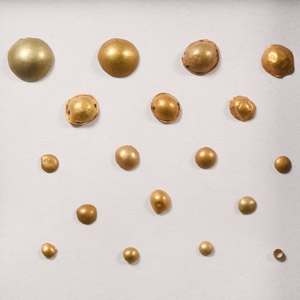
Western Asiatic Gold Disc Ornament Collection
1st millennium B.C.Sold for (Inc. bp): £208
Mixed group of domed appliqués in a display frame. 3.21 grams total, 2-11 mm
From a late Japanese specialist collector, 1970-2000s. This lot has been cleared against the Art Loss Register database, and is accompanied by an illustrated lot declaration signed by the Head of the Antiquities Department, Dr Raffaele D'Amato.
