
Loading, please wait...
LOT 0366
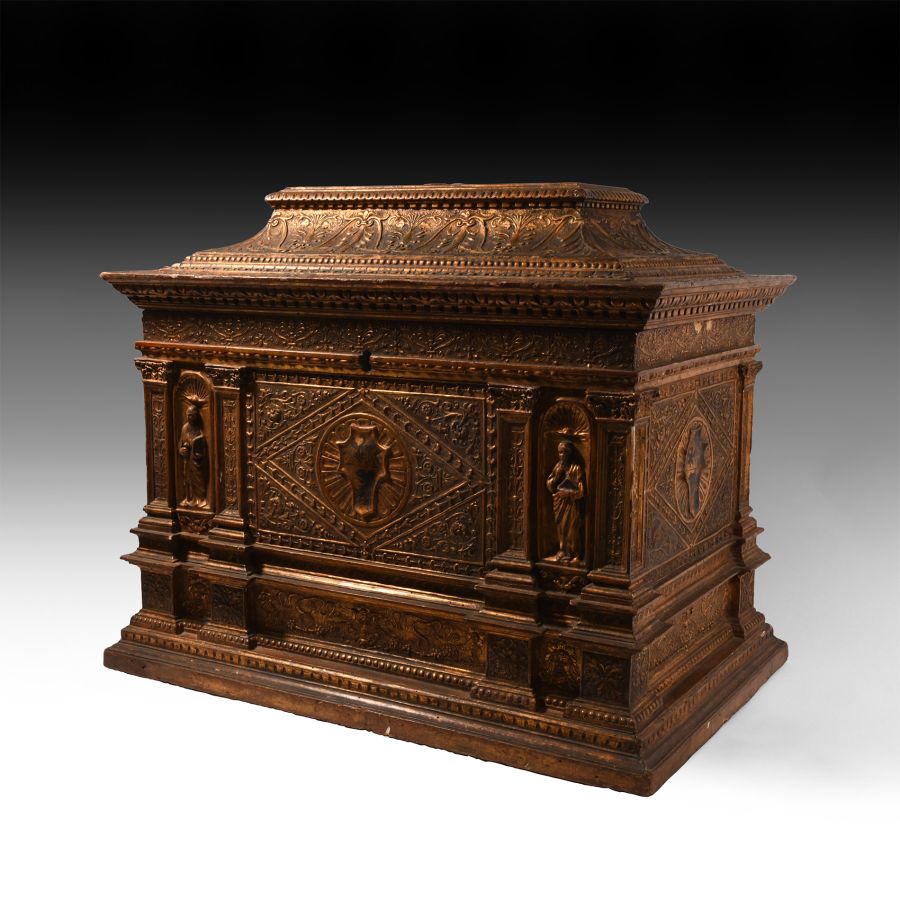
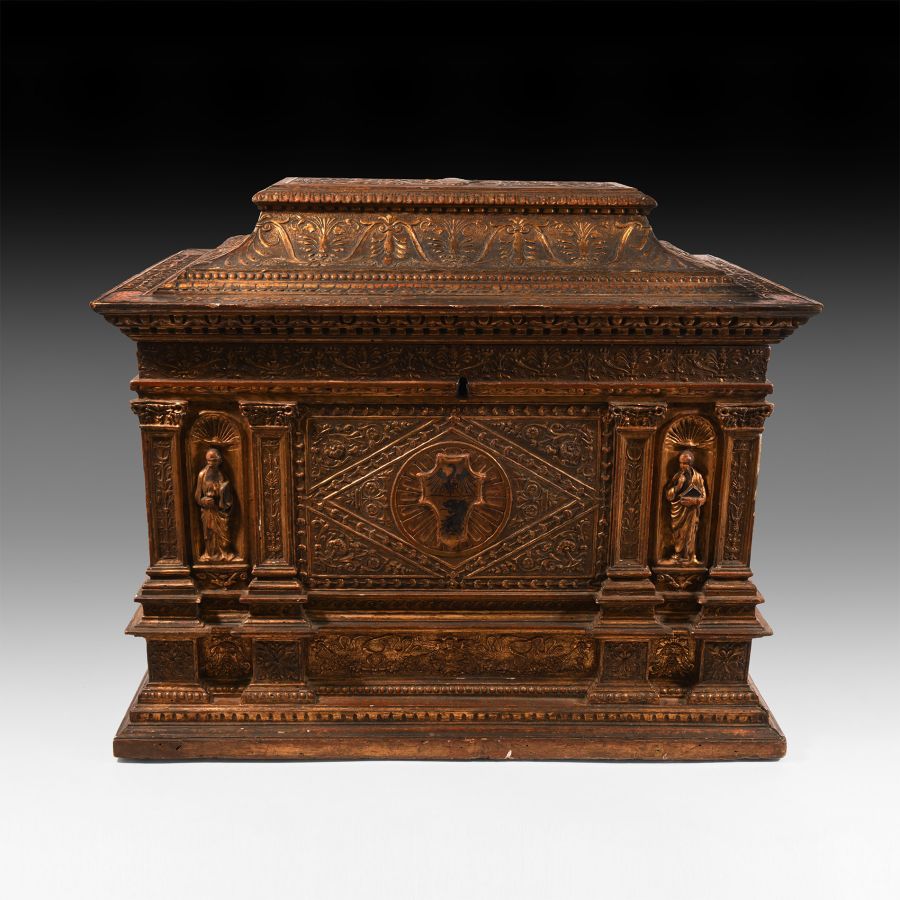
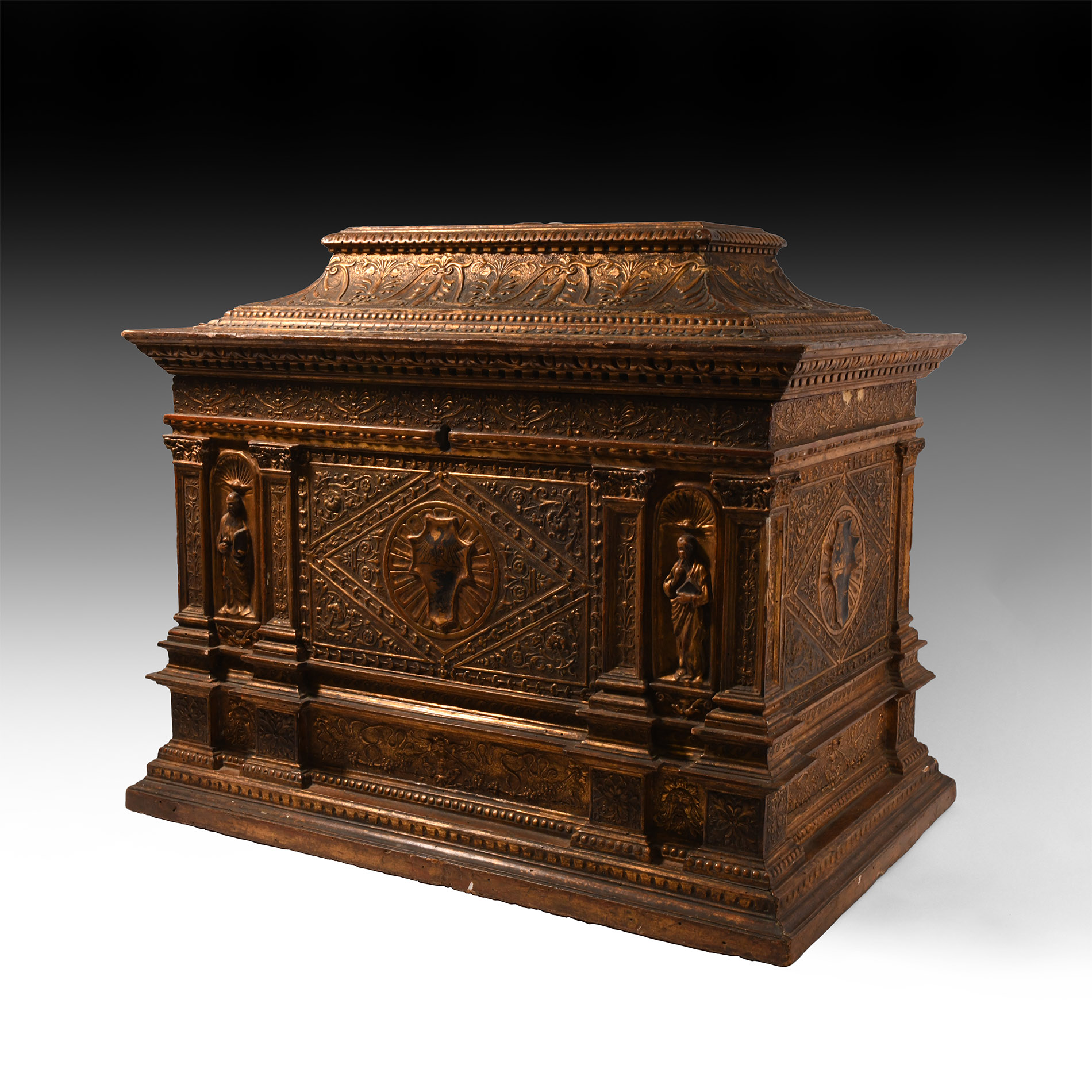
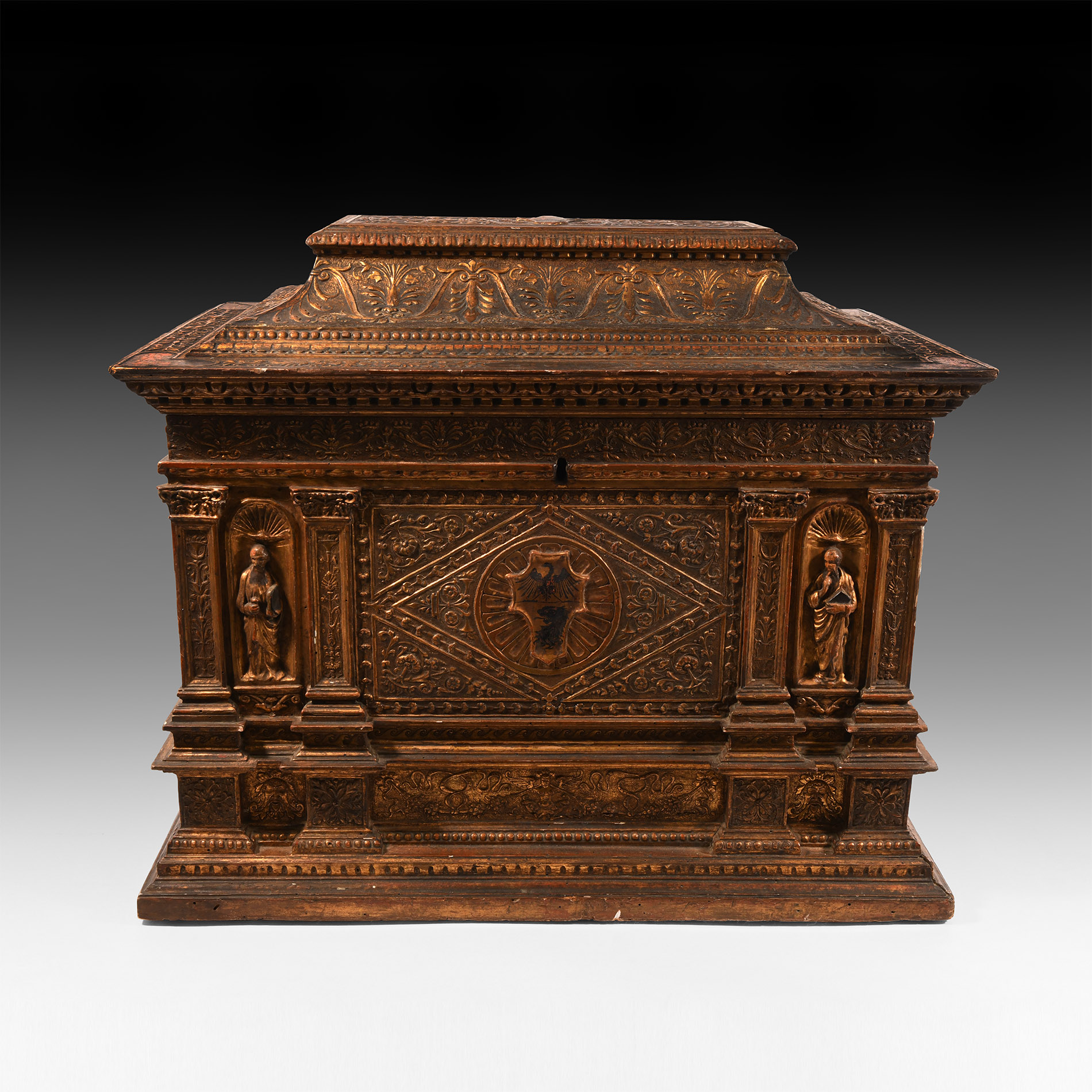
Northern Italian Gilt Wooden Casket
18TH-19TH CENTURY A.D.
27 3/8 x 17 1/2 in. (69.5 x 44.5 cm).
An architectural gilt wooden casket with hinged lid; the exterior with billeting, egg-and-dart ornament and gadrooning, flowering vegetal schemes over the whole; the two principal faces each with a central heater shield painted with heraldic devices, flanked by robed standing figures holding a book each within a niche and with a palmette motif above; remains of polychrome to the shields and elsewhere.
ProvenanceEnglish private collection.
This lot has been checked against the Interpol Database of stolen works of art and is accompanied by search certificate number no.11679-199810
The arms are quartered: or an eagle sable; sable a demi-lion rampant or issuant from a fess; sable a mullet of eight points or; or a lion's head erased sable; the repetition of the colours 'or' gold and 'sable' black may be due to the overall colour-scheme of the casket. The timber shows some old insect flight holes and we are advised that this piece has been recently treated with Permethrin, as a precaution.
CONDITIONTimeLine Auctions follows a vetting process to ensure the authenticity and legality of all items, reinforcing our commitment to integrity and responsible trading. Each antiquity, antique, and coin lot undergoes thorough examination by a vetting committee of at least ten external specialists, professional trade association members, scientists, and archaeologists: Our Vetting Process
AUCTIONS:
TimeLine is a leading auction house specialising in antiquities, ancient art, collectables, natural history, coins, medals, and books. Our auctions offer museums, collectors, historians, and enthusiasts the opportunity to acquire unique and historically significant pieces.
LOT 0366
Northern Italian Gilt Wooden Casket
Estimate £4,000 - 6,000€4,640 - 6,960 (for guidance only)$5,400 - 8,100 (for guidance only)
-
Naples Cameo Group
Late 19th century A.D.Sold for (Inc. bp): £72
A group of four coral cameos displaying ladies of fashion in relief, each individual in pose, character and detail. 1.49 grams total, 8-12 mm
From the collection of G.M.R.H., London, UK. -
Amethyst Bead Necklace
20th century A.D.Sold for (Inc. bp): £59
A necklace composed of graduated amethyst beads of facetted type. 99 grams, 42 cm long
Acquired 1980-2015. Ex Abelita family collection. -
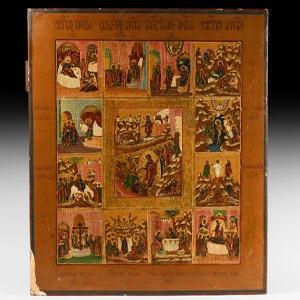
Large Russian Anastasis Icon with Twelve Feasts
18th century A.D.Estimate: £500 - 700 (+bp*)
Opening Bid: £225
A tempera on wood Anastasis icon with a large central panel surrounded by twelve smaller scenes representing the twelve feasts of the Orthodox church; the central image depicting Christ‘s descent into Hell and Resurrection, the smaller scenes depicting, clockwise from top left: the birth of the Virgin Mary; the presentation of the Virgin Mary to the temple; the Annunciation; the Nativity; the presentation of Christ to the temple; the Epifania (Baptism); the entrance to Jerusalem; the Metamorphosis (Transfiguration); the Exaltation of the Holy Cross; the Ascension; the Holy Trinity (the Pentecost); and the Dormition of the Virgin; inscriptions to the outer border; some restoration. 3.1 kg, 44.5 x 37 cm
Property of a London lady, part of her family's collection.
The Greek term Dodekaorton (Δωδεκαόρθον) designates the twelve most important holidays of the Orthodox Christian liturgical year. They are divided into fixed date holidays and variable date holidays (calculated in relation to Easter). A second division is between the feasts dedicated to Mary and those dedicated to Christ. Each holiday is represented by an image (icon) encoded according to the interpretation of the Holy Scriptures. On the day of the celebration, the corresponding icon is placed on a lectern in the center of the church.
