
Loading, please wait...
LOT 1044
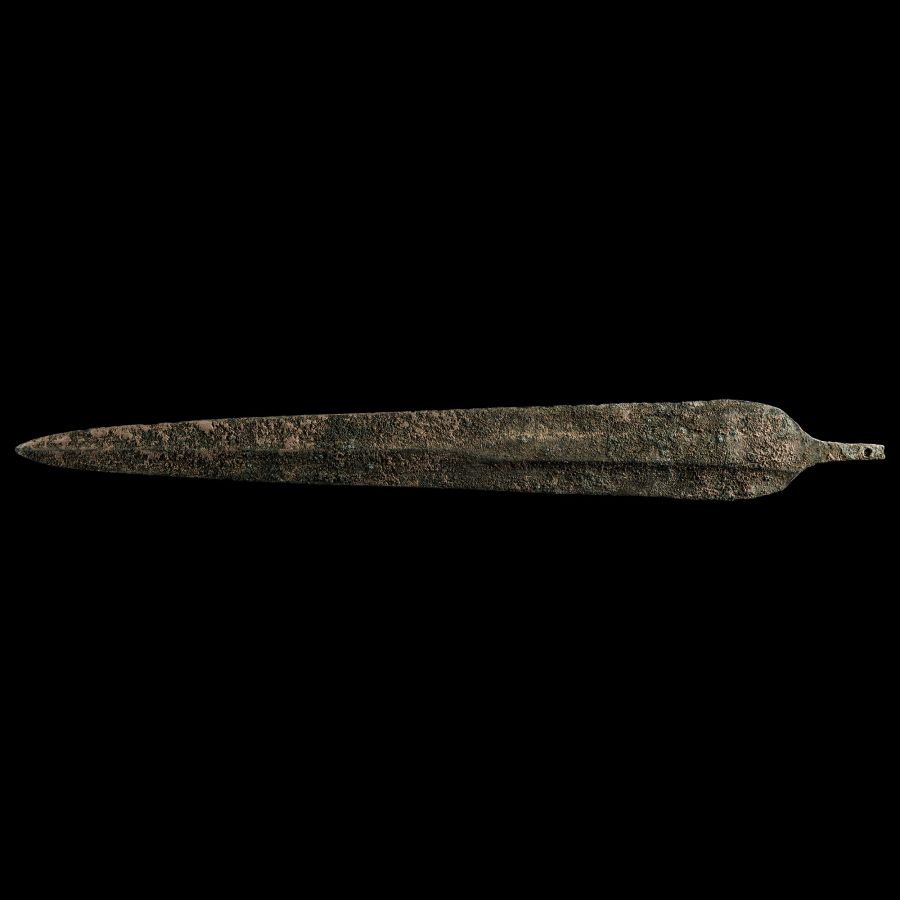
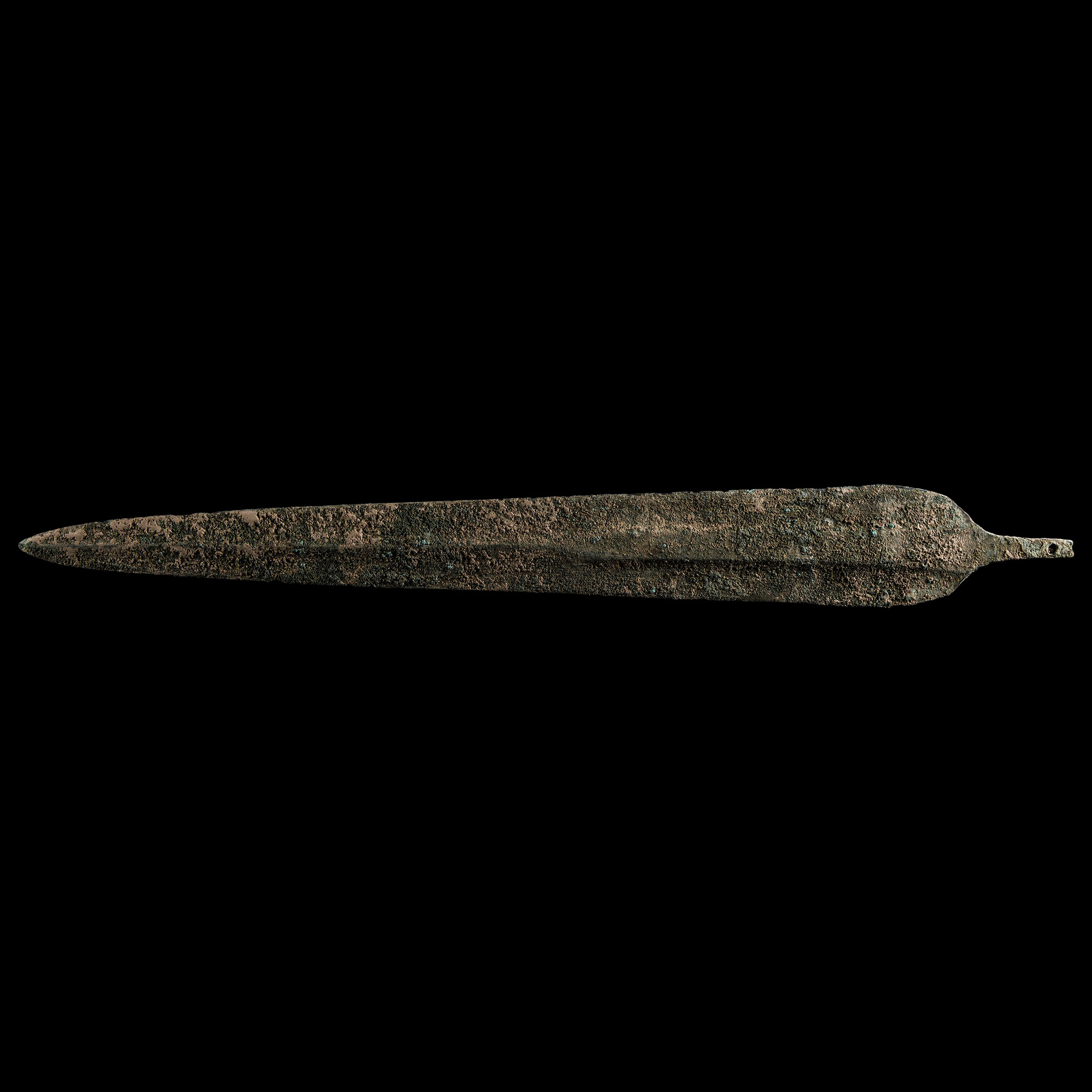
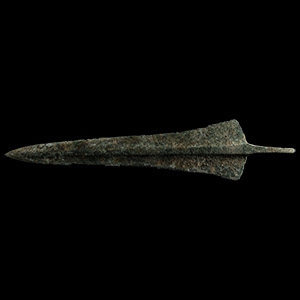
North-Western Persian Type Sword Blade
1ST MILLENNIUM B.C.
14 1/2 in. (220 grams, 37 cm).
With rounded shoulders and shallow square-sectioned mid-rib running to the blade tip; short tang with fastening hole.
ProvenanceAcquired 1980-2015.
Ex Abelita family collection.
Cf. Christie's, The Axel Guttmann Collection of Ancient Arms and Armour, part 2, London, 2004, item 40, p.36.
FootnotesThe Luristan people produced fine metalwork, which according to Dr. Khorasani, was made possible by a settled period which arose as a result of the defeat of the Elamites by the Babylonians, leaving the Luristani people in relative peace for a period of time after 1200 B.C. According to Khorasani, 'A culture of innovation and experimentation flourished, and the repertoire of the Luristan smiths expanded in the period between 1150-1050 BC.' It became widespread throughout Mesopotamia, the Caucasus and the Near East.
CONDITIONTimeLine Auctions follows a vetting process to ensure the authenticity and legality of all items, reinforcing our commitment to integrity and responsible trading. Each antiquity, antique, and coin lot undergoes thorough examination by a vetting committee of at least ten external specialists, professional trade association members, scientists, and archaeologists: Our Vetting Process
AUCTIONS:
TimeLine is a leading auction house specialising in antiquities, ancient art, collectables, natural history, coins, medals, and books. Our auctions offer museums, collectors, historians, and enthusiasts the opportunity to acquire unique and historically significant pieces.
-
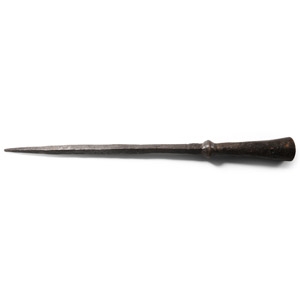
Medieval Iron Socketted Javelin
Circa 15th-16th century A.D.Sold for (Inc. bp): £111
With square-section spike and flaring socket. 342 grams, 36 cm
Ex California, USA, collection formed since the late 1960s. European art market before the late 1990s. -
Western Asiatic Bronze Tanged Spearhead
Circa 13th-6th century B.C.Estimate: £100 - 140 (+bp*)
Opening Bid: £50
With leaf-shaped blade and rounded tip, pronounced medial rib and shoulder flanges, short flat-section tang. 255 grams, 31 cm
Acquired 1980-2015. Ex Abelita family collection.
The spearhead belongs to type 2 of spearheads according to the classification of Khorasani. A similar specimen was excavated by Negahban in Marlik. -
.jpg)
Italic Bronze Triple-Disc Cuirass
South-Central Italy, 420-350 B.C.Sold for (Inc. bp): £9,360
Matched pair of Samnite triangular breast and backplates, a suite of 'triple-disc' type, each with three repoussé panels with carinated rim, flat spandrel above and curved on the lower sides, with perforated edges to affix to a separate mail garment; rivetted loops to the shoulders for attachment of supporting straps, and similar lateral loops with portion of round-link chain in situ; mounted on a custom-made stand. 2.72 kg total, 40 cm high including stand
Ex Axel Guttmann collection of ancient arms and armour, Germany (1944-2001). with Hermann Historica, Munich, Germany. Ex Art Ancient, London, UK, 2019. with Sotheby’s, London, Ancient Sculpture and Works of Art, Part II, 8 December 2021, lot 155. Accompanied by an academic report by Dr Raffaele D’Amato. This lot has been checked against the Interpol Database of stolen works of art and is accompanied by search certificate no.11941-210864.
These breastplates (kardiophylax) were a reduced version of the muscled armour (statos). Many archaeological specimens of this type were found in South Italian graves (Paestum, Alfedena), and are represented on the famous statuette of a Samnite Warrior found in Sicily (Connolly, 1981, p.108) in the Louvre and on many frescoes from Paestum, or are visible on the Campanian and Lucanian pottery, representing warriors (Christie's, 2004, no.90). The triple cuirass is well attested in archaeology, and the finds of Alfadena and Paestum show that it was mainly used by the coastal Samnites. This example is fairly representative of those in which the shoulder and side plates were attached to the front and back plates by rings and hooks. Born suggested that the upper two discs of the cuirass represented the pectoral muscles, the disc below the abdominal muscles.
