
Loading, please wait...
_900x900.jpg "North-Western Persian Type Bronze Blade")
_200x200.jpg "North-Western Persian Type Bronze Blade")
.jpg "North-Western Persian Type Bronze Blade")
LOT 1458
North-Western Persian Type Bronze Blade
EARLY 1ST MILLENNIUM B.C.
13 in. (99 grams, 33 cm).
With tapering triangular blade, having straight shoulders, flat midrib and tapering square-sectioned tang ending with a rounded pommel.
ProvenanceAcquired 1980-2015.
Ex Abelita family collection.
Cf. Christie's, The Axel Guttmann Collection of Ancient Arms and Armour, part 1, London, 2002, item 31, p.34.
FootnotesMoorey, Gordon and Khorasani created a classification of bladed weapons, according to which daggers are edged weapons not greater than 36cm in length, dirks (short swords) are between 36cm and 50cm in length, and swords are edged weapons greater than 50cm in length.
CONDITIONTimeLine Auctions follows a vetting process to ensure the authenticity and legality of all items, reinforcing our commitment to integrity and responsible trading. Each antiquity, antique, and coin lot undergoes thorough examination by a vetting committee of at least ten external specialists, professional trade association members, scientists, and archaeologists: Our Vetting Process
AUCTIONS:
TimeLine is a leading auction house specialising in antiquities, ancient art, collectables, natural history, coins, medals, and books. Our auctions offer museums, collectors, historians, and enthusiasts the opportunity to acquire unique and historically significant pieces.
LOT 1458
North-Western Persian Type Bronze Blade
Estimate £80 - 100€93 - 116 (for guidance only)$108 - 135 (for guidance only)
-
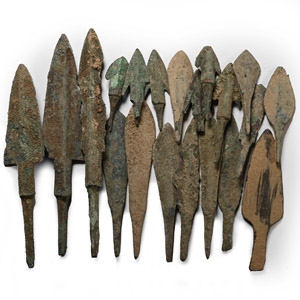
Luristan and Phoenician Bronze Arrowheads
13th-7th century B.C.Sold for (Inc. bp): £260
Mixed group of socketted, tanged and other arrowheads. 202 grams total, 3.3-11.5 cm
Ex London, UK, collection, 1990s. -
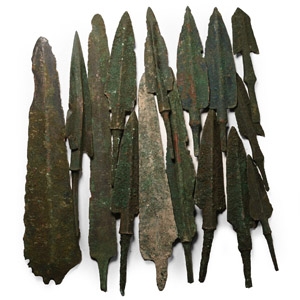
Luristan Bronze Arrows and Blades Group
13th-7th century B.C.Sold for (Inc. bp): £221
Comprising mainly narrow two-edged blades, barbed-and-tanged arrowheads and other types. 503 grams total, 9-20.7 cm
Ex London, UK, collection, 1990s. -
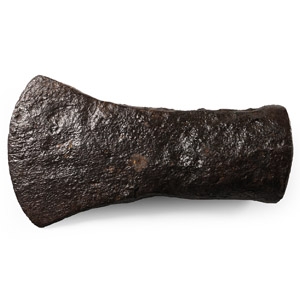
Iron Age Celtic Iron Axehead
Britain, circa 4th century B.C.Sold for (Inc. bp): £286
With lateral flanges curved inwards to form an open socket, long neck, broad flared blade. 278 grams, 11.5 cm
Found South East England. From the private collection of Kenneth Acquired Coincraft, London, UK. Machin (1936-2020), Buckinghamshire, UK; with collection no.IA25; his collection of antiquities and natural history was formed since 1948; thence by descent.
