
Loading, please wait...
LOT 1045
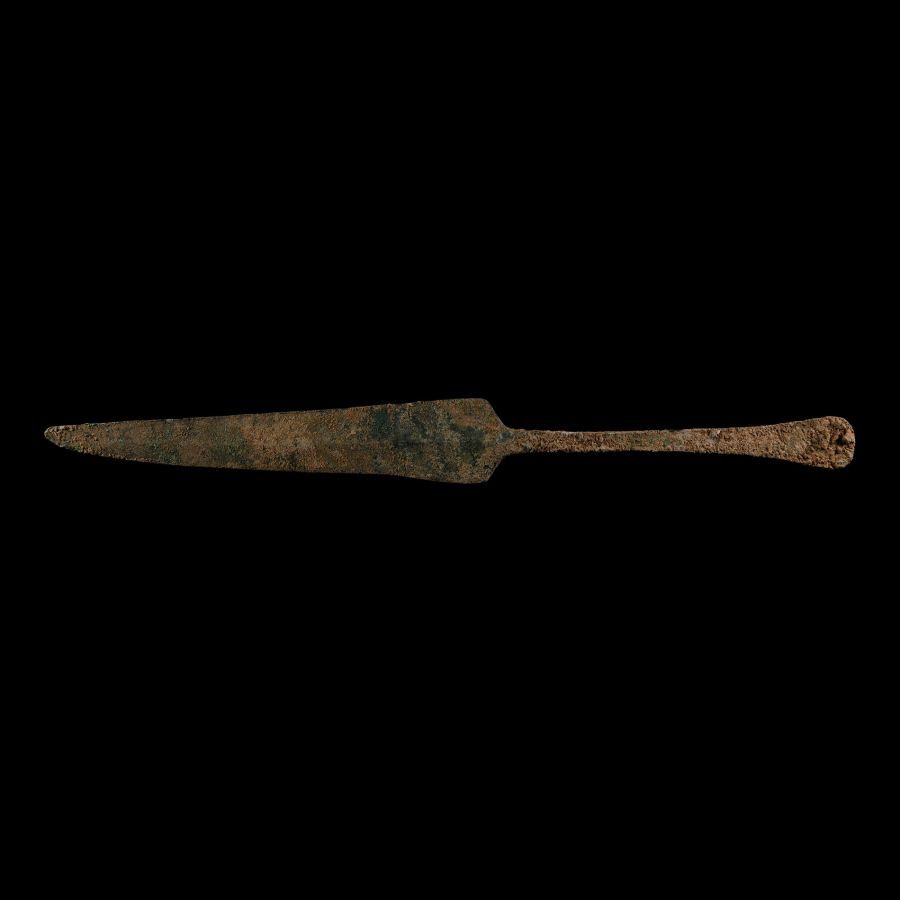
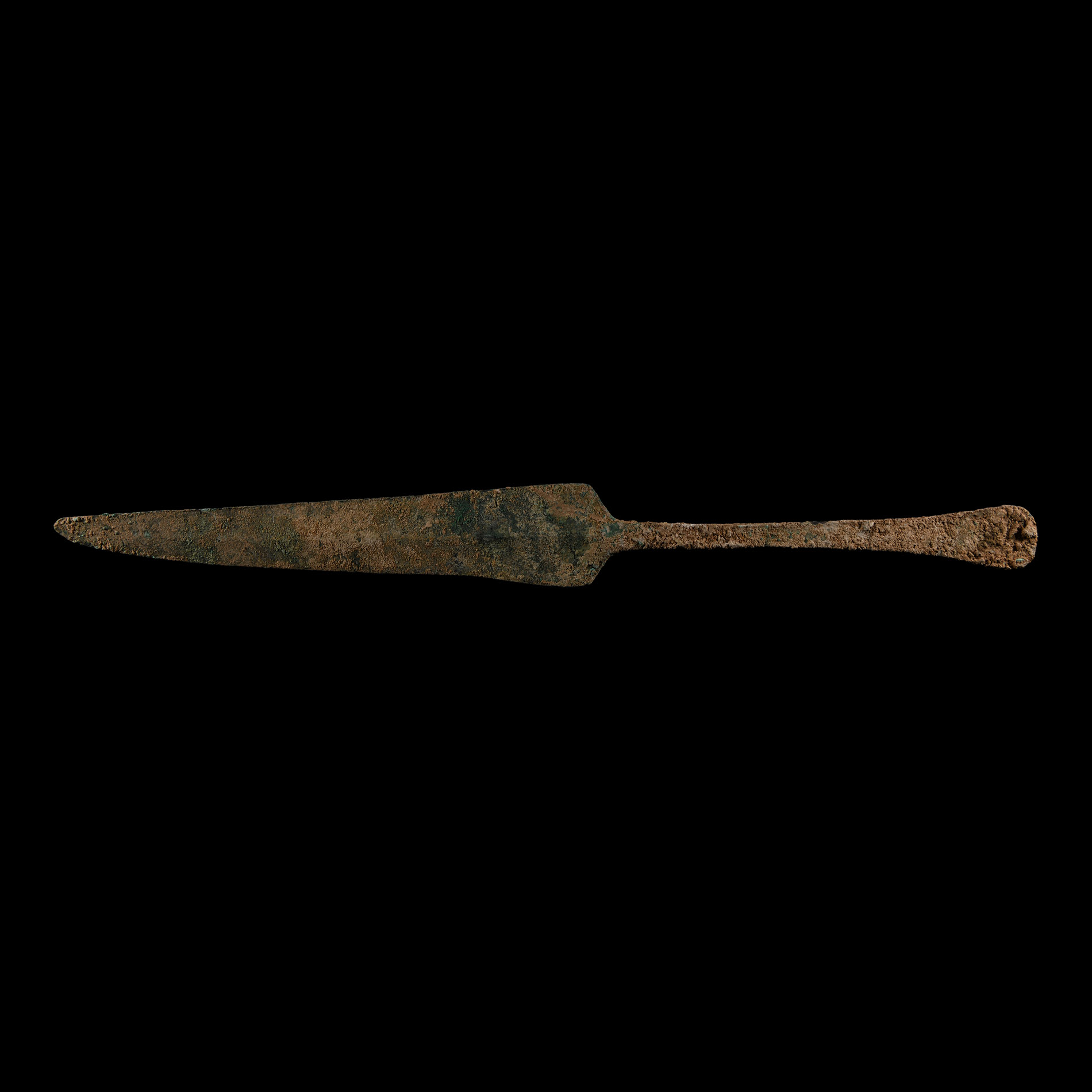
North-Western Persian Type Bronze Blade
EARLY 1ST MILLENNIUM B.C.
13 in. (99 grams, 33 cm).
With tapering triangular blade, having straight shoulders, flat midrib and tapering square-sectioned tang ending with a rounded pommel.
ProvenanceAcquired 1980-2015.
Ex Abelita family collection.
Cf. Christie's, The Axel Guttmann Collection of Ancient Arms and Armour, part 1, London, 2002, item 31, p.34.
FootnotesMoorey, Gordon and Khorasani created a classification of bladed weapons, according to which daggers are edged weapons not greater than 36cm in length, dirks (short swords) are between 36cm and 50cm in length, and swords are edged weapons greater than 50cm in length.
CONDITIONTimeLine Auctions follows a vetting process to ensure the authenticity and legality of all items, reinforcing our commitment to integrity and responsible trading. Each antiquity, antique, and coin lot undergoes thorough examination by a vetting committee of at least ten external specialists, professional trade association members, scientists, and archaeologists: Our Vetting Process
AUCTIONS:
TimeLine is a leading auction house specialising in antiquities, ancient art, collectables, natural history, coins, medals, and books. Our auctions offer museums, collectors, historians, and enthusiasts the opportunity to acquire unique and historically significant pieces.
LOT 1045
North-Western Persian Type Bronze Blade
Estimate £100 - 140€120 - 160 (for guidance only)$140 - 190 (for guidance only)
-
North-Western Persian Type Bronze Blade
Early 1st millennium B.C.Estimate: £100 - 140 (+bp*)
Opening Bid: £50
With tapering triangular blade, having straight shoulders, flat midrib and tapering square-sectioned tang ending with a rounded pommel. 99 grams, 33 cm
Acquired 1980-2015. Ex Abelita family collection.
Moorey, Gordon and Khorasani created a classification of bladed weapons, according to which daggers are edged weapons not greater than 36cm in length, dirks (short swords) are between 36cm and 50cm in length, and swords are edged weapons greater than 50cm in length. -
.jpg)
Hellenistic Bronze Armour Section with Herakles Fighting Hydra
Circa 4th-3rd century B.C.Sold for (Inc. bp): £3,120
Comprising an embossed fragment of a breast-plate from muscle-type armour (thorax statos) representing Herakles fighting against the Hydra of Lerna; three-quarters of the hero's body preserved showing him naked in a dynamic position, wearing a fluttering short cloak (chlamys), overlooking the body of the monster of which the long tail covered with scales and fins is visible; fragment of cloak preserved separately. 122 grams total, 3.4-17.5 cm
Good portion of armour, extremely rare
Acquired on the French art market before 2000. From an EU collection before 2020.
This kind of armour is very rare, especially for this period, when most of the attested armour is plain or only slightly decorated. The young Herakles appears in heroic nudity running to the right, but, as on the cheek-piece from Gurlo, his head was probably turned in the opposite direction. The plasticism of the scene finds a good match in the Thracian tradition of the representation of weapons and armour, and the embossed elements with the highly prized work of the Panagyurishte treasure. The warrior-theme and the representation of Herakles or other fighting scenes on the Thracian and Hellenistic armours was a reference to the spirit of the immortal fighter. -
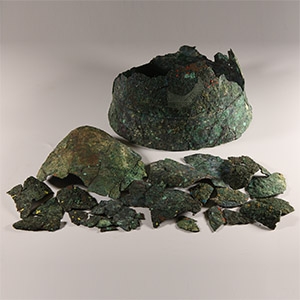
Greek Fragmentary Bronze Pilos Helmet
5th-4th century B.C.Sold for (Inc. bp): £2,015
Conical in shape, comprising a thick hammered bowl and broad rim with carination to the upper edge; remains of crest at brow and rear; a restoration project. 951 grams total, 1-24.5 cm
Ex Axel Guttmann Collection of Ancient Arms and Armour, Germany [1944-2001]. with Hermann Historica, 13 October 2010, lot 2169 [Part].
This type of helmet (called ‘bell-helmet’ by Connolly, 1981, p.70), named pilos after the Greek felt cap (in the Laconian shape, but distinguished from the cap by the noticeable point and the shape of the rim), had a conical shape and was pointed or rounded at the top. Its introduction was linked with the streamlining of Hoplite equipment, and it soon the replaced the closed Corinthian helmet. The helmet was widespread in the Greek and Mediterranean world from the last quarter of the 5th century B.C. and was widely used by continental Greeks, South Italian Greeks and Italic people, Etruscans, and even Romans.
